Millions will go hungry if the Strait of Hormuz stays closed
One blockade was bad enough. Iran’s closure of the Strait of Hormuz has pushed up prices for oil, natural gas and fertiliser, among other commodities. On April 13th America initiated a blockade of its own, halting the few vessels Iran had been letting past, which will presumably compound the problem.
Abdul Qayoom spreads fertilizer on his mustard field in Pampore (REUTERS)
Commodity prices are rising again, to the dismay not just of drivers, but of farmers, too, who need fertiliser for their fields and diesel for their tractors. Some are planting or fertilising less, which inevitably means smaller harvests later in the year. Food prices are starting to rise. The World Food Programme (WFP, a UN agency) estimates that if the blockage continues until mid-year, an extra 45m lives will be at risk, on top of the more than 300m people who already struggle to feed themselves. If the El Niño weather pattern takes hold in the next few months, as many climate scientists think likely, things could get worse still; some of the poorest parts of the world could get too much rain and others too little, which means crops will fail.
The starting-point for the incipient crisis is higher energy prices. These affect every step in food production: planting, harvesting, processing, transport. In rich countries energy accounts for as much as half of variable costs in farming, says the International Energy Agency, a club of countries that are big oil consumers. Global food-price indices generally track the price of crude, albeit with a lag. Edgar Terry, who runs a fruit and vegetable farm in California, says the diesel he uses to power his tractors now costs $6.13 per gallon, up from $3.41 before the fighting began. As a result, he is planting less celery this spring.
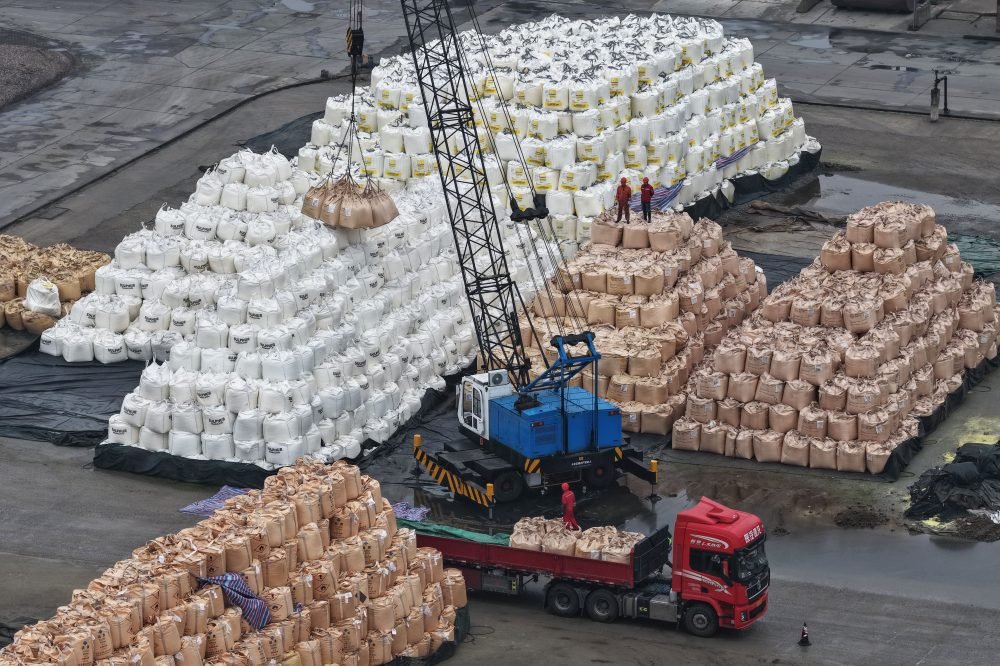
The price of fertiliser, much of which is made with natural gas, is rising as well. The Gulf is arguably more central to the global fertiliser industry than it is to energy. It is the source of 30-35% of the international trade in urea and around 20-30% of ammonia, both widely used fertilisers. Perhaps 30% of the world’s fertiliser trade passes through Hormuz. The war has stopped that flow. Kpler, a data provider, reckons nearly 1.9m tonnes are stuck on the wrong side, equal to 12% of all the fertiliser shipped through the strait in 2024. Qatar Fertiliser Company, a state-backed firm that produces 14% of the world’s urea, has been offline for over a month.
Other suppliers are not in a position to fill the gap. Plants in Russia, the world’s biggest exporter, have been targeted by Ukrainian drones; those still operating are at full capacity. China, the second-biggest, is cutting exports to protect its own domestic supply. Gas shortages have forced fertiliser producers in other countries, including India and Bangladesh, to curb their output. And there is no global system of fertiliser stockpiles, as there is for oil. The prices of urea and ammonia have risen by 65% and 40%, respectively, since the start of the war. An index of fertiliser affordability from Rabobank, a Dutch lender, has plunged to a four-year low.
The timing could not be worse. The northern hemisphere and parts of Africa are in the midst of planting season. Farmers in South Asia will start sowing in the next couple of months, when the monsoon arrives. Agronomists say fertiliser doubles the world’s agricultural output and it typically needs to be used when crops are planted to have the optimal impact. Even if the war ends tomorrow, says Julian Hinz at the Kiel Institute, a think-tank, much damage is already done.
Wealthy farmers in the West are fairly sanguine. Many stockpile fertiliser and lots of them overuse it anyway. Those struggling with the cost are switching crops. This season America’s Department of Agriculture expects a shift from maize (which requires a lot of fertiliser) to soyabeans (which require less). In Europe a similar adjustment is under way.
For poorer farmers, the consequences are graver. Many of the world’s 500m smallholders barely grow enough to feed their families. They certainly cannot afford to keep stocks of fertiliser. Sayed, who farms wheat, barley and chickpeas on his tiny plot in central Afghanistan, is one of them. The price of a 50kg bag of urea has jumped to 2,400 afghanis ($29) at his local market, from 2,000 afghanis in January. He has given up using the stuff, which will shrink his harvest.
Asia and Africa rely especially on fertiliser from the Gulf. The region provided 71% of Thailand’s imports of urea last year, 67% of South Africa’s and 41% of India’s. More than half of Indians depend on agriculture for their livelihood. Before the war the government in New Delhi had planned to cut fertiliser subsidies to save money. Now, officials are scrambling to secure additional supplies from Russia and China, probably at significantly greater expense.
A detour de force
The result is what Michael Werz of the Council on Foreign Relations, a think-tank, calls a “slow-motion famine machine”. For now, the countries hardest hit are those that relied on humanitarian aid before the war began. The closure of Hormuz has trapped enough of the WFP’s supplies of food to feed 4m people for a month. It is scrambling to reroute these deliveries.
One example is a shipment of high-energy biscuits that the WFP wanted to send from Dubai to Afghanistan. Instead of trucking the biscuits across Iran it was forced to send them on a nine-country detour, to enter Afghanistan from the north. Corinne Fleischer, the WFP’s supply-chain chief, reckons this is extending the journey by weeks—and at added cost to boot.
Humanitarian groups can ill afford such expenses. Rich countries have slashed their aid budgets of late (while boosting spending on defence). Net official development assistance dropped by 9-17% year on year in 2025, after a 9% decline the previous year, according to the OECD, a club of mostly rich countries. As Jean-Martin Bauer at the WFP puts it, “The humanitarian shock absorber isn’t there any more.”
Higher fuel prices already mean smaller helpings for the world’s poor. Take Lalita Devi, a farmhand who lives just north of New Delhi in the village of Singhu. Since February, she says, the price of cooking gas has quintupled. Stalls that sold rotis for five rupees apiece have raised that to eight. With cooking out of the question and fast food pricier too, Ms Devi has begun skipping meals and all but given up vegetables.
The longer supplies are snarled, the more widespread such effects will be. If traffic through Hormuz is impeded for six months, Helios AI, a data provider, reckons global food prices will rise 12-18% above pre-war levels by the end of the year. Again, the effects are likely to be uneven. Analysts at Germany’s Kiel Institute predict food-price inflation will reach 30% in Zambia, 11% in India and 8% in Venezuela within a year. With oil above $100 a barrel, the diversion of crops to biofuels could send food prices higher still.
The pain will be felt by those already on the margin: people in the poorest corners of the poorest countries and in conflict zones with little buffer against shocks. In contrast to a conventional famine, in which hunger is concentrated in a particular spot, the effects will be distributed around the world, with little direct connection to local weather and harvests and with few television cameras present.
That does not mean they will be insignificant. After Russia and Ukraine, both big exporters of grain, went to war in 2022, food prices shot up. Researchers believe that more people have died of hunger than on the battlefield as a result of that conflict. Unless the strait reopens quickly and the fuel and fertiliser start flowing, the war in Iran could be as bad—or worse.
Iran’s military planning ahead of the war helped blunt the impact of US-Israeli strikes on its arsenal and leadership, according to Western military intelligence assessments, which say Tehran still retains the ability to respond if the ceasefire breaks down. A man flashes a victory sign as he carries an Iranian flag in front of an
WASHINGTON, April 16 (Reuters) – U.S. President Donald Trump on Thursday said Pope Leo was free to say what he wanted but that it was important for him to understand that Iran could never have a nuclear weapon. Trump has repeatedly criticized the religious leader, who has emerged as an outspoken critic of the U.S.-Israeli
WASHINGTON, April 16 (Reuters) – U.S. President Donald Trump said on Thursday that if a deal with Iran to conclude the war is reached and signed in Islamabad, he might go, and that Iran has agreed to almost everything. Trump struck an optimistic tone about Iran as he spoke with reporters on the White House
A federal agency gave the first approval to President Donald Trump’s design for an ambitious – and controversial – triumphal arch in the U.S. capital, the first step toward building the 250-foot-tall monument celebrating the nation’s 250th birthday. The U.S. Commission of Fine Arts – full of Trump allies – voted to advance the president’s
By Andrew Osborn and Dmitry Antonov MOSCOW, April 16 (Reuters) – The Kremlin took the unusual step of publicly acknowledging sharp criticism of the authorities from a celebrity blogger on Thursday, saying work was under way to address a slew of problems identified by social media influencer Viktoria Bonya. Bonya, who is well known inside
The United States warned of a sustained blockade on Iranian ports, and threatened renewing strikes on the country if Tehran refused to make a deal. Pentagon chief Hegseth also warned Tehran that the US was aware of Iran’s alleged movements of its military assets. (AP) US defense secretary Pete Hegseth said that the military could
By Michaela Cabrera and Daria Sito-Sucic VILLERS-COTTERETS, France, April 16 (Reuters) – French President Emmanuel Macron urged high school pupils on Thursday to switch off their phones and read, pushing for one “no screens day” per month for all, and a blanket social media ban for those under 15 years of age. Following Australia’s groundbreaking
IN THE MAZOWE river valley, 50km north of Harare, Zimbabwe’s capital, the gold rush is hard to miss. Hillsides have been hewed by excavators that scoop out ore as if it were gelato from a tub. Pipes divert the river to washing stations used by small-scale miners. So much water has been redirected that the
new video loaded: Russia Launches Largest Barrage on Ukrainian Cities in Months 1:07 At least 15 people died after Russia flew more than 700 drones and missiles across Ukrainian cities, according to the Ukrainian Air Force. By Monika Cvorak April 16, 2026 Frenchman Wins $1.2 Million Picasso Painting 1:33 L.G.B.T.Q. Community Expresses Hesitancy About Hungary’s
All the key questions ahead of the 2026 UK local elections, including how to vote, when to register and what ID you need to bring to the polling station. Want LBC stories before everyone else? Set us as your Preferred Source on Google Sir Keir Starmer is not up for election next month, but a
BUDAPEST, April 16 (Reuters) – Over 90 journalists from Hungarian state news agency MTI have demanded the immediate restoration of impartial news coverage following election winner Peter Magyar’s pledge to shake up state media, according to a letter obtained by Reuters. Magyar, whose centre-right TISZA party scored a landslide victory in Sunday’s elections, said his
Explorers have dreamed of harvesting deep-sea metals since the 1870s, when the British scientific ship HMS Challenger pulled up mineral-laden rocks on its round-the-world voyage. Ocean scientists are racing to determine whether marine life can coexist with machines that rake their habitat for undersea treasure. The first commercial effort to exploit these riches failed a
Iranian threats hobbled shipping through the Strait of Hormuz during the war, moving what little remained north into its own waters. Before war Feb. 18–27 After Iranian retaliation April 3–12 Now the U.S. has mounted a blockade of its own, redrawing the board once again. After the U.S. blockade U.S. ships enforcing blockade in Gulf
YAOUNDE, April 16 (Reuters) – Pope Leo was scheduled to travel to the biggest city in Cameroon’s conflict-hit anglophone region on Thursday, the latest stop on an ambitious four-country Africa tour amid attacks on the pontiff by U.S. President Donald Trump. Trump’s attacks on Leo, who has emerged as a vocal critic of the Iran war,
The prowess of America’s armed forces has been on full display in the skies over Iran. During the 38-day air campaign, warplanes flew more than 13,000 combat sorties, smashing Iran’s armed forces, industrial sites and nuclear facilities. The campaign demonstrated careful planning and tactical brilliance. And all this has been carried out while America’s top
HONG KONG (AP) — China’s economy accelerated in the first quarter of this year, expanding 5% from a year earlier as it largely shrugged off impacts from the Iran war so far, according to data released Thursday. The January-March data released by the government, covering a period during which the Iran war began, was better
At a time when Pakistan is in focus in the context of sensitive diplomatic engagements between Iran and the US, a familiar question has come into focus: Who is spearheading the mediation in Islamabad? US President Donald Trump with Pakistan PM Shehbaz Sharif and General Asim Munir. (White House/ File photo) Former Information Minister Fawad
Mark Mobius, who put emerging markets on investors’ radar with on-the-ground insights over more than four peripatetic decades, has died. He was 89. FILE PHOTO: Mark Mobius, executive chairman at Templeton Emerging Markets Group, speaks during the SALT conference in Las Vegas, Nevada, U.S. May 17, 2017. REUTERS/Richard Brian/File Photo (REUTERS) He died today, according
BANGKOK (AP) — Have you “become Chinese”? In recent months, 20-somethings around the world have taken over social media with posts enthusing about how they’re embracing Chinese ways of life. Videos proclaiming users are “Chinamaxxing,” or “in a very Chinese time of their lives” — namely by drinking hot water with boiled goji berries, eating
White House Press Secretary Karoline Leavitt denied that the US has formally sought a ceasefire extension, stressing that negotiations remain “productive and ongoing,” and said the next round of US-Iran talks will very likely be held in Pakistan again, underscoring its role as the sole mediator. White House press secretary Karoline Leavitt smiles as Small