Middle East Situation Reshapes Forex Market Landscape

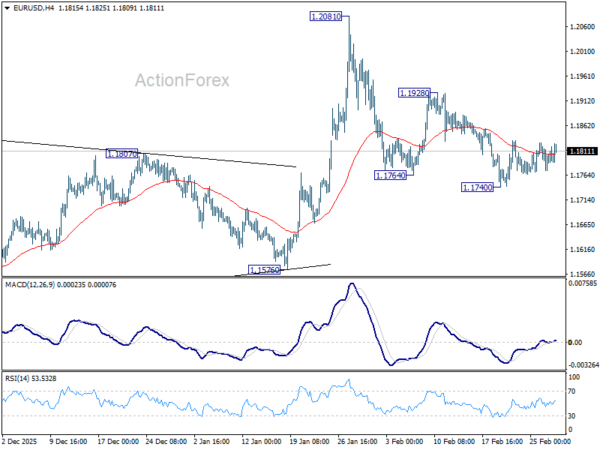
On Monday this week (March 2), influenced by the escalation of the situation in the Middle East, the US dollar opened stronger, with intraday gains expanding at one point. As of now, the increase has narrowed to approximately 0.5%. Compared to the market risk aversion sentiment triggered by the tensions in the Strait of Hormuz, this reaction remains relatively restrained. Investors’ core concerns have shifted from the ‘duration of the conflict’ to whether ‘shipping through the Strait of Hormuz can be restored,’ as well as whether Trump’s previous statement of a ‘four-week military operation’ will lead to further escalation.

large

The market is weighing two scenarios: if Trump controls the duration of military actions as expected and shipping through the Strait of Hormuz gradually resumes, Brent crude oil prices are likely to stabilize in the range of $75-80 per barrel; if the conflict escalates, leading to a prolonged blockade of the strait, oil prices may quickly exceed $90 per barrel, thereby pushing up US inflation and forcing the Federal Reserve to adjust its interest rate cut schedule. The latter scenario would directly impact the eurozone and the euro, which heavily rely on oil imports, with the euro-to-dollar exchange rate already falling 0.3% during the Asian early trading session.

Investors are closely watching the Federal Reserve meeting scheduled for over two weeks from now, focusing on its adjustment of risk priorities. Previously, Fed Governor Milan repeatedly emphasized the need for a 100-basis-point interest rate cut (i.e., four cuts) by 2026, favoring earlier implementation. This stance is primarily based on the current weak inflationary pressure in the United States, lacking strong price-driving factors. However, the oil price fluctuations caused by the situation in the Middle East may prompt the Fed to reassess inflation risks versus economic support needs, adjusting the timing and magnitude of rate cuts.

Before last weekend, the prevailing market view was that, amid slowing inflation and a stabilizing labor market, the Fed was poised to resume interest rate cuts around June, making the medium-term outlook for the US dollar bearish. Following the US Supreme Court’s tariff ruling, a reduction in the average tariff rate is expected to further suppress prices. Companies cutting costs by lowering product pricing while raising transportation and insurance service fees also explains why US inflation growth has fallen short of expectations.

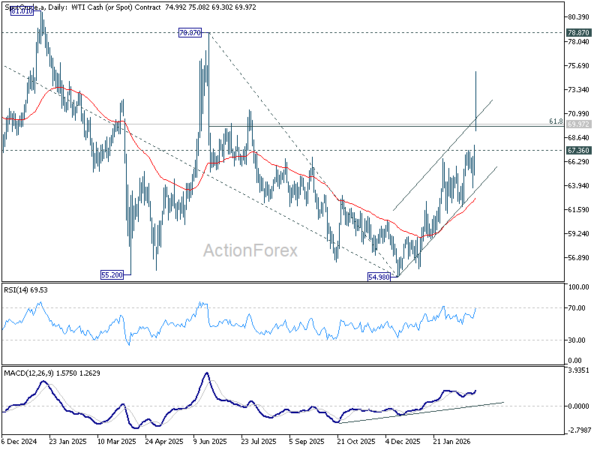
The current market narrative has diverged: On one hand, the sharp short-term spike in oil prices (ICE Brent crude surged 13.04% at the March 2 opening to $82.37 per barrel, with gains narrowing to around 8.3% by the close of the day) has raised concerns about a rebound in inflation, potentially delaying the Fed’s rate-cut cycle temporarily. This expectation benefits US dollar bulls, pressuring the euro-to-dollar exchange rate and some other European currencies — these economies, closer to the conflict zone, face significant pressure from purchasing energy resources at high prices, resulting in notable currency depreciation. On the other hand, calls for interest rate cuts within the Fed persist, with officials like Milan arguing that the current interest rate level is ‘too high and restrictive.’ If oil prices fall and geopolitical risks ease, the rate-cut process could still proceed as originally anticipated, putting downward pressure on the US dollar.

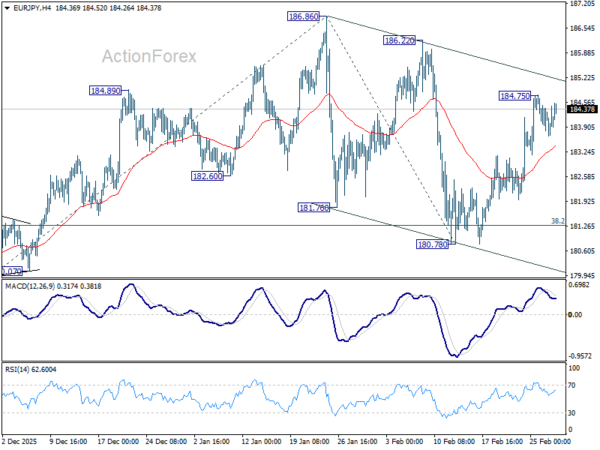
According to Monex Group analysis, if Brent crude oil remains in the $85-95 per barrel range, it will cause a supply shock to Japan, disrupting Saeko Takagi’s economic stimulus plan. In this scenario, Japanese inflation is expected to accelerate by 0.5 percentage points. The slowdown in Japanese inflation during January-February had provided the prime minister with policy space, but sudden changes in the Middle East situation and oil price volatility could alter everything. Affected by this, the USD/JPY exchange rate has risen to 157.47, with an increase of 0.91%, further intensifying the depreciation pressure on the yen.

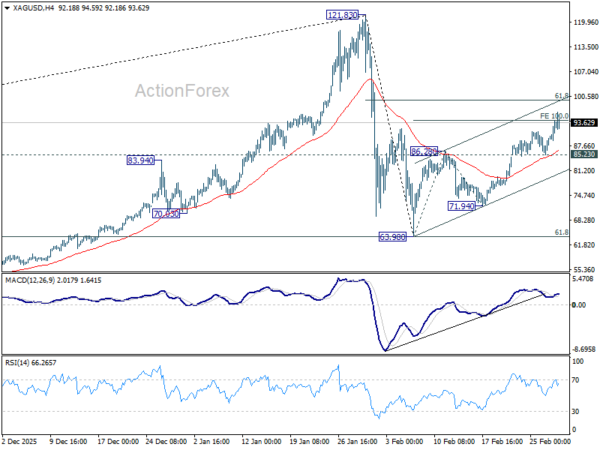
Gold has become one of the main beneficiaries of the recent escalation in the Middle East situation. On March 2, COMEX gold prices surged past $5,409 per ounce, rising over 3%, but by March 3, the spot price of London gold fell to $5,299.13 per ounce, down $87.03 from the previous trading day, representing a 1.62% decline, exhibiting a ‘sharp rise followed by a pullback’ pattern. In February, precious metals recorded their seventh consecutive monthly gain, marking the longest continuous uptrend since 1973. Coupled with geopolitical factors such as the kidnapping of Venezuela’s president and US tariff threats against Europe over Greenland, gold’s safe-haven appeal will continue to attract capital, with upside potential after short-term corrections.

Currently, investors’ reactions to fluctuations in risk premiums remain more pronounced than to fundamental factors: the short-term surge and plunge in oil prices, developments in shipping through the Strait of Hormuz, statements by Fed officials, and progress in the Middle East conflict have all become key variables influencing market movements. In this environment of high volatility and uncertainty, the safe-haven value of gold and the periodic strength of the US dollar will alternately come to the fore, while currencies such as the euro and yen continue to face dual pressures from geopolitics and energy.


Source link

Visited 1 times, 1 visit(s) today

Related Article

Retail Trading Enters New Maturity Phase: SpecFX Rebrands

Retail Trading Enters New Maturity Phase: SpecFX Rebrands

Sydney, Australia, March 02, 2026 (GLOBE NEWSWIRE) — The global retail trading industry is entering a more deliberate and regulated phase, marked by stronger oversight, greater operational transparency, and rising expectations from traders. Against this backdrop, SpecFX has officially rebranded as Spec Markets, signaling an expanded offering and a strategic shift toward long-term infrastructure, compliance,

ISM manufacturing beats forecast, prices jump to highest since 2022

ISM manufacturing beats forecast, prices jump to highest since 2022

US ISM Manufacturing PMI edged down from 52.6 in January to 52.4 in February, but the reading remained comfortably above expectations of 51.9 and firmly in expansion territory. The data point to continued resilience in the factory sector, with activity still consistent with moderate economic growth. The most striking development was the sharp surge in

WTI soars above 70 despite OPEC+'s "band aid" production hike

WTI soars above 70 despite OPEC+’s “band aid” production hike

On Sunday, the OPEC+ “V8” coalition took a proactive stance by accelerating production hikes to 206,000 bpd starting in April. This move—surpassing the 137,000 bpd initially anticipated—serves as a strategic pivot to buffer a market shaken by the sudden U.S./Israeli strikes on Iran. While the alliance officially points to “market fundamentals,” the timing is clearly

War premium lifts Silver, violent move possible if 100 gives way

War premium lifts Silver, violent move possible if 100 gives way

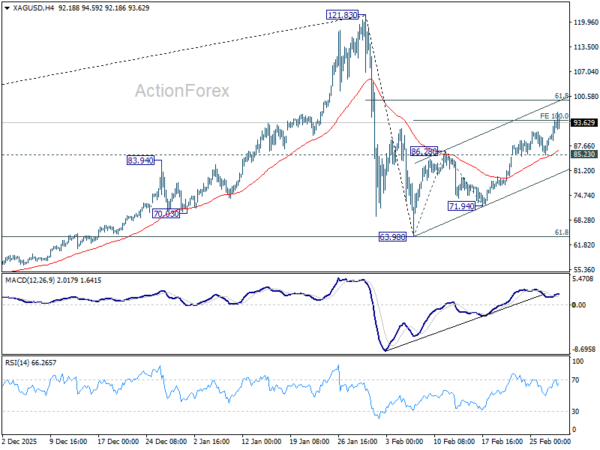
Silver edged higher as markets reacted to escalating tensions in Middle East, with US-Israel-Iran conflict driving aggressive safe-haven flows. Prices surged to an intraday high above 96 before easing slightly as traders locked in partial profits. Despite intraday consolidation, underlying bid remains intact as war premium continues to underpin precious metals. For now, further gains

EUR/AUD Daily Outlook - ActionForex

EUR/AUD Daily Outlook – ActionForex

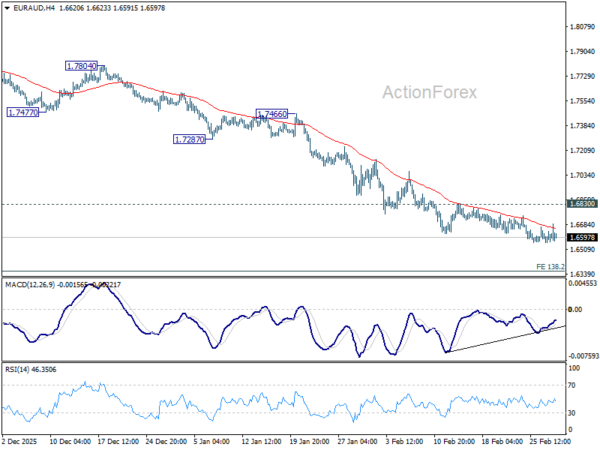
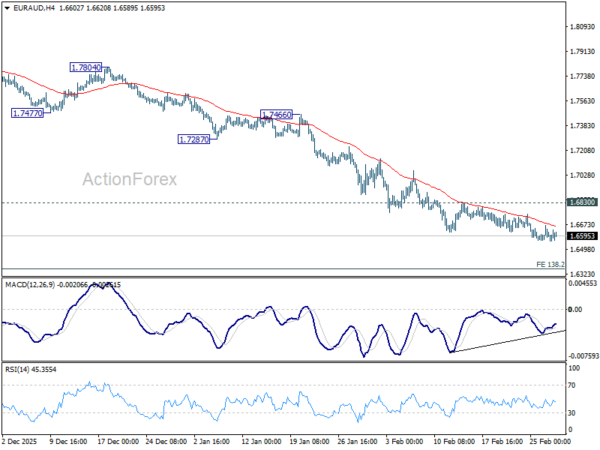
Daily Pivots: (S1) 1.6567; (P) 1.6604; (R1) 1.6647; More… Further decline is expected in EUR/AUD with 1.6830 resistance intact, despite some loss of downside momentum. Current fall should continue to 138.2% projection of 1.8554 to 1.7245 from 1.8160 at 1.6351. However, firm break of 1.6830 resistance will confirm short term bottoming, on bullish convergence condition

Safe-Haven Flows Build But No Panic, Focus Turns to Iranian Succession

Safe-Haven Flows Build But No Panic, Focus Turns to Iranian Succession

Markets opened the week with a clear but measured risk-off tone following dramatic escalation in Middle East tensions over the weekend. While safe-haven flows were evident in Asia, price action so far remains contained rather than disorderly. Investors are reacting, but not capitulating. Equity markets in the region reflected caution rather than panic. Japanese and

Image used for representational purposes only.

Rupee falls 21 paise to 91.29 against U.S. dollar in early trade amid Iran-Israel conflict

Image used for representational purposes only. | Photo Credit: Getty Images/iStockphoto The rupee depreciated 21 paise to 91.29 against the U.S. dollar on Monday (March 2, 2026), amid higher crude oil prices, a strong American currency and intense global volatility due to the escalated West Asia tension. Negative equity market sentiment and massive withdrawal of

EUR/USD Rejected at Resistance, Bears Eye Fresh Decline Ahead

EUR/USD Rejected at Resistance, Bears Eye Fresh Decline Ahead

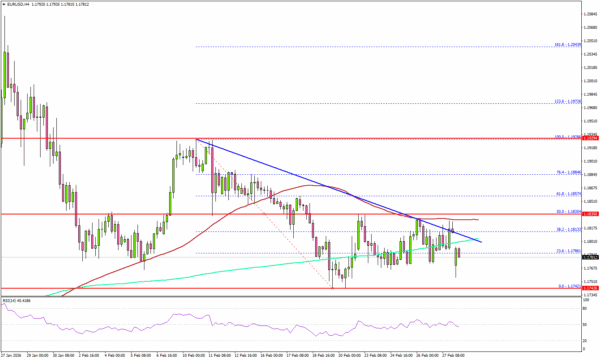
Key Highlights EUR/USD started another decline and traded below 1.1840. A key bearish trend line is forming with resistance at 1.1800 on the 4-hour chart. GBP/USD extended losses and traded below 1.3460. Crude Oil prices jumped above $74.50 before trimming some gains. EUR/USD Technical Analysis The Euro failed to stay above 1.1900 and declined against

USD/CHF Mid-Day Outlook - ActionForex

USD/CHF Mid-Day Outlook – ActionForex

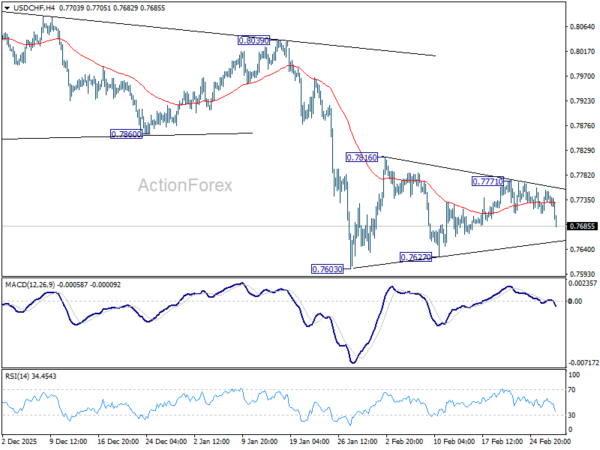
Daily Pivots: (S1) 0.7716; (P) 0.7735; (R1) 0.7759; More…. USD/CHF falls notably today but remains bounded in established range. Intraday bias remains neutral for now. In case of another rise, upside should be limited by 55 D EMA (now at 0.7824) to complete the pattern. On the downside, below 0.7627 will bring retest of 0.7603.

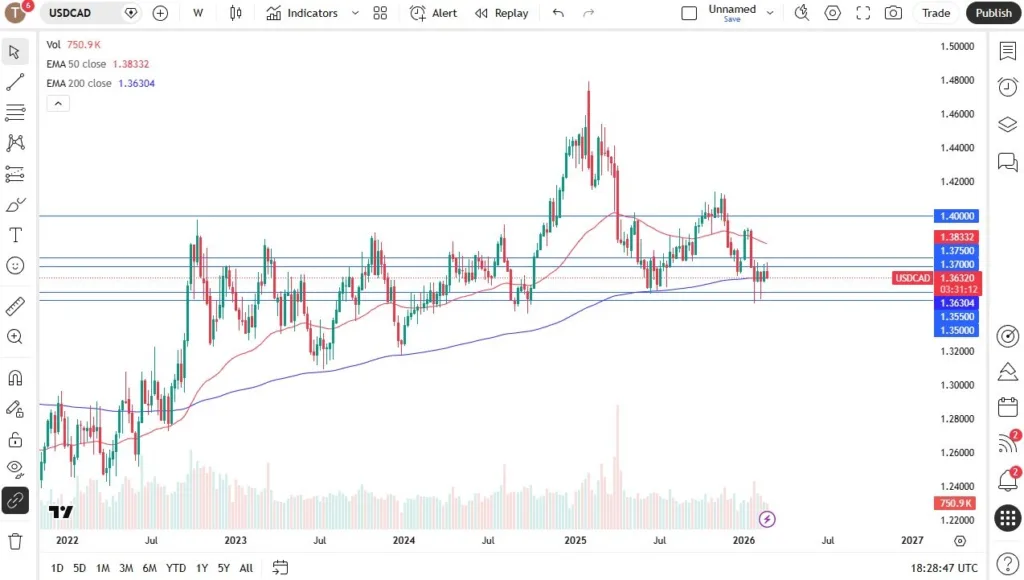
Price USD/CAD 01/03/2026

Weekly Pairs in Focus 1st to 6th March 2026 (Charts)

By Christopher Lewis Reviewer 24bulls Created on March 01, 2026 The US dollar initially rallied against the Canadian dollar during the week but has since turned around to show signs of hesitation. This is not a huge surprise considering that we have been bouncing around in the same region for 5 weeks now. It is

EUR/AUD Weekly Outlook - ActionForex

EUR/AUD Weekly Outlook – ActionForex

EUR/AUD’s down trend resumed last week but downside momentum has been unconvincing with bullish convergence condition in 4H MACD. Still, there is no clear sign of bottoming yet. Further fall is expected this week to 138.2% projection of 1.8554 to 1.7245 from 1.8160 at 1.6351. However, firm break of 1.6830 resistance will confirm short term

EUR/GBP Weekly Outlook - ActionForex

EUR/GBP Weekly Outlook – ActionForex

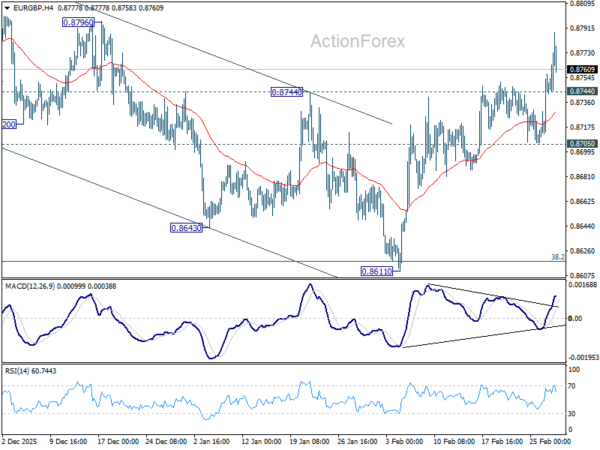
EUR/GBP’s solid break of 0.8744 resistance last week suggests that corrective fall from 0.8863 has completed at 0.8611. More importantly, up trend from 0.8221 is not completed. Initial bias stays on the upside this week for retesting 0.8863 first. For now, further rally is expected as long as 0.8705 support holds, in case of retreat.

EUR/JPY Weekly Outlook - ActionForex

EUR/JPY Weekly Outlook – ActionForex

EUR/JPY’s extended rise last suggests that correction from 186.86 has completed with three waves down to 180.78 already. But as a temporary top was formed at 184.75, initial bias remains neutral this week for consolidations first. On the upside, break of 184.75 will target 186.86 high. Firm break there will resume larger up trend to

USD/CAD Weekly Outlook - ActionForex

USD/CAD Weekly Outlook – ActionForex

Despite the late dip in USD/CAD, it’s still holding on to 1.3630 minor support. Initial bias stays neutral this week first. Outlook is unchanged that price actions from 1.3480 are forming a consolidation pattern. Upside should be limited by 55 D EMA (now at 1.3728). On the downside, firm break of 1.3630 will bring retest

AUD/USD Weekly Report - ActionForex

AUD/USD Weekly Report – ActionForex

AUD/USD remained bounded in consolidations below 0.7146 last week and outlook is unchanged. Further rise is expected with 0.6896 support intact. On the upside, firm break of 0.7146 will resume resume larger up trend to 100% projection of 0.5913 to 0.6706 from 0.6420 at 0.7213. In the bigger picture, current development argues that rise from

USD/CHF Weekly Outlook - ActionForex

USD/CHF Weekly Outlook – ActionForex

USD/CHF stays in consolidations above 0.7603 last week and outlook is unchanged. Initial bias stays neutral this week first. In case of another rise, upside should be limited by 55 D EMA (now at 0.7824). On the downside, break of 0.7603 will resume larger down trend, and target 0.7382 projection level next. However, sustained break

EUR/USD Weekly Outlook - ActionForex

EUR/USD Weekly Outlook – ActionForex

EUR/USD gyrated in tight range above 1.1740 last week. Initial bias remains neutral this week first. Risk will stay on the downside as long as 1.1928 resistance holds. Below 1.1740 will target 1.1576 support next. Firm break there should confirm rejection by 1.2 key psychological level and turn near term outlook bearish. However, break of

0
Would love your thoughts, please comment.x
()
x