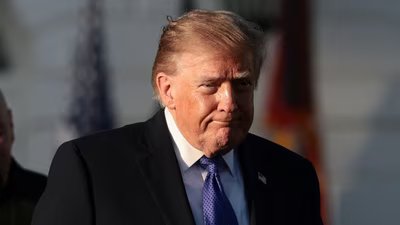
President Donald Trump is planning to visit Beijing in the coming months, just as China has published an ambitious new 141-page five-year policy plan that aims to “seize the commanding heights of science and technological development” by 2030. This plan aims to go far beyond investment in China’s artificial intelligence and tech infrastructure — the Communist Party’s clear goal is to unseat US tech dominance, turning China from the world’s tech factory into the world’s tech innovator.
Should Beijing gain the upper hand in tech, it will be on a path to strategic advantage against the West. Neither the US nor Europe can outcompete China alone. Washington needs to work with its Asian and European allies to succeed in meeting the China challenge. Europe, in turn, should bury counterproductive fantasies of ripping out American tech in pursuit of a digital sovereignty mirage.
America cannot go it alone. On AI models, for example, the US leads in key areas, but China is catching up fast: in 2024, the US produced 40 notable AI models, compared to China’s 15 and Europe’s three. But China is quickly closing the model quality gap while still leading in AI publications and patents. Chinese open-weight models also now account for 17.1% of global open-weight AI model downloads, ahead of the US at 15.8%. Only two years ago, American models dominated, with more than 60% of downloads. And the competition is now global, with new notable AI models launching in the Middle East, Latin America, and Southeast Asia.

It is not just AI, either. According to the Australian Strategic Policy Institute’s Critical Technology Tracker, which evaluates 64 critical technology categories across 8 domains, China leads in 57, while the US leads in only seven technology sub-categories.
Beijing does not just want to lead. It wants to define the global rules and standards on tech to create far-reaching dependencies that it can use for coercion.
The US can harness vast economic and technological comparative advantages to get ahead and stay ahead, but only by working with allies. The new White House-sponsored Pax Silica coalition aims to do just that, securing a silicon supply chain, from critical minerals and energy to high-end manufacturing and software.
By promoting Pax Silica, the US acknowledges that it needs access to European, Japanese, Korean, and Taiwanese technology, and Australian and Canadian raw materials. American tech companies benefit from access to Europe’s 450 million consumers, key to the US trade surplus of $75 billion in services. $2 trillion of trade moves across the Atlantic annually, making the US-Europe economic relationship the largest one in the world by far.
Get the Latest
Sign up to receive regular Bandwidth emails and stay informed about CEPA’s work.
At the same time, European “derisking” from America will fail. Attempts to replace US tech, software, hardware, and services would cost, according to several recent estimates, upwards of €5 trillion. Europe cannot afford such decoupling. Even if it could mobilize such a gigantic sum, the duplication would be counterproductive, hurting its own ability to innovate.
Without Western partnership, China could win. Start with critical minerals. After Japanese Prime Minister Sanae Takaichi made a comment about Taiwan that Beijing disapproved, it retaliated by imposing export controls on raw and critical minerals. China did the same to the US in response to tariffs. Europe is equally vulnerable: a just-published report by EU auditors reveals that the continent relies on China for seven of the 26 minerals studied, importing 97% of its magnesium and 71% of its gallium.
Japan shows the way forward to loosen the Chinese stranglehold. After China cut off the supply of metals over a territorial dispute in 2010, Tokyo built an alternative supply chain, investing in Australian and other non-Chinese mining operations. The US and Europe should follow this lead, partnering with Japan to diversify supply chains for critical and raw minerals.
Another essential building block of the tech future is semiconductors. Europe boasts its own impossible-to-duplicate strengths. Dutch ASML holds a virtual monopoly over the manufacturing of lithography machines required to make the most advanced chips. German technology leader Merck produces chemicals needed in chipmaking. Belgium’s imec, a part of the University of Leuven, leads the world in research on lithography and exotic chipmaking materials.
AI chip manufacturing is complex, requiring specializations spread across the globe. The US dominates AI chip design, with American NVIDIA claiming 80% of market share for the most cutting-edge semiconductors. But Taiwan dominates chip manufacturing, with TSMC capturing a 70% market share. TSMC makes the chips that NVIDIA and other American companies design. All depend on imec to test out new designs in the Leuven laboratory and ASML machines to engrave silicon.
The United Kingdom should be included in a democratic chip alliance. Arm, born in Cambridge, revolutionized the design of power-efficient chips that run all of our mobile phones. The bottom line is that Europe cannot do without US- and UK-designed chips, and the US cannot live without access to European chip-imaging prowess.
Mutual dependence prevails in other cutting-edge tech fields. Europe is strong in quantum computing and biotech. A German company pioneered the COVID-19 vaccine, after all. Japan alone accounts for 45% of the global production of robots.
Rather than working together for mutually beneficial solutions and leveraging these respective strengths, however, the risk is rising that democratic partners pursue counterproductive go-it-alone strategies — or even cuddle up to China. Europeans underestimate the security risks of de-risking from the US, a strategy that leads in only one direction: dependence on Beijing.
The US has unnerved allies by raising tensions across trade, defense, and tech policy. These moves are counterproductive, raising fears that Washington might cut off access to key American technologies, including cloud computing and payment services.
War in the Middle East has overshadowed the planned US-China summit. President Trump was scheduled to visit Beijing at the end of March, but the administration has requested that the trip be delayed by a month due to the war in Iran.
The long-term risk remains ceding tech leadership. Unless the US and its allies collaborate, we risk seeing a splintered tech world that would slow innovation. China would win, racing ahead — and leaving the West chasing behind.
Dr. Alina Polyakova is President and CEO of the Center for European Policy Analysis (CEPA) as well as the Donald Marron Senior Fellow at the Henry A. Kissinger Center for Global Affairs at the Johns Hopkins University’s School of Advanced International Studies (SAIS).
Bandwidth is CEPA’s online journal dedicated to advancing transatlantic cooperation on tech policy. All opinions expressed on Bandwidth are those of the author alone and may not represent those of the institutions they represent or the Center for European Policy Analysis. CEPA maintains a strict intellectual independence policy across all its projects and publications.

Read More From Bandwidth
CEPA’s online journal dedicated to advancing transatlantic cooperation on tech policy.