In an unprecedented act of defiance, Beijing has ordered Chinese businesses to ignore the United States’ sanctions against Iran.
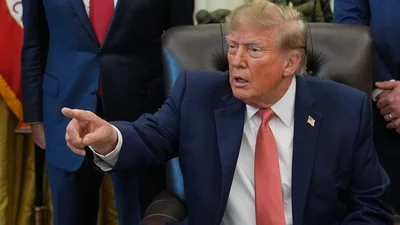
Chairman Xi Jinping is due to meet President Donald Trump for personal talks in the coming days.
And a lot has changed since their last Beijing soiree in 2017.
Trade is a deeply entrenched battleground between the world’s two largest economies as they strive to shape the global system in their own image.
Now, with President Trump mired in a debilitating standoff with Iran in the Strait of Hormuz, Chairman Xi senses an opportunity.
“This is unprecedented. It’s a major escalation in terms of China’s response to US economic statecraft. It is a measure of defiance by Beijing,” says Foundation for Defence of Democracies research fellow Max Meizlish.

The world’s second-largest (and rapidly closing) economy has so far largely fended off a flurry of recent taxes, restrictions and tariffs hurled at it by Washington DC.
So last month, the Trump Administration imposed fresh penalties on five Chinese refineries for purchasing sanctioned Iranian “dark fleet” crude oil.
This week, Beijing responded by ordering Chinese corporations to ignore the move.
“It’s putting firms in China in the position where they either comply with the CCP order or the US order, and either way, there could be consequences,” Meizlish explains.
But Beijing is prepared. It says it will help cover any cost such sanctions-busting will incur.
Knives out
Communist Party mouthpiece the People’s Daily called the order “a pivotal step” in bypassing the “wrong practice of abuse of sanctions and long-arm jurisdiction” by the United States.
China’s Ministry of Commerce says the sanctions “improperly prohibit or restrict normal economic and trade activities between Chinese companies and third countries”.
“The Chinese government consistently opposes unilateral sanctions that lack authorisation from the United Nations and the basis of international law,” it adds.
Beijing has activated its 2021 Rules on Counteracting Unjustified Extra-Territorial Application of Foreign Legislation and Other Measures.
This enables sanctioned firms to sue those who benefit from complying with foreign sanctions, and authorises the state to compensate for losses incurred.
“This marks the first time China has invoked its so-called blocking statute – one of its strongest tools for countering foreign sanctions,” says Foreign Policy editor James Palmer.
“Though China objects to the US-led global sanctions regime, dollar dominance generally leaves Chinese financial institutions little choice but to comply with it (albeit with some workarounds).”
But Beijing has its own economic muscles to flex.
“China is likely emboldened by its success last year in leveraging its dominance over critical minerals to force a de-escalation in its trade dispute with the United States,” Palmer adds. “That episode may have reinforced a perception among Chinese leaders that Washington is reluctant to engage in a prolonged confrontation, particularly when its attention is divided.”
Plea bargains
President Trump is travelling to Beijing this week on the back foot, both diplomatically and economically.
The US Supreme Court has struck down his much-hyped “Liberation Day” tariffs. This was supposed to raise the price of Chinese goods sold in the US by up to 145 per cent.
Washington DC is struggling to find new legal avenues to revive the scheme.
And his special military operation against Iran was supposed to be won within “a few weeks”. More than two months and a shaky ceasefire later, Iran maintains a tight grip on the jugular vein of the world’s energy and fertiliser trade – the Strait of Hormuz.
It’s been letting China-bound ships through.
It’s a move that has angered Washington DC.
“Iran is the largest state sponsor of terrorism,” US Treasury Secretary Scott Bessent stated on Tuesday.
“China has been buying 90 per cent of their energy. So they are funding the largest state sponsor of terrorism.”
Iranian Foreign Minister Abbas Araghchi travelled to Beijing on Thursday for discussions with Chinese Foreign Minister Wang Yi. No doubt the subject of Hormuz and its impact on global trade was the centre of discussion – and how it could be used to drive a wedge into the US-dollar-based trade network.
Iran is already demanding ransoms from India and Japan to allow crucial deliveries of liquid petroleum gas and crude oil through the Strait. And this must be paid in Chinese yuan.
Now it wants to turn this into a permanent transit fee.
“This has the potential to significantly alter regional and global power balances,” argues University of Auckland international affairs analyst, associate professor Chris Ogden.
“If Iran can continue to charge these tariffs, it could tilt regional influence away from the US towards China and Asia by eroding the historical dominance of the petrodollar.”
Duelling dollars
Beijing has for decades been attempting to promote its own currency, the yuan, as an alternative means of international exchange.
It has been using its chokehold on critical minerals and rare earths refining as leverage to do so. Now, the chaos engulfing global oil and gas supplies offers a new opportunity.
“Paying (transit) tariffs in petroyuan would … play into Beijing’s narrative of being a reliable and more stable economic force. It also mirrors Russia’s request for payment in yuan for its oil since 2025,” Oaten argues.
“It would be premature to argue Iranian tariffs will lead to a general ‘de-dollarisation’ of the world economy. But they may be a step towards a devaluing of the US dollar.”
That would diminish the influence the US economy has on global trade.
It would also weaken the impact of its unilateral sanctions.
“Overall, Iranian tariffs denominated in yuan would be another sign of an emerging multipolar world in which US pre-eminence is no longer a given,” Oaten adds.
“It would mean more strategic flexibility for all countries, great and small, but also more uncertainty.”
It’s just another unanticipated consequence of Operation Epic Fury.
And President Trump must contend with this added source of geopolitical pressure when he visits Beijing this week.
“China’s ambitions extend beyond ignoring US measures to shaping the rules of the global system itself,” Palmer writes.
“It has already had some success … But the yuan remains a small fraction of global trade, and China will be hard-pressed to replicate the extent of US influence.
“Eroding that influence, however, may prove a more attainable goal.”
Jamie Seidel is a freelance writer