“Made in Europe” and China’s interests: can they be reconciled?

China has warned the European Union of possible retaliatory measures if the new European “Made in Europe” law harms Chinese companies, Xinhua news agency reported, citing China’s Ministry of Commerce.

Made in Europe” (Made in Europe/EU) is an EU initiative aimed at labelling and supporting goods produced within the bloc in order to strengthen its industrial base and reduce dependence on imports, particularly in the technology sector. The new draft law envisages giving priority to European products in public procurement.

Beijing has stated that the EU’s industrial acceleration law creates serious barriers to investment and constitutes institutional discrimination. “If China’s position is ignored, the country will be forced to take countermeasures,” the ministry said.

China has reason for concern. The European Union is one of its largest trading partners, consistently ranking among the top three destinations for its foreign trade. By the end of 2025, trade turnover between China and the EU had increased by 5.4 percent, reaching $828.11 billion. The EU is a key market for Chinese exports, while China is one of the main sources of imports for the bloc. In the first quarter of 2026, trade between China and the EU grew by 17.6 percent. Exports from China to the EU rose to $147.76 billion, while imports from the EU reached $64.64 billion.
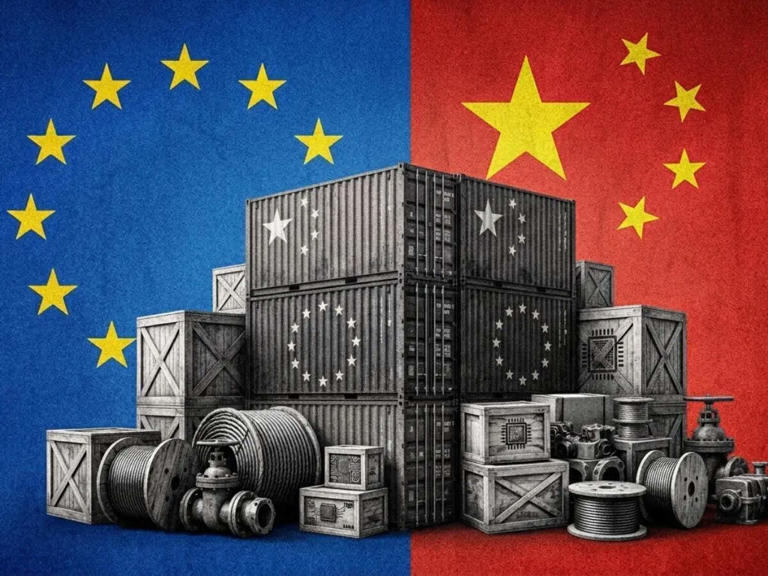
Another trade war? EU fires first shot in economic clash with China

Source: MSN

In March, the European Commission presented a strategy to enhance economic competitiveness amid China’s growing influence in several sectors. This regulation, known as the Industrial Accelerator Act, aims to increase the share of manufacturing in the EU’s GDP to 20 percent by 2035, up from about 14 percent in 2024. The document will enter into force after approval by the European Parliament, after which it will become binding on all EU member states.

The Act covers industries such as automotive manufacturing, battery production, construction, the chemical sector, steelmaking and transport — sectors in which China is actively investing.

France is the main proponent of the new measures. European media report that the scope of the document was somewhat scaled back to secure support from Germany and Northern European countries.

Beijing’s statement on potential countermeasures in response to the “Made in Europe” bill reflects not just another trade dispute, but a deeper global shift. It signals the gradual breakdown of the previous model of open interdependence between China and the European Union and a transition towards competition between industrial blocs.

Made in Europe” implies that companies receiving state support in strategic EU sectors must comply with requirements to localise production and components within Europe. From Brussels’ perspective, such a policy is a tool to strengthen industrial sovereignty, especially amid competition with the United States and China, as well as an attempt to accelerate the green transition and reduce dependence on external supply chains.

However, for Beijing, the measures amount to an attempt to limit Chinese companies’ access to European subsidies and strategic markets.

Analysts note that China is employing both diplomatic and deterrent approaches. On the one hand, Beijing has expressed readiness for dialogue with the EU on the issue. On the other, it has warned of possible countermeasures. Experts believe China has the means to respond to the marginalisation of its interests in Europe, but it traditionally favours soft power and will try to resolve the issue diplomatically. If the situation escalates, it may reveal the real cost of the emerging conflict.

Who is right and who is wrong in this dispute? Each side has its own rationale.

The EU seeks to reduce the vulnerability of its supply chains, especially in critical sectors. China, in turn, views the European market as a key destination for expanding its high-tech exports. In essence, two positions are clashing: the European logic of security, focused on protecting strategic industries and subsidies, and the Chinese logic of open markets, which emphasises access to EU-supported programmes and infrastructure.

The EU’s move at this particular moment is no coincidence. Against the backdrop of a slowing global economy and ongoing tariff tensions with the United States, Europe is being forced to seriously consider protecting its own industrial interests. A period is emerging in which domestic production capabilities are becoming increasingly important and require stronger support, including limits on access for external investors.

China, for its part, does not face constraints in domestic production. On the contrary, it is dealing with overcapacity in certain sectors, the need to diversify export markets and restrictions from the West that exacerbate these challenges. China is interested in expanding into Western markets, while those markets are increasingly showing a tendency to contract in an effort to shield themselves from Chinese expansion.
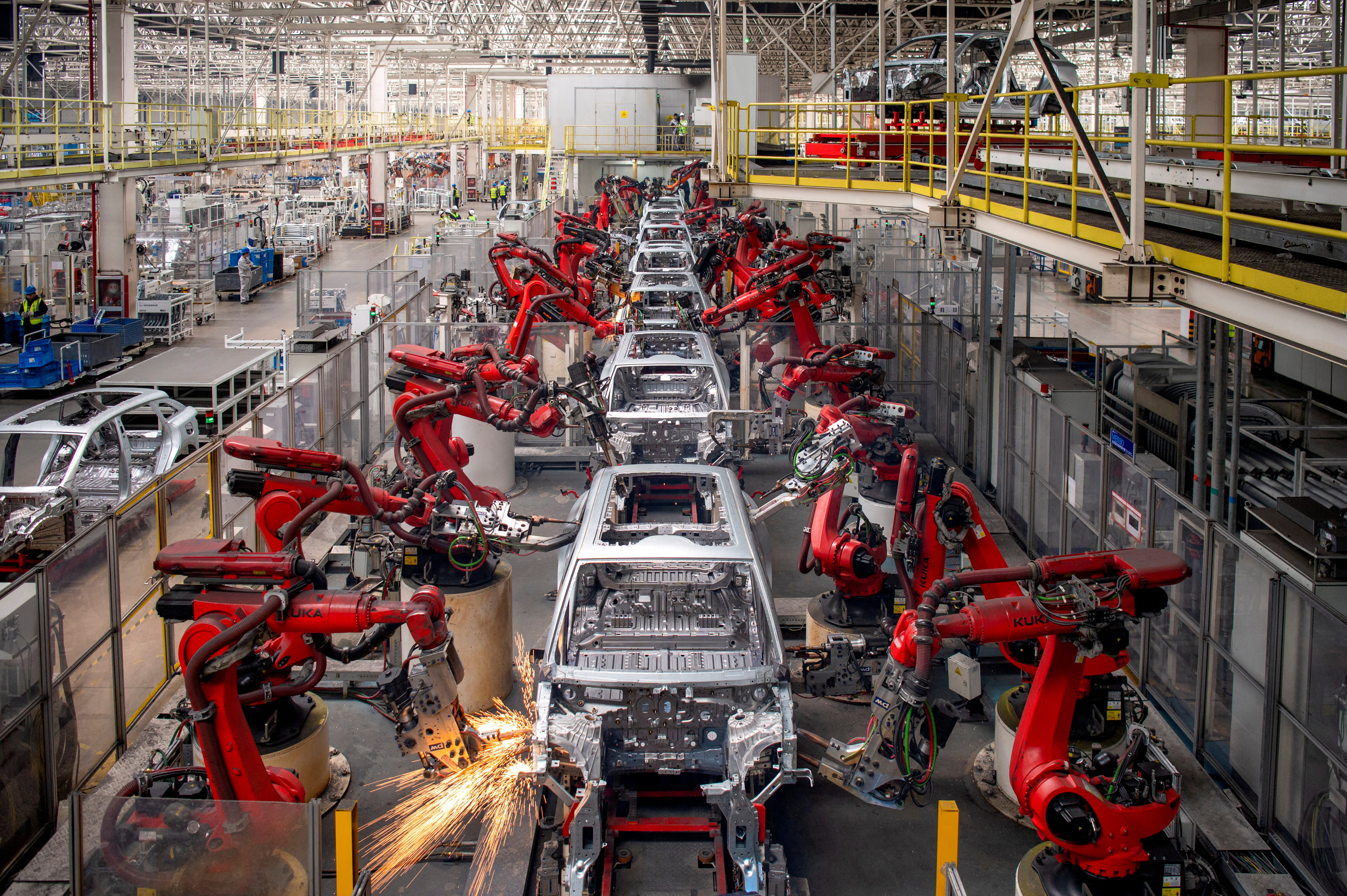
China's Sept industrial profits extend gains helped by policy support |  Reuters

Source: Reuters

The adoption of the Act is only a matter of time. The European Parliament is expected to vote in favour. If it is adopted in its current form, without any softening of the EU’s position, consequences are likely.

According to experts, China may introduce targeted restrictions against European companies operating in China, particularly in the automotive, chemical and engineering sectors. Chinese companies may reduce their participation in European projects and redirect investments to countries in Asia, the Middle East and Latin America. The formation of separate technological ecosystems — European and Chinese — will accelerate, with limited compatibility between them.

More optimistic analysts expect that China may succeed in softening the law through negotiations and securing certain adjustments. However, this scenario appears less likely given the growing misunderstandings in the dialogue between Brussels and Beijing.

In these conditions, Beijing’s statement is not just a reaction to a single draft law, but a signal that economic relations between China and the European Union are entering a phase of structural reassessment. Even if the current dispute is resolved, the trend towards separation is likely to persist.

It appears that the era of open markets is coming to an end.

By Trural Heybatov


News.Az 

Source link

Visited 1 times, 1 visit(s) today

Related Article

Japan’s US-2 joins Balikatan

Japan’s US-2 joins Balikatan exercises in South China Sea

Japan’s US-2 advanced amphibious aircraft made its debut during Balikatan, the largest joint military exercises between the Philippines and the United States. A ShinMaywa US-2 aircraft of the Japan Maritime Self-Defense Force (JMSDF) splashed down in South China Sea as part of a joint casualty evacuation drill for the Balikatan exercises last April 27, according

ET logo

China stresses urgent need to maintain Iran war ceasefire

China’s U.N. ambassador Fu Cong said on Friday it was an urgent necessity to maintain the Iran war ceasefire and that he was sure the Strait of Hormuz issue would be high on the agenda if it is still closed when U.S. President Donald Trump goes to China ‌this month. Fu told ⁠reporters ⁠at the

China Carmakers Overtake Peers With AI, Battery Tech

China Carmakers Overtake Peers With AI, Battery Tech

KR-Asia reports that **China’s carmakers** are pulling ahead of Japanese and European rivals by integrating advanced **AI** driver systems and battery technology into mass-market EVs. The article highlights **Xpeng**’s new **GX SUV**, which is described as capable of the equivalent of Level 4 autonomous driving, and notes that **Volkswagen** chairman Oliver Blume visited Xpeng’s booth

electric sports car showcased at an event with an audience

China’s Rocket-Powered EV Claims Zero to 62 in 0.9 Seconds

Believe it or not, Chinese company Dreame is not the first vacuum cleaner manufacturer to dream (dreame?) of being a big player in electric vehicles. Britain’s Dyson had big plans to build seven-seat EVs with solid-state batteries—the company paid $90 million for Michigan battery startup Sakti3 in 2015, and planned a Singapore factory—but then abandoned

China Priority Watch List Status by USTR

China Priority Watch List Status by USTR

The Special 301 Report, released by the Office of the United States Trade Representative (USTR) on April 30, 2026, is the product of an annual review conducted pursuant to Section 182 of the Trade Act of 1974, as amended by the Omnibus Trade and Competitiveness Act of 1988 and the Uruguay Round Agreements Act. The

China-Linked Hackers Target Asian Governments, NATO State, Journalists, and Activists

China-Linked Hackers Target Asian Governments, NATO State, Journalists, and Activists

Cybersecurity researchers have disclosed details of a new China-aligned espionage campaign targeting government and defense sectors across South, East, and Southeast Asia, along with one European government belonging to NATO. Trend Micro has attributed the activity to a threat activity cluster it tracks under the temporary designation SHADOW-EARTH-053. The adversarial collective is assessed to be

Leong Jun Hao

China crush Malaysia’s Thomas Cup hopes

Leong Jun Hao put up a much improved display by taking a game off world No 1 Shi Yu Qi before losing 10-21, 21-16, 9-21 in the opener. (Bernama pic) PETALING JAYA: Malaysia’s campaign in the Thomas Cup ended after losing to favourites China in the quarter-final today in Horsens, Denmark. China who are gunning

BYD sales fall for eighth month as China demand lags — TradingView News

BYD sales fall for eighth month as China demand lags — TradingView News

Chinese electric vehicle maker BYD reported another monthly decline in vehicle sales, marking its longest-ever downturn as demand in its home market remains subdued. BYD’s vehicle sales fell 15.5% year-on-year in April, extending the streak to eight consecutive months of decline. The figures were based on Reuters calculations using data from a Weibo post by

Japanese, Chinese, and European Companies Still Feed Russia’s Weapons Industry

Russia Imports 90% of Sanctioned Military Tech via China — UNITED24 Media

Russia is now importing more than 90% of its sanctioned technology through China, a sign of Moscow’s increasing reliance on Beijing to sustain its war effort in Ukraine, Bloomberg reported on April 30. This figure represents a significant increase from approximately 80% last year. The increase follows the European Union’s crackdown on alternative routes Russia previously used to acquire restricted goods. According to Bloomberg’s sources, who spoke on condition

Johnson Matthey to supply biomethanol technology for China plant - News

Johnson Matthey to supply biomethanol technology for China plant – News

Wirestock Creators / Shutterstock.com ENGINEERING firm Johnson Matthey has partnered with Chinese green energy developer Guangdong Liquid Sunshine to build a biomethanol plant in Tiandong County, Guangxi. Johnson Matthey will provide its methanol synthesis technology to convert gasified biomass waste into biomethanol. The plant is expected to have a production capacity of 75,000 t/y. China

China Moves to Block US Capital in Its AI Startups: The New Wall Around Tech Talent and Technology

The New Wall Around Tech Talent and Technology

In a significant escalation of its tech decoupling strategy, China is now actively discouraging its leading AI companies from accepting American investment without explicit government approval. According to Bloomberg reporting from April 24, 2026, Chinese regulators — including the powerful National Development and Reform Commission (NDRC) — have privately warned several high-profile AI startups to

PSA expands China presence with Xiamen port investment

PSA expands China presence with Xiamen port investment

PSA International has secured an investment in Xiamen Container Terminal Group through a public bidding process. The group operates eight container terminals with a combined annual capacity of about 20 million TEUs. The deal remains subject to regulatory approvals and closing conditions. Expanding logistics integration As part of the transaction, PSA will also increase its

Cadillac seeking a 'comeback' in China's auto market with new NEV model

China’s EV price war turns into AI arms race beyond cheaper cars

AI signage at the Robert Bosch booth at the Beijing Auto Show in Beijing, China, on Saturday, April 25, 2026. Bloomberg | Bloomberg | Getty Images BEIJING — Electric carmakers in China are layering on more of the same artificial intelligence features as they try to survive a prolonged price war in the world’s largest

Cision

World’s First Immersive Acrobatics Theme Park Opens in Wuqiao, China

CANGZHOU, China, April 30, 2026 /PRNewswire/ — A news report from Xinhuanet: Today, Wuqiao County in Cangzhou, China, officially opened the Wuqiao Acrobatics Fantasy Park, a large-scale immersive theme park that transforms a centuries-old performance tradition into a fully interactive visitor experience. Known as the cradle of acrobatics, the county has developed the new complex as

Bipartisan bill seeks to block Chinese autos as dealer pressure looms

Bipartisan bill seeks to block Chinese autos as dealer pressure looms

Growing concerns about Chinese automakers have prompted a bipartisan push to block their entry into the U.S., as President Donald Trump prepares to meet with Chinese President Xi Jinping. The details: Sens. Bernie Moreno, R-Ohio, and Elissa Slotkin, D-Mich., introduced legislation Wednesday that would ban Chinese vehicles and parts from being imported into the U.S.,

An aerial view shows a crude oil tanker at an oil terminal.

China using a double-insurance strategy to secure crude oil supplies amid Iran war

As the world’s largest crude oil importer, China has long relied on a double-insurance system to safeguard domestic oil supply. The strategy combines two pillars: diversifying where its crude comes from, while simultaneously building vast strategic and commercial stockpiles. Experts say that approach appears to have helped China absorb at least the initial shock after

China’s investment in innovation is fostering scientific and technological advances. Jin Liwang/Xinhua via Getty Images

China surpasses US in research spending

China’s rapid rise in science has hit a milestone. The country’s investment in research and development has reached parity with – and by purchasing power measures has surpassed – that of the United States, according to a March 2026 report from the Organisation for Economic Co-operation and Development. Both nations have crossed the US$1 trillion

Sign up for Yahoo Finance's Week in Tech newsletter.

Apple tops Q2 earnings estimates on strong iPhone, China sales

Apple (AAPL) reported its second quarter earnings on Thursday, topping analysts’ estimates on the top and bottom lines on strong iPhone sales. Apple stock rose roughly 1% on the news. For the quarter, Apple saw earnings per share (EPS) of $2.01 on revenue of $111.2 billion. Analysts were anticipating EPS of $1.96 and revenue of

0
Would love your thoughts, please comment.x
()
x