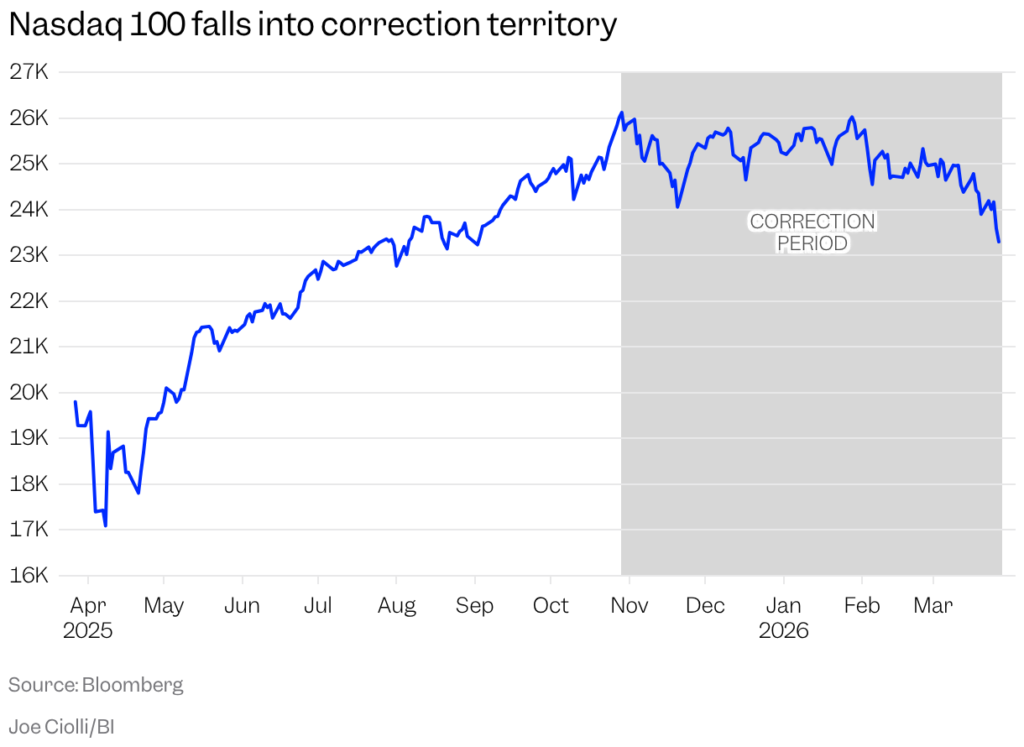
From a purely statistical standpoint, the stock market has thrived under President Donald Trump. Although volatility has been something of a theme, the ageless Dow Jones Industrial Average (^DJI 1.73%), benchmark S&P 500 (^GSPC 1.67%), and tech-dependent Nasdaq Composite (^IXIC 2.15%) soared 57%, 70%, and 142%, respectively, during his first, non-consecutive term.
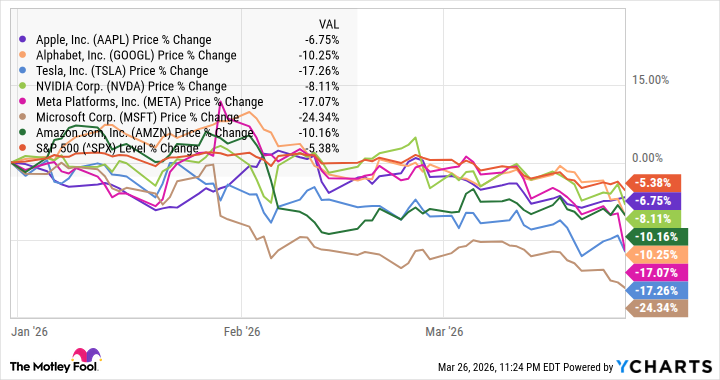
Until four weeks ago, the Dow, S&P 500, and Nasdaq Composite were delivering an encore performance in Trump’s second term. But as history teaches us, when things seem too perfect on Wall Street, they usually are.
President Trump delivering remarks. Image source: Official White House Photo by Joyce N. Boghosian.
Since the Iran war kicked off on Feb. 28, Wall Street has been on edge. While skyrocketing gas prices have been the most direct way this Middle East conflict has, thus far, impacted the U.S., there’s a much bigger chess piece that’s yet to move: the Federal Reserve. If and when it does, there’s the potential for the Fed to upend this tech-driven bull market and trigger a stock market crash under President Trump.
Gas prices are skyrocketing in the wake of a historic energy supply disruption
On Feb. 28, U.S. and Israeli forces commenced military operations against Iran. Shortly after these missions began, Iran announced that it would virtually close the Strait of Hormuz to oil exports. On a given day, approximately 20 million barrels of liquid petroleum, representing 20% of the world’s daily needs, travel through the Strait of Hormuz, per the Energy Information Administration. This shutdown is the largest energy supply chain disruption in history.
The law of supply and demand is straightforward: When the supply of an in-demand good is constrained, the price of that good will rise until demand tapers. Since conflict began, the per-barrel price for West Texas Intermediate and Brent crude oil has ascended to the heavens — and prices at the pump have followed.
Gas prices in the US have moved up to $3.93/gallon, their highest level since August 2022. The 34% spike over the last month ($2.94/gallon to $3.93/gallon) is the biggest we’ve seen in the past 30 years.https://t.co/oI8wTDHxnD pic.twitter.com/vZ0mo3XfQF
— Charlie Bilello (@charliebilello) March 21, 2026
According to data from AAA, the average nationwide price for a gallon of regular gas has skyrocketed 34% over the last month to roughly $3.93 as of March 21. The parabolic climb in diesel has been even steeper, with the nationwide average coming in at about $5.21 per gallon, up 41% from the previous month.
For some households, this increase isn’t something that can be swept under the rug. According to a 2023 analysis by the Federal Reserve Bank of Dallas, energy price shocks, including sizable increases in prices at the gas pump, disproportionately hurt low-income households.
However, when looking at fuel expenses for all households, the direct impact of skyrocketing gas prices isn’t as immediately dire as it seems. According to research from The Motley Fool, spending on gas accounted for 3.1% of total household expenditures (on average) in 2024. While this isn’t a negligible sum, it’s not an expenditure category known for toppling the U.S. economy or stock market.

Fed Chair Jerome Powell delivering remarks. Image source: Official Federal Reserve Photo.
If the Federal Reserve shifts its monetary policy stance, look out below
But if investors look beyond skyrocketing gas prices and take in the full impact and uncertainty surrounding the Iran war, they’ll see the bigger implications for the U.S. economy and stock market. Namely, the possibility of the Fed shifting its monetary policy stance and reshuffling its proverbial chess pieces.
Roughly six times per year, the 12-person Federal Open Market Committee (FOMC) meets to decide what, if any, changes should be made to America’s monetary policy. With the dual mandate in mind — maximize employment and stabilize prices — the FOMC can adjust the federal funds target rate (the overnight lending rate between financial institutions), thereby increasing or reducing the lending rate borrowers pay on credit cards, loans, and (indirectly) even mortgages.
Over the last 18 months, the FOMC has lowered the federal funds target rate on six occasions to its current range of 3.50% to 3.75%. Lowering borrowing costs is designed to encourage lending and stimulate economic growth. For businesses, cheaper access to capital potentially means more hiring, acquisitions, and spending on innovation.
S&P 500 Shiller PE Ratio hits 2nd highest level in history 🚨 The highest was the Dot Com Bubble 🤯 pic.twitter.com/Lx634H7xKa
— Barchart (@Barchart) December 28, 2025
For Wall Street, the prospect of additional rate cuts in 2026 (and beyond) has been built into valuations. According to the S&P 500’s Shiller Price-to-Earnings Ratio, the stock market entered 2026 at its second-priciest valuation in 155 years. One of the reasons stocks have remained historically expensive has been the expectation that lower interest rates were on the way.
The Iran war may end up dashing those hopes.
Initial estimates from the Federal Reserve Bank of Cleveland call for the trailing 12-month inflation rate to spike from a reported 2.4% in February to 3% in March. Given the ongoing uncertainty in the Middle East, there’s potential for energy commodities to significantly increase the prevailing inflation rate, as they did in 2022.
If the nation’s central bank alters its stance and removes the prospect of additional rate cuts in 2026 and/or 2027, or worse yet, puts the possibility of rate hikes on the table, it could turn into a look-out-below moment for the Dow Jones Industrial Average, S&P 500, and Nasdaq Composite.
To complicate matters, Jerome Powell’s term as Fed chair ends on May 15, and the FOMC has been historically fractured since mid-2025. While Powell has enjoyed the lowest level of dissenting opinions among any Fed chair since 1978, the last six FOMC meetings have featured at least one dissent.
Anna is correct below when she says:
“I have not seen a meeting with so much contradictions.”
—
This meeting was a mess.See the labels in the dot plot below.
One member of the FOMC thinks the Fed is going to HIKE rates this year. One (Stephen Miran) thinks it is going to cut… https://t.co/TRUQmD5I2E pic.twitter.com/qPlJGL57ln
— Jim Bianco (@biancoresearch) September 17, 2025
Worse yet, the October and December FOMC meetings had dissents in opposite directions. Though the federal funds target rate was lowered by 25 basis points at both meetings, at least one member favored no cut, while another pushed for a 50-basis-point reduction. Division within the FOMC threatens to undermine the Fed’s credibility.
If a stock market crash does materialize under President Donald Trump, it’s not going to be because gas hit $4 or $5 a gallon at the pump. Rather, it’s likely going to be because the Federal Reserve made a necessary but unpopular move.