The high-efficiency and stable flexible perovskite-silicon tandem solar cell technology, jointly developed by LONGi Green Energy and Soochow University, has been recognized by China’s ZGC Forum as one of the country’s top 10 scientific advances in 2025, marking a major breakthrough for China in the core technologies of next-generation photovoltaics. The achievement is one of two major scientific advances from Shaanxi Province to be recognized this year.
Themed as ‘Deep Integration of Technological Innovation and Industrial Innovation’, this year’s forum highlighted the selected achievement as a prime example of advanced industry-university-research integration and collaborative innovation, LONGi currently being the world’s only photovoltaic company possessing the manufacturing capability for wafer-size ultra-thin flexible tandem cells.
The laboratory maximum conversion efficiency of traditional monocrystalline silicon cells is approaching its theoretical limit of 29.4%. Constructing a tandem structure by combining perovskite materials with crystalline silicon allows for the full utilization of different wavelengths of sunlight, with a theoretical efficiency exceeding 43%, recognized as a next-generation disruptive photovoltaic technology. Among these, flexible tandem cells based on ultra-thin silicon wafers, with their exceptional lightweight and bendable characteristics, are expected to unlock advanced applications such as wearable devices and curved building-integrated photovoltaics. However, flexible devices are prone to interface delamination and failure due to repeated bending and temperature changes during use, resulting in a stability and lifespan far inferior to rigid devices, which has long constrained their commercialization.
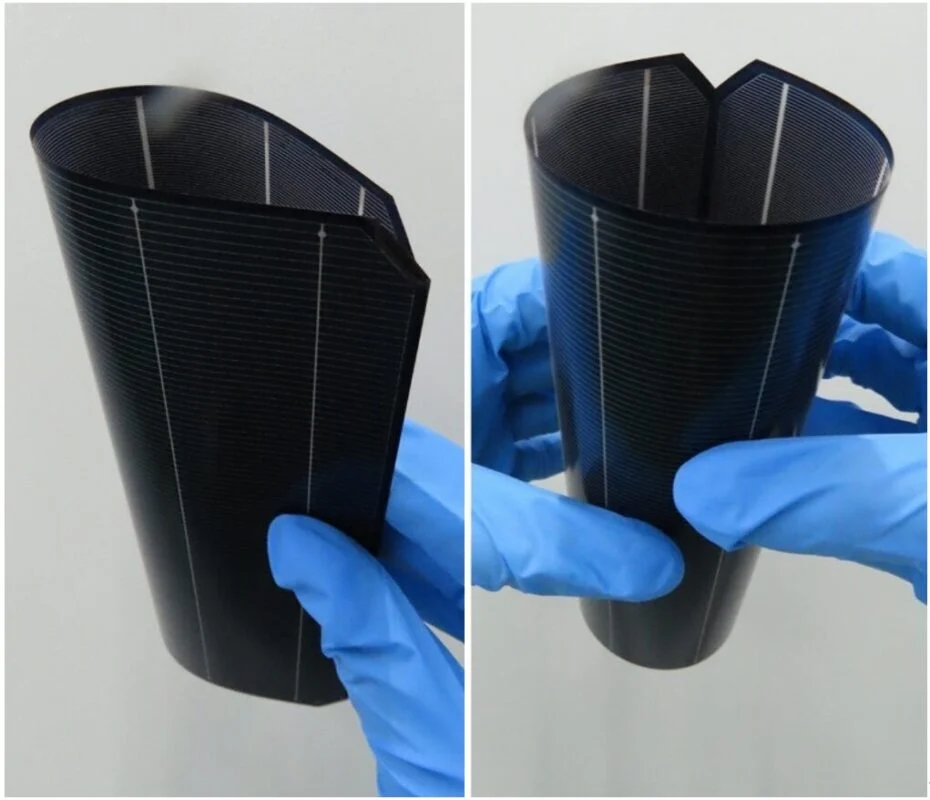
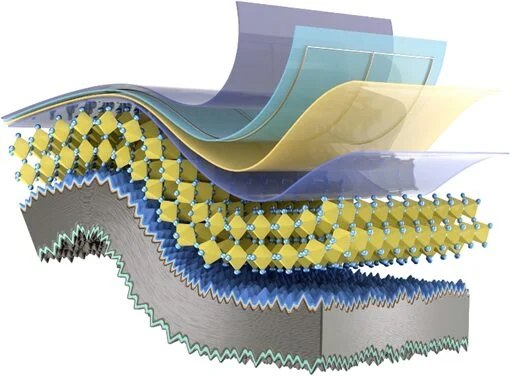
To address this core challenge, the teams led by Li Zhenguo, Xu Xixiang and He Bo from LONGi’s Central R&D Institute, in collaboration with Professors Zhang Xiaohong and Liu Jiang from Soochow University, innovatively designed a “tight-loose” dual-buffer layer structure. The loose layer acts like a spring mattress to absorb and dissipate strain energy, relieving mechanical stress, while the dense layer ensures efficient interface charge extraction and a stable connection. This “rigid-flexible” nanoscale layered design provides a “durable armour” for flexible tandem cells.
The ultra-thin tandem cells (approximately 60 micrometers thick) fabricated using this technology achieved a certified efficiency of 33.4% at the laboratory cell size by the U.S. National Renewable Energy Laboratory, and 29.8% at the full wafer size, setting world records for this type of device in both categories. Its power-to-weight ratio reaches as high as 1.77 watts per gram, demonstrating significant lightweight advantages.
The selection among the nation’s top ten scientific advances not only represents high recognition for the research capabilities of LONGi and its collaborative team, but also lays a solid foundation for the application of flexible tandem technology.