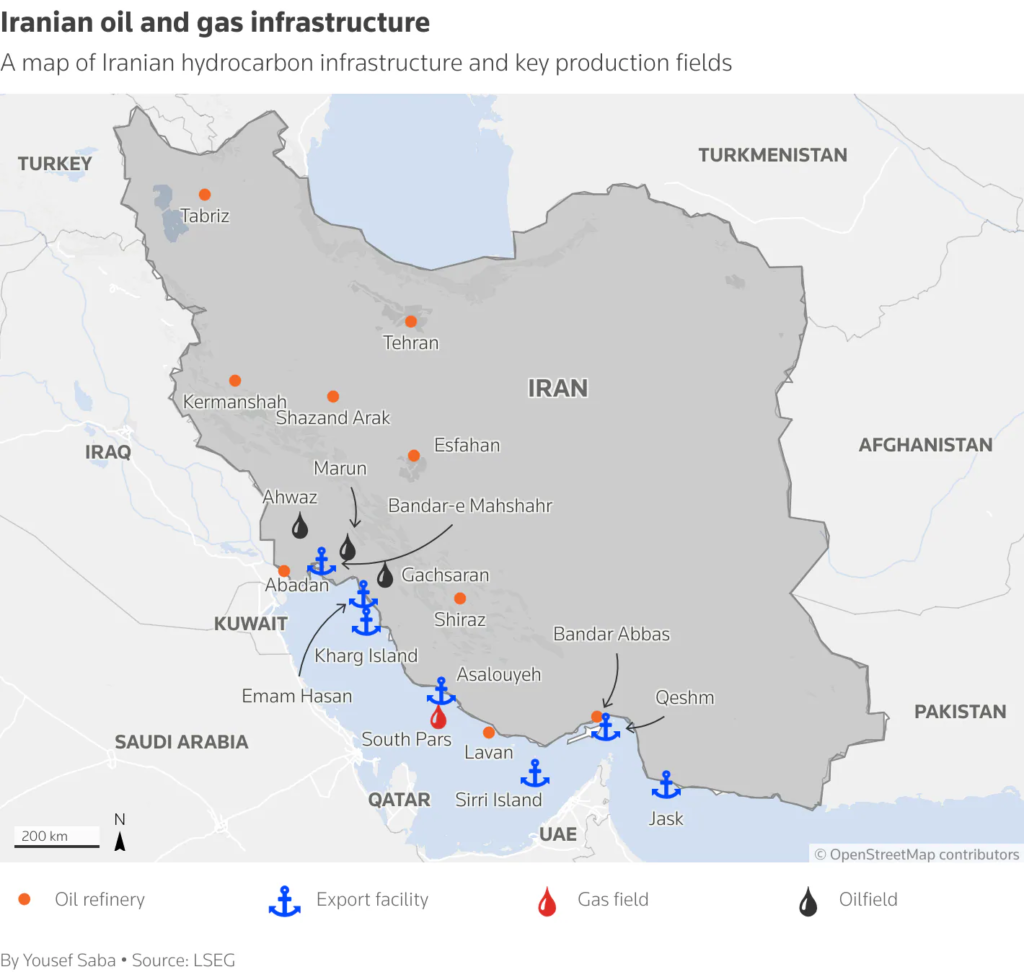

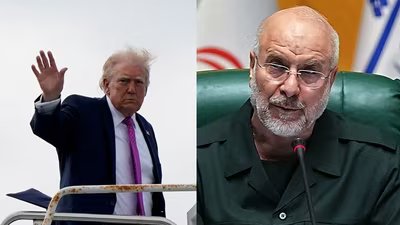
Israel and US strikes have wiped out senior Iranian leaders and hit key targets across the country. But after a month of fighting, it is arguably Iran that has secured the most significant strategic victory — a tightening grip over traffic through the Strait of Hormuz.

So far in March, the first full month of war, barely six vessels per day on average have traversed the narrow waterway connecting the Persian Gulf to the world, in either direction. That compares with about 135 a day in normal times, according to ship-tracking data compiled by Bloomberg.
Over that time, 80% of the small number of oil tankers exiting the strait have been Iranian — or belong to countries with which it is on cordial terms, the figures show.
Electronic interference in the Hormuz area disrupts vessel-tracking systems and some ships disable their transponders, impacting the timeliness and precision of tracking data. Even so, there is every sign that Tehran’s ability to control the strait is increasing.
Virtually all vessels that make the crossing now are doing so along Iran-approved routes — sailing close to its shores, and not to the Omani side of the strait — and often after talks to seek safe passage. Over the past few days, Malaysia and Thailand have reported bilateral deals to free tankers trapped in the gulf.
“Hormuz remains a closed gate for oil tankers,” said Anoop Singh, global head of shipping research at Oil Brokerage Ltd, adding the problem was not likely to see a quick fix without a ceasefire. “Even if there is one, it will not mean a rapid return of flows and shipping through Hormuz. Oil traders, refiners and supply-chain players are being forced to adapt.”
Iran has now passed a law introducing a toll and banning US and Israeli vessels from transiting the strait. The bill formalizes a system which multiple shipowners have already been reporting, as tankers are asked — through intermediaries — for detailed cargo and crew lists, and, in some cases, for payment. Perhaps as part of this move to normalize control, some interference with signals has begun to ease, a change that would help navigation in the area.
International maritime law — the UN Convention on the Law of the Sea — specifies that transit passage should be allowed through critical waterways including this one, which consists of overlapping Iranian and Omani territorial waters. But neither Iran nor the US have formally ratified UNCLOS.
Sovereignty over the waterway is one of Tehran’s five conditions for peace presented to the US.
Iran declared its control of the chokepoint immediately after US and Israel began strikes at the end of February, warning that no American vessel was allowed to enter the Persian Gulf. In early March, four ships with no clear ties to the US were hit by projectiles, resulting in at least three fatalities, rattling crews, shipowners and insurers.
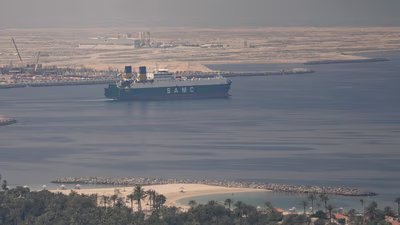
Those strikes have not eased, with a fully laden Kuwaiti crude tanker hit off Dubai in the early hours of Tuesday — one of the most significant attacks to date.
The near-total closure of Hormuz, through threats and attacks, has proved an exceptionally effective asymmetric weapon in Iran’s fight against two of the world’s most powerful military forces. It gives Tehran a means of directly impacting global energy markets and of inflicting acute financial pain — in a way Washington has struggled to counter, despite floating options ranging from insurance support to naval escorts.
Out of the 110 individual ships that left the gulf this month, more than 36% were sanctioned Iranian ships or part of the so-called dark fleet serving Tehran, data compiled by Bloomberg show. For oil tankers, 21 out of 35 that have exited had direct Iranian ties — but most of the remainder went to nations with whom Tehran has a friendly relationship.
Until this war, one long-held assumption around Hormuz was that Iran would never attempt to close the strait, for fear of risking its own exports, a vital economic lifeline. In fact, ship-tracking data suggest that Tehran’s oil has continued to flow — almost entirely to China — even as other ships are stranded and producers in the region have been left scrambling for alternatives or forced to stop producing as storage fills up.
Iran exported roughly 1.8 million barrels a day this month, a nearly 8% increase from its average over 2025, according to figures from data intelligence firm Kpler as of March 26. That likely facilitated hundreds of millions of dollars of oil revenue for Tehran, a Bloomberg News analysis shows.
In contrast, exports over the same month from Iraq, situated deep in the Persian Gulf, plunged more than 80% compared to 2025 levels, while Saudi Arabia was more than a quarter below last year’s average — even with the help of a pipeline carrying its oil to the Red Sea.
The impact of Iran’s control is visible in oil markets, with Brent is up close to 60% this month. It is also translating into diplomatic clout, especially with large oil-importing nations. Countries such as India, Turkey, Pakistan and Thailand have have sought Tehran’s approval to get ships through and alleviate a tight energy crunch.
Even Washington has been forced to make concessions in order to cool prices, waiving sanctions on some seaborne Iranian oil. Buyers have been reluctant, given the risk of getting caught out as restrictions return — but India has taken its first Iranian LPG cargo in almost eight years.
Other Gulf producers, in the meantime, are rushing to redirect oil flows through alternative routes.
Oil traders, shippers and all those reliant on long-established norms, are struggling to cope.
Overnight, freight rate assessments for a benchmark Middle East-to-China collapsed, prompting the Baltic Exchange to experiment with a new one originating from Oman, as ships divert to the Gulf of Oman and the Red Sea to pick up redirected flows. Local oil benchmarks have become incredibly erratic and unreliable, and no longer provide a true price-discovery function, according to traders and officials. The head of the International Energy Agency has urged European nations to consider decoupling gas and power prices to limit the fallout from the Iran war.
Insurers are also seeing unprecedented disruption. Almost the entire Middle East is now designated as a war zone by the Joint War Committee, a London-based group of underwriters. As a result, rates to offer premiums for additional war-risk cover for ships in the Persian Gulf and Hormuz have shot up, with those in the gulf at around 1.5% of a vessel’s value, and those for the strait hitting at times 10%.
Tehran’s toll in theory offers a framework to get traffic moving. In practice, it underscores the reality that even an end to the war will not bring a return to the status quo ante. Many larger shipowners and insurers say they will also struggle to take up the option even if they wanted to, for fear of falling foul of US sanctions.
“It would be a sort of slippery slope,” said Amanda Bjorn, head of claims at marine insurance broker Cambiaso Risso Asia, “if countries can decide that they’re not going to respect legislation that’s been in place for a good number of years now.”
(Updates with Iranian bill in paragraph seven, tanker attack in paragraph eleven.)
More stories like this are available on bloomberg.com
©2026 Bloomberg L.P.