THE REACTION OF RUSSIA’S STATE PROPAGANDISTS to Viktor Orbán’s trouncing at the polls last Sunday can be summed up in one word: “cope.”
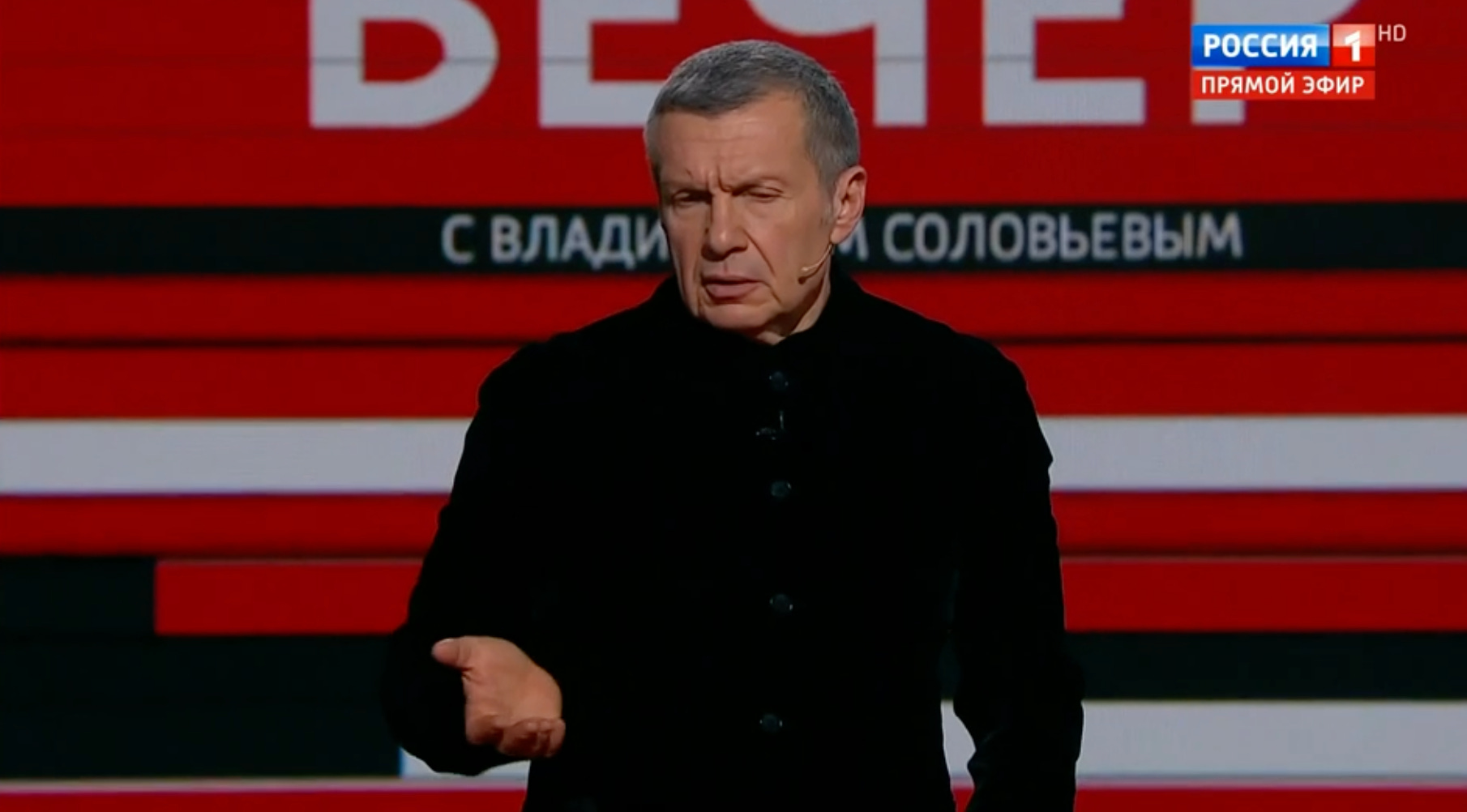
On his online show Solovyov Live the day after the Hungarian election, the Kremlin’s top propaganda jock, Vladimir Solovyov, sounded somber—downright funereal—as he announced Orbán’s “stunning defeat.” This outcome, Solovyov intoned, was “a step toward the final establishment of a bureaucratic European Reich whose existence has no other purpose besides war with Russia”; in the short term, it means more money and arms for Ukraine and more intense activity on the front lines, and in the longer term, more militarization of Europe. Bad news for Russia? Not according to Solovyov:
I can’t say that this is a defeat for Russia, because Russia hasn’t participated in European politics in a long time and has neither the resources nor the means for it. For Russia, there can be only one plus in this: deliverance from any illusions that some sort of healthy forces can exist in Europe, capable of at least partly slowing down the continent’s militarization. Now those illusions are gone, and we must get ready for the difficult stage of confrontation.
The real loser, though? Donald Trump, “who had invested in this campaign both emotionally and with his offers of economic aid, to the point of sending over JD Vance, who was a de facto active participant in the campaign.”
Solovyov Live cohost Sergei Mardan was even more sanguine, mocking some pro-Kremlin Russians’ “sufferings” over Orbán’s loss and assuring viewers that “it’s going to be exactly the same,” pointing out that Orbán had also voted for sanctions packages against Russia “after a little ass-wiggling.” An expert (political scientist Sergei Fyodorov) was also brought on for assurances that winner Péter Magyar was actually “quite conservative”: Sure, he may unblock funds for Ukraine, but he’s not that different from Orbán on everything else.
The same upbeat spirit prevailed the next day on Solovyov’s primetime television talk show on Rossiya-1, where Trump’s and Vance’s woes dominated. “Trump got a smack in the face from Europe—a proper smack in the face,” gloated guest Andrey Sidorov, a history professor at Moscow State University. “The man was calling for keeping Orbán in office, even promising benefits . . . and now what? He even sent poor Vance down there.” (“The kiss of death,” chortled Solovyov.) As for the idea that Orbán’s loss was a defeat for Vladimir Putin? “I don’t think Vladimir Vladimirovich invested a lot in Orbán,” shrugged Sidorov. “He didn’t say anything about supporting him.” Besides, any notion of “a Russia-loving Orbán” was a silly invention anyway, ventured Solovyov: “He was a pragmatic, absolutely pro-Hungarian politician. It would actually be difficult to find anywhere in Hungary a politician who likes Russia a lot.” (The things that pass for good news on pro-Kremlin political shows!) In any case, everyone agreed, the Hungarians would soon regret their rash move—and “Hungary isn’t going anywhere” because it still needs Russian energy.
It was much the same on fellow propagandist Olga Skabeyeva’s 60 Minutes, with more schadenfreude over the bad news for Trump and Vance, whose friendship now looked like toxic baggage. (You know what they say about broken clocks.) Besides, Skabeyeva predicted, Orbán’s successor might have some unpleasant surprises in store for the liberals: “Magyar himself said that he’s prepared to unblock the loan but will insist on the lifting of sanctions on Russia and continue to talk to Putin.”
Wait, did Magyar say that? Nope. He did say that he would pick up the phone if Putin called—and “tell him that it would be nice to end the killing after four years and end the war,” so “it would probably be a short phone conversation.” He also voiced the hope that Russia would end the war so that the sanctions could be lifted. But that’s not exactly 60 Minutes material.
INTERESTINGLY, THE MOOD AMONG the pro-war bloggers, who are much more independent of the Putin regime—even if they still have to tread carefully—was much more morose. “We already have few enough supporters in this world, and now their number is further reduced by this unpleasantness in Hungary,” sighed one Telegram blogger in a widely shared post, which blamed “the global deep state” and the EU for hoodwinking Hungarians by offering them a fake nationalist candidate “younger and less corrupt” than Orbán and predicted that Magyar would “pursue harshly anti-Russian policies”—not to mention promote sodomy, drugs, and invasion by black and Asian migrants.
There was also this lamentation from one of the biggest Telegram war blogs, Troyka, which has 192,000 subscribers:
What have we missed over the weekend? Well, not missed exactly, but pissed away: the last reasonable man in Europe, Orbán, the stern Hungarian. He was the one who blocked 90 billion Euros for the khokhols [the Russian anti-Ukrainian slur] for a long time. He’s being replaced by a pro-khokhol Russophobe. . . . Facts are facts: soon, the khokhols will have even more drones, missiles, and other technology. Our own prospects in that regard are far less happy.
Another big pro-war blogger, Yuri Baranchik, commented on the abject failure of the Russian political strategists dispatched to help Orbán—no surprise, he added, since Russian political strategists had no idea how to run a campaign without the help of “the administrative resource” (i.e., with the government’s heavy hand on the scale). “When you’ve got the administrative resource and control the vote-counting,” he added, “even a monkey can win”—a rather heretical comment which prompted expatriate Russian journalist Michael Nacke to wonder “just whom he meant by ‘a monkey.’” The blog Bashni Federatsii (Federation Towers) veered into even more shocking heresy, suggesting that Orbán’s defeat reflected “the simple math of political exhaustion”:
A sixteen-year period without change at the top has come to an end because the country’s leadership had reached an economic and moral impasse, having lost the sense of limits. In such a situation, the opposition does not need complex strategies. Everything is decided by an abnormally high turnout: People just come in, pick up their ballots and demolish the old system.
Remarkably, this wasn’t the only war-hawk blog to blame Orbán’s loss on his sixteen years in power and the resulting Orbán fatigue among Hungarians. Were these deliberate or accidental allusions to another head of state who has been in power for more than a quarter of a century?
IT’S NO WONDER, perhaps, that the Russian opposition in exile has been at least as buoyed by Orbán’s defeat as the Ukrainians. “Everyone is glad that an election could unseat a man who was not a fan of democracy and tried to shut it down in Hungary,” writer Dmitry Bykov said in a YouTube interview. Some even thought a thaw was underway in Russia, partly because of the hope inspired by Magyar’s win.
Political scientist Ekaterina Shulman, who now lives in Berlin, threw a damper on hopes that the Hungarian experience could be repeated in Russia: The house that Putin built is too entrenched, and even if a mass of Russians were finally motivated to throw the bastards out, the election-rigging may be too insurmountable. (Shulman also pointed out that Orbán’s ability to rig or steal elections was hemmed in by Hungary’s EU membership—and added a fascinating thought: The fetishization of sovereignty is largely a strategy by which would-be autocrats seek to protect themselves from free and fair elections.)
Journalist Stanislav Kucher sees a more optimistic, if morally fraught, lesson in Magyar’s win: Change in Russia is most likely to come from a former Putin associate who switches sides, as Magyar did against Orbán.
If nothing else, the sight of a Putin ally at the head of another ex-Communist country getting the boot may tap into the Putin fatigue already growing inside Russia. When even war-hawk bloggers are starting to say that too many years in power breed corruption and hubris, the regime has a problem.