A young woman slowly adds Chinese dates to hot water, then stirs in rose petals, goji berries and a slice of lemon, creating a hot and healthy drink inspired by Chinese traditions.
“My morning routine since I became Chinese,” says this TikTok fan from Frankfurt, Germany. She hopes her recipe will inspire others to “become Chinese” too, or “turn Chinese.”
Such videos are spreading rapidly through Instagram and TikTok as youngsters share how they are adopting habits from the daily lives of Chinese people.
They start the day with warm water and bone broth or make a traditional rice porridge known as congee. In the evening, apple tea is a must for digestion. They wear slippers to keep their feet warm.
Is China suddenly cool?
All these rituals are based on traditional Chinese medicine, which many hope will bring health benefits.
This puts the trend-setting spotlight right on China, a country often slammed for its authoritarian government, human rights violations and unfair economic practices.
The ‘Becoming Chinese’ trend appears to have originated in the US, then spread to Europe. A widely shared post is cited as the starting point – “You met me at a very Chinese time of my life” – a line that riffs on a similar quote from the film “Fight Club.”
‘Chinamaxxing’ is now seemingly everywhere, with the neologism drawn from the world of video games, where one extracts maximum abilities from a character.
Longing for balance
“Several developments are contributing to the current popularity,” says trend watcher Ulrich Köhler from consultancy firm Philoneos. Many people perceive their Western way of life as hectic, fast-paced and unbalanced, giving rise to a longing for balance, mindfulness and alternative lifestyles, says Köhler.
“On the other hand, we are seeing a positive shift in media coverage of topics relating to China.” Critical issues now play only a minor role in reporting. Now, he says, the focus is on fascination with technological advances, as well as the visible order and security in large parts of society.
Did Trump boost China trend?
Some observers also note that the trend has less to do with China as a state, and more to do with China as a culture. In the US, the change of government in Washington is also suspected to be behind the emergence of the trend.
Right at the start of his first term, US President Donald Trump sought to ban TikTok. The decision triggered a brief exodus among those users who publish content on the platform for a living, leading them to the Chinese Instagram equivalent Xiaohongshu (Little Red Book).
In January 2026, one year into Trump’s second term, TikTok’s US business was officially transferred to a newly established joint venture, after a 2024 law ordered its Chinese owner ByteDance to sell the app’s US operations or take it offline.
The impending TikTok ban was followed by a sensational visit to China by a US YouTuber. Darren Watkins Jr., better known as “IShowSpeed,” toured China for two weeks, showing his millions of viewers the country’s futuristic cities alongside culinary delights, all whilst dressed in traditional attire. Some saw this as a soft power win for Beijing, gaining influence through culture.
Uncertainty growing elsewhere
China’s state media also view the current trend as a soft power success. “The ‘Becoming Chinese’ trend reflects a deeper shift away from imitating a lifestyle towards adapting values,” says China’s state news agency Xinhua, a mouthpiece of the Communist Party. The trend is no coincidence, but the result of “unwavering openness, technological innovation and cultural adaptation,” it added.
In other countries, including parts of Europe, Trump’s Eurosceptic stance caused further uncertainty. With his America First policy, he distanced himself from the trans-Atlantic alliance and dealt a lasting blow to the sense of community that had existed for decades.
Did that make many of us like China better?
“I believe that the accelerated global expansion of Chinese products – such as BYD, Midea and Haier – is changing the way consumers worldwide perceive the Chinese market,” says financial analyst Guo Shiliang. The Western public is increasingly accepting Chinese products, he adds, pointing to the popularity of apps such as TikTok and Temu.
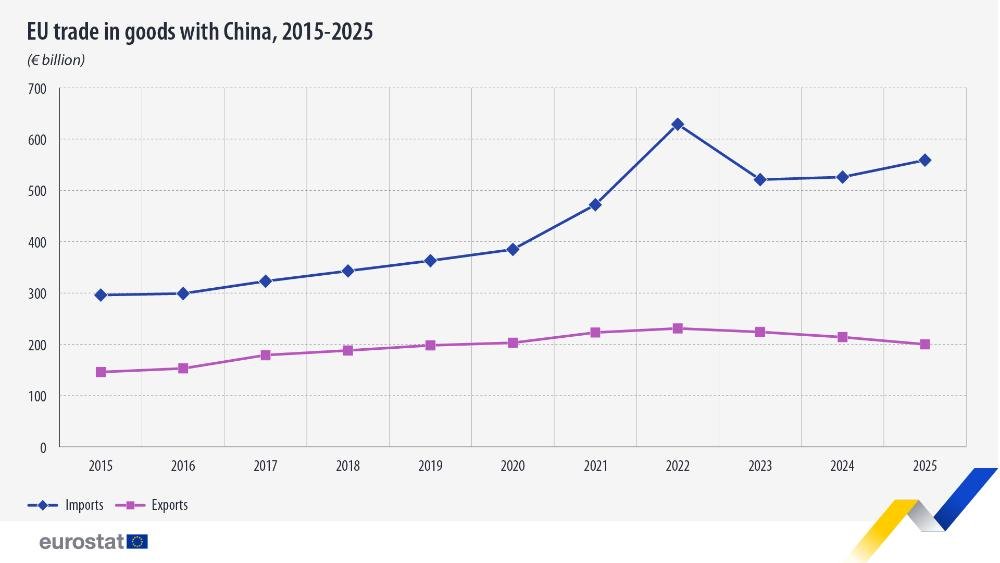
Almost one in two Germans currently views the United States more as an adversary than a partner, according to a survey by the polling institute YouGov commissioned by dpa. The aversion is even greater than towards China, despite the fact that Brussels and Berlin warn of security concerns in the reliance of Chinese technology.
Köhler also fears the trend will reinforce stereotypes. “It’s always the same eating and drinking rituals, the same cultural quirks that are shown,” he says. “There is a risk of what often happens on social media platforms like TikTok: a lifestyle trend spreads quickly and uncritically, only to disappear again after a few weeks.”

China, a country often slammed for its authoritarian government and human rights violations, has also found itself with a brand new soft power. Johannes Neudecker/dpa

Two people take photos of each other against the red wall of the Drum Tower, a popular attraction among tourists in Beijing. Johannes Neudecker/dpa

Pieces of fruit and Chinese dates float in a glass bowl filled with warm snow pear juice. A trend is doing the rounds on social media, encouraging people to act in a particularly Chinese way and imitate Chinese customs. Johannes Neudecker/dpa