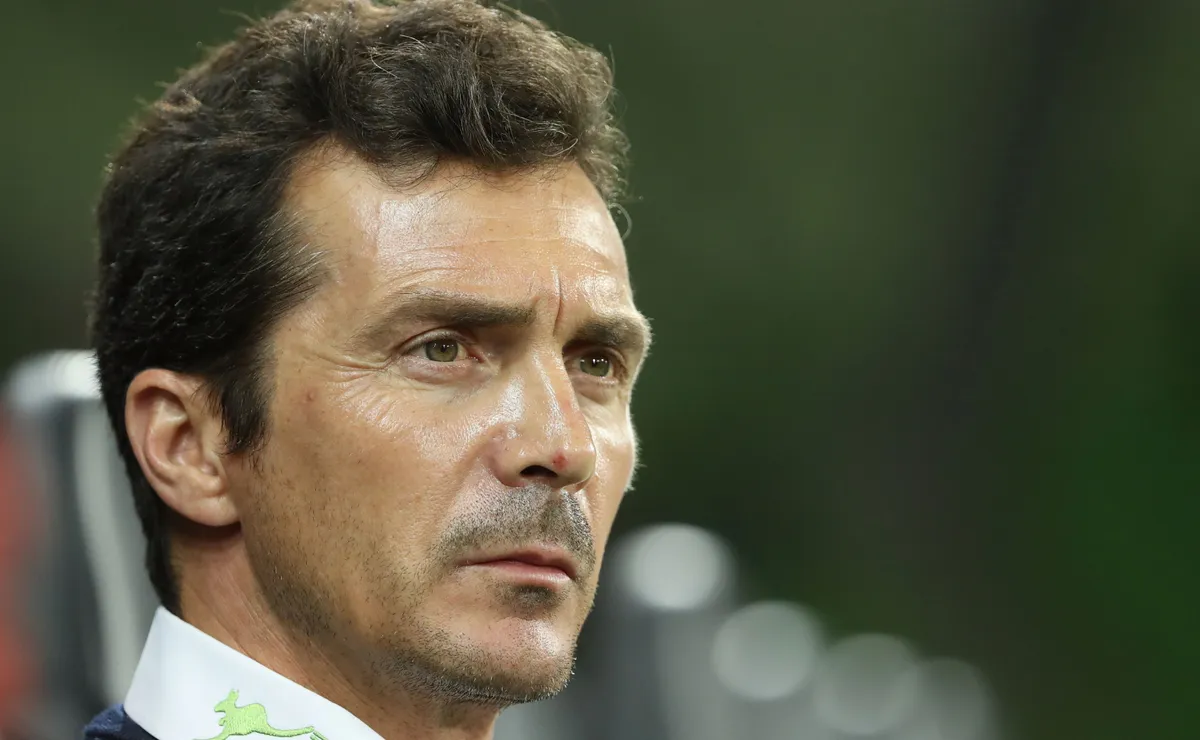
From Lionel Messi to Sergio Busquets, from Xavi Hernández to Lamine Yamal, from Andrés Iniesta to Gerard Piqué, Barcelona’s La Masia academy has produced a seemingly endless line of future Blaugrana stars. However, the very first player to go from developing in La Masia to thriving in Barcelona’s first team was none other than Guillermo Amor.
Born in Benidorm, Spain, Amor started playing football at an early age for a number of different teams in the Alicante province and, after impressing in a tournament against the likes of Barcelona, Valencia, and Hércules, he was invited to undergo a week-long trial at Barcelona. It didn’t take much for Barcelona to see that he could be a world-class player: at 12 years old, Amor left Alicante and made the move to the brand-new academy in January 1980. Six years after making his unofficial debut—replacing Diego Maradona in a friendly to celebrate the Miniestadi’s opening—Amor made his competitive debut against Catalan rivals Espanyol.
He quickly established himself as a vital cog under new manager Johan Cruyff, scoring 13 goals in 36 appearances across the 1988/89 season and helping the Blaugranas win the UEFA Cup Winners’ Cup. At the time, Real Madrid were the undisputed kings of Spain, winning five consecutive LaLiga titles between 1986 and 1990, but Amor would help turn the tide in Barcelona’s favor by scoring eight goals and an assist in 42 appearances in 1989/90—none more important than his opening goal in Barcelona’s 2-0 win against Real Madrid in the 1990 Copa del Rey Final. Cruyff, then on the hot seat, was given another season to showcase his managerial prowess, a decision that would quickly bear fruit.
“It was a very nice moment, partly because it was very close to my hometown of Benidorm. I was practically 140 kilometers away, so the whole family and a lot of friends came to see the final, and we really needed them to be there,” recalled Amor of his goal in an exclusive World Soccer Talk interview. “We were focused on the match, thinking that we absolutely had to win, that’s all that we had left, because we didn’t know what was going to happen afterwards. The feeling is so wonderful when it’s your turn on a day like that, being able to participate by scoring a goal, whilst Julio Salinas scored at the end of the match to secure the victory. For me, that was very important, not just as a local player, but a good player who loves his club, who had been waiting for those moments for many years, who had also faced Real Madrid in the youth categories, and who knew what these matches are like and what’s at stake. The truth is, it was a very special, very beautiful moment.”
With Amor orchestrating the show in midfield, Barcelona were able to claim four consecutive league titles from 1991 to 1994, whilst they were also able to claim their first-ever European Cup (now the UEFA Champions League) after beating Sampdoria in the 1992 final, in addition to reaching the 1994 final. But after missing out on three trophies in the span of 10 days, Cruyff was sacked in 1996. However, Amor would nevertheless prove essential by guiding them to the Copa del Rey, Supercopa de España, and UEFA Cup Winners’ Cup in 1996/97 under Bobby Robson. The 1997/98 season, meanwhile, would see Amor help Barcelona win the LaLiga title and Copa del Rey under Louis van Gaal, and it also saw him compete in the biggest tournament in the world. Having excelled in Spain’s Euro ’96 run, Amor would play in all three of Spain’s matches in the 1998 FIFA World Cup. Little did he know it, but it would be his final tournament as a Spain player, as well as his final international tournament as a Barcelona player.
“The Spain national team manager Javier Clemente tried to put together a team of good people who were very compatible with him, but when you have so many players from different teams, forming a team is difficult. It used to be even more difficult, because there weren’t as many matches. Now, national teams play many matches throughout the year, there are friendlies, tournaments, and championships, but in our time, we didn’t play so many matches. Clemente trusted a group of players, many from Barcelona and Real Madrid, and I was fortunate that he trusted me enough to be in the 1996 Euros in England and the 1998 World Cup in France. Those are two unforgettable moments for me because of what they mean for any player’s career, and it coincides with my departure because my Barcelona contract was ending, and I had to start a new chapter in a different city, a different country, and a different championship.”
After nearly 20 years with Barcelona, Amor made the move to Serie A outfit Fiorentina, where he spent two seasons, before returning to Spain and helping newly promoted Villarreal establish their place in LaLiga. Amor then made the move to Scottish side Livingston, where he made three appearances and helped them avoid relegation, before retiring at the age of 35. The Spaniard quickly transitioned into a backroom role with FC Barcelona, overseeing the club’s youth categories as the Head of Youth Football from 2003 to 2007. He returned three years later and worked as the club’s Technical Director of Football Training between 2010 and 2014, before starting a new journey in Australia as Adelaide United FC’s Technical Director and later the club’s head coach.
Similarly to how figures like Stevie Grieve are looking to spearhead the return of clubs like Helsingborgs to their respective top flights, Amor led Adelaide to their first and only A-League Championship before returning to his boyhood club in 2017 and overseeing Barça B and the U19A and B sides before being shifted into the role of Head of Institutional and Sports Relations for the first team from 2017 to 2021. At 58 years of age, Amor spends his time in Barcelona, working with his oldest son (a licensed FIFA agent) in his consulting and player representation business. But every now and then, he’ll head back to his native Alicante and watch the matches of Club de Fútbol Benidorm, a club whose stadium (Estadio Municipal Guillermo Amor) bears his name.
“It’s very special, but even more so having it in the town where I was born, and where I left at a very young age. That field is where I also started playing, in the schoolyard where I studied, and it was on that field where we had the Easter Children’s Tournament, which is where Barcelona saw me for the first time. That’s where I played against Barcelona and earned the invitation to FC Barcelona, so whenever I go to Benidorm, I always visit that field, and if I get a chance, I’ll go and watch a match there. There are a lot of matches that are played there, from the Spanish national youth teams like the under-17s and the under-18s to CF Benidorm, which is also working hard to see if they can get promoted, and I’m always keeping a close eye on that too. But this recognition is an honor, whether it’s in your town or city, it’s an honor that someone remembers you and puts something in your name… it’s beautiful. And if you can experience it while you’re still alive, even better. The bad thing is when they show you something you’re no longer around for, but if you have the chance to experience something while you’re still enjoying it, then all the better.”