Global stock discounts vs US stock discounts

Unlock the Editor’s Digest for free

This article is an on-site version of our Unhedged newsletter. Premium subscribers can sign up here to get the newsletter delivered every weekday. Standard subscribers can upgrade to Premium here, or explore all FT newsletters

Good morning. In a move that could have been designed to reignite fears about AI and employment, the payments processing company Block announced yesterday that it was planning to let more than 40 per cent of its staff go, citing improved productivity from using AI tools. The stock rose 20 per cent after hours. Whatever you think about the long-term impact of AI on the economy, it’s clear that information-processing industries are changing. Email us: unhedged@ft.com.

Valuations

Crikey, look at Korea’s stock market: 

The Kospi is up 50 per cent in two months and 150 per cent in the past year. I can’t think of another major stock market that had ever risen that fast. And before this glorious summer, the winter was long: Jim Reid of Deutsche Bank notes that in inflation-adjusted terms the Kospi returned to its 1989 high only last September. The run is backed by good economic growth, corporate governance reform and overwhelming exposure to the semiconductor industry — Samsung and SK Hynix account for half the market (Unhedged discussed all three factors back in November).

Inevitably, the index has become much more expensive. Its forward price/earnings ratio has risen from nine to 17 in a year. Reid runs a model portfolio which leans into inexpensive indices, relative to the global average, and leans away from expensive ones. The Kospi has now moved from the cheap to the expensive group. “Over the long run, valuation wins out handsomely, so this shift is worth bearing in mind,” he writes. Unhedged agrees, and the comment got us thinking. We have written a lot about global stocks’ valuation discount to US stocks. After a good period of relative performance for global stocks, how are the discounts holding up? Well:

Line chart of % discount* to the S&P 500 showing Cheaper

Emerging market stocks have given up much of their valuation edge, but the discounts for Europe (Stoxx 600) the UK (FTSE 100) and Japan (Topix) have remained wide and fairly stable, while the emerging market discount has tightened some. This looks like a rebalancing opportunity for long-term investors — particularly those who believe the rotation away from tech and towards “old” industries, driven by AI, is for real. The S&P 500 is still a third tech. The Stoxx 600, for example, is 7 per cent tech, and its biggest sectors are industrials and healthcare. As my colleague Leo Lewis recently pointed out, Japan is crammed with AI-resilient stocks, too. 

But there is another, perhaps more attractive way to rebalance towards cheap stuff: US small and mid-caps. Here are their discounts: 

Line chart of % discount* to the S&P 500 showing Still on sale

Small and mid-cap US stocks may be at a smaller discount to big US stocks than the global indices in absolute terms — 20 per cent or so versus 30 per cent or so. But in historical terms, as the chart above shows, they are cheaper. Small and mid caps traded at part or even a premium to big caps before tech shares went bananas post-Covid. That is never true of the global indices. And the smalls and mids have the AI-resilient characteristics; the mid-cap index is a quarter industrials. Unhedged still likes this stuff. 

10-year Treasuries: sniffing out risk?  

There has been a pretty sharp move down in the 10-year Treasury yield this month: 

Line chart of Ten-year Treasury yield showing Are you trying to tell me something?

This is not just down to lower inflation expectations. Of the 25 basis points in yield reduction, 15 basis points come from real yields (as proxied by inflation-indexed Treasuries). At the same time, the yield curve has flattened meaningfully — the yield difference between the 10-year and the two-year Treasury has tightened by 14 basis points. 

What’s the message here?

Calvin Tse of BNP Paribas thinks Treasuries are picking up a geopolitical risk premium, driven by fears about a conflict in the Middle East. Brent crude has risen from $61 to $71 this year, and that explains the flattening of the curve: worries about higher inflation keep the short end anchored, while the threat to growth from a supply-driven rise in the oil price pushes the long end higher. 

Longtime readers will know that this column tends to be dismissive of Donald Trump’s threats. The market usually is, too. But Tse thinks that after the president’s successful adventure in Venezuela, the market is pricing in a possibility the build-up of US forces in striking distance of Iran is more than just theatre.

Tse adds that option skew — the relative pricing of put and call options on long Treasuries — is reflecting some risk aversion, too. It’s usually cheaper to buy calls on long Treasuries than puts, but recently the price has equalised, as it tends to do at moments of fear and turmoil. 

Ed Al-Hussainy, the longtime rates svengali for this newsletter, cautions against reading too much into the move. But he notes that it might reflect the shift away from tech stocks and towards “value” sectors. “From a portfolio perspective, when you switch from growth to value equities, you shorten the duration [interest rate sensitivity] of your portfolio,” so it makes sense to add some duration back by buying long-dated Treasuries. 

As we like to do in confusing market moments, we’ll be keeping our eyes out for further developments in the Treasury market. 

One good read

Brr.

FT Unhedged podcast

Can’t get enough of Unhedged? Listen to our new podcast, for a 15-minute dive into the latest markets news and financial headlines, twice a week. Catch up on past editions of the newsletter here.

Recommended newsletters for you

Due Diligence — Top stories from the world of corporate finance. Sign up here

The AI Shift — John Burn-Murdoch and Sarah O’Connor dive into how AI is transforming the world of work. Sign up here

Source link

Visited 1 times, 1 visit(s) today

Related Article

Hong Kong Stock Market Midday Review

Junda Co., Ltd. (02865) surged over 21%, with institutions optimistic about the growth potential driven by space-based solar power. According to Zhitong Finance, the Hang Seng Index rose by 0.75%, up 197 points, to close at 26,578 points, while the Hang Seng Tech Index increased by 1.03%. The morning trading volume of Hong Kong stocks

Wall Street Says the Stock Market’s Return in 2026 Will Crush the 30-Year Average

Wall Street says the S&P 500 will return about 12% in 2026, easily outpacing the 30-year average of 8.1% About 5,500 companies were listed across U.S. stock exchanges last year, according to the Securities Industry and Financial Markets Association (SIFMA). Many of those companies are included in stock indexes, which measure various aspects of the

Volatus Aerospace Receives Conditional Approval to Graduate to the Toronto Stock Exchange

Volatus Aerospace Inc. MONTREAL, Feb. 26, 2026 (GLOBE NEWSWIRE) — Volatus Aerospace Inc. (TSXV: FLT) (OTCQB: TAKOF) (FSE: ABB.F) (“Volatus” or the “Company”), a Canadian aerospace and defence company delivering crewed and uncrewed aerial systems, manufacturing, and mission-critical operational services, today announced that the Toronto Stock Exchange (“TSX”) has conditionally approved the listing of the

2 Stock-Split Stocks to Buy and Hold for the Next 10 Years

There is way more to these market leaders than their recent (or upcoming) stock splits. Stock splits happen pretty regularly, but most are conducted by companies with relatively little name recognition. Such moves tend to attract wider attention only when larger, well-established corporations perform them. And two of the most prominent stock splits in recent

Stock Investors Are Hedging a Drop. Strategists See a Buy Signal

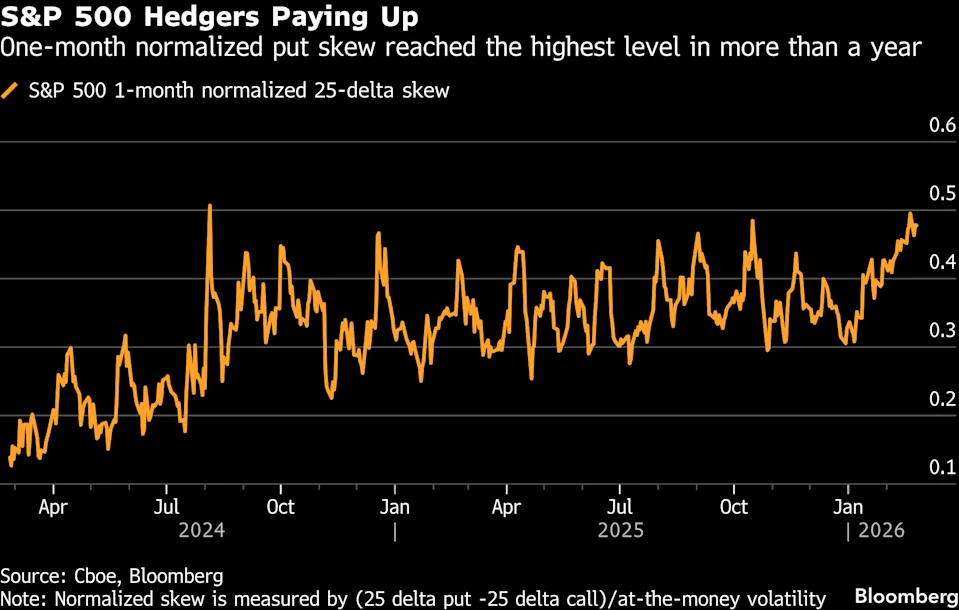
(Bloomberg) — The S&P 500 has been stuck in a range for the better part of four months, and investors are paying up to protect against the possibility that the next big move is down. To a growing number of strategists, that pessimism is cause to expect the opposite. The change in mood among investors,

2 Stocks Down 74% and 40% To Buy Now

Investors came into 2026 worried about an AI bubble. Indeed, a bubble is bursting, but it’s not in AI stocks. Instead, software stocks have dived this year with the iShares Expanded Tech-Software Sector ETF (NYSEMKT: IGV), which counts Microsoft, Palantir, and Salesforce among its biggest holdings, down 24% year-to-date through Feb. 25 as fears of

US should not be the default IPO choice

Unlock the Editor’s Digest for free Roula Khalaf, Editor of the FT, selects her favourite stories in this weekly newsletter. The writer is chief executive of European exchange operator Six Group For the past two decades or more, the logic for ambitious technology companies considering an initial public offering appeared quite straightforward. If scale, liquidity

Jim Cramer drops unexpected take on stock market

Jim Cramer isn’t buying into the AI doomsday scenario. At a point when Mr. Market had gotten rattled by a viral memo from Citrini Research’s Alap Shah, Cramer pushed back, calling it essentially a work of “science fiction” rather than sober forecasting. The fallout from the report was immediate. On Monday, Feb. 23, the Dow

Why Cava Stock Surged Today

The pita purveyor is winning market share. Shares of Cava Group (CAVA +25.91%) climbed on Wednesday after the Mediterranean-style restaurant chain showed progress on its expansion initiatives. By the close of trading, Cava’s stock price was up over 26%. Image source: Getty Images. Cava’s concept is resonating with diners Cava’s revenue rose 21.2% year over

Stock Market Today, Feb. 25: Netflix Jumps After Warner Bros. Bid Fuels Investor Optimism

On Feb. 25, 2026, streaming’s standout dealmaker faces a high-stakes Warner Bros. bidding war and rising antitrust scrutiny. Today’s Change (5.99%) $4.67 Current Price $82.72 Key Data Points Market Cap $329B Day’s Range $79.35 – $83.11 52wk Range $75.01 – $134.12 Volume 3.4M Avg Vol 46M Gross Margin 48.59% Netflix (NFLX +5.99%), a provider of

Wall Street Is Divided on This AI Stock. Here’s Why I’m Bullish.

This company’s growth opportunity could be huge. Palantir Technologies (PLTR +4.11%) posted another blockbuster earnings report in early February. Its fourth-quarter revenue surged 70% year over year, accelerating from the 63% growth in the previous quarter. The main dilemma for investors considering the stock is valuation. It’s expensive, trading at a forward price-to-sales ratio (P/S)

The Best Dividend Stocks to Buy Right Now

Where to invest $1,000 right now? Our analyst team just revealed what they believe are the 10 best stocks to buy right now, when you join Stock Advisor. See the stocks » With the S&P 500 (SNPINDEX: ^GSPC) down just 1% from its all-time high, the stock market isn’t remotely in crash mode. But cracks are

Stock Market Concentration Has Surpassed Its 1930s Peak. Should Investors Worry?

I recently gave a presentation to some new colleagues from the Center for Research in Security Prices, an affiliate of the University of Chicago acquired by Morningstar. One of my slides highlighted the top-heavy nature of today’s US stock market. A graph showed that the top 10 stocks represent a bigger chunk of the market

Strong Earnings Not Enough to Power Stocks Past AI, Credit Worry

(Bloomberg) — Corporate America just delivered one of the strongest earnings seasons in recent memory, but you wouldn’t know it looking at the stock market. Companies in the S&P 500 grew earnings by 13% in the fourth quarter, almost six percentage points better than expected. They also served up optimism about the coming year. The

Is Taiwan Semiconductor Stock a Buy Now?

Despite an exceptionally strong 2025 performance, Taiwan Semiconductor still has plenty of room to run this year and beyond. Taiwan Semiconductor (TSM +4.24%) is a core player in the global AI boom. It’s also the world’s largest dedicated chip manufacturer, with approximately 70% market share. The semiconductor foundry has benefited immensely from AI-related demand and

Hong Kong Stock Market Midday Review

According to Zhitong Finance, the Hang Seng Index rose by 2.29%, gaining 604 points to close at 27,017 points; the Hang Seng Tech Index increased by 3.32. The morning trading volume of Hong Kong stocks reached HKD 106.5 billion. Optical communication concept stocks are among the top gainers. Key enterprises in Optics Valley will continue

0
Would love your thoughts, please comment.x
()
x