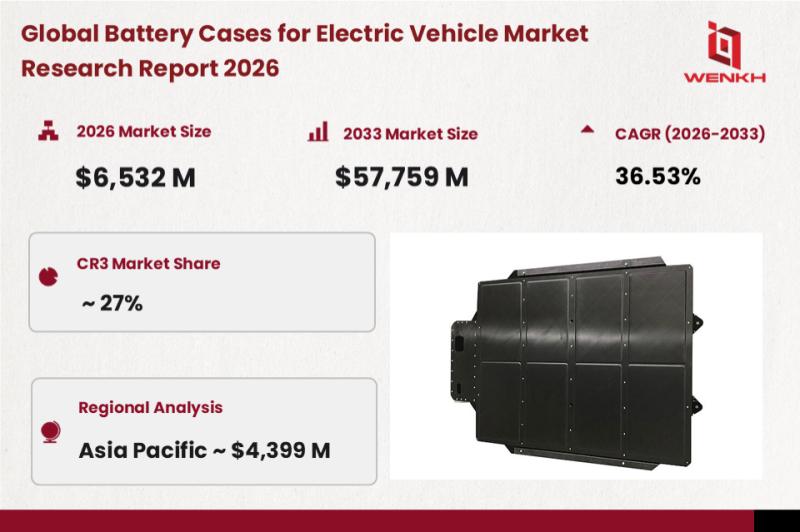
Battery cases for electric vehicles are structural components designed to encase and protect power battery packs, typically made from aluminum alloys, high-strength steel, magnesium alloys, or composite materials, offering high strength, corrosion resistance, effective heat dissipation, and sealing performance. These cases provide mechanical support and protection against impacts, vibrations, moisture, and dust, while integrating thermal management systems, wiring interfaces, and safety devices to ensure stable temperature control and electrical safety during charging and discharging. The design of EV battery cases must balance lightweight construction, mechanical strength, airtightness, and serviceability to enhance driving range, crash safety, and overall energy efficiency, making them essential for battery electric vehicles, plug-in hybrid vehicles, and energy storage systems.
Battery Cases for Electric Vehicle Market Overview
According to WENKH research statistics, the Battery Cases for Electric Vehicle market size is set to climb from $6,532 million in 2026 to $57,759 million by 2033, achieving a compound annual growth rate (CAGR) of around 36.53%. Driven primarily by the ongoing global push for electric vehicle (EV) adoption, the pace of vehicle market penetration continues to accelerate. As the demand for powertrain batteries in EVs rises, so does the need for battery cases, which serve as critical protective and structural components for the power batteries. This heightened demand for battery enclosures is expected to drive the market’s long-term positive growth trajectory, supporting the expansion of the global electric vehicle battery case market. The integration of advanced materials and technologies to enhance battery safety and performance further contributes to the market’s dynamic growth.
Battery Cases for Electric Vehicle Competitive Landscape
According to WENKH’s in-depth research, key market players of Battery Cases for Electric Vehicle include Ling Yun Industrial Corp Ltd, Novelis, Guangdong Hoshion Alumini, Nemak, SGL Carbon, HUAYU Automotive Systems Co Ltd, Ningbo Xusheng Auto Tech, Constellium, Gestamp, Minth Group Ltd., Hitachi Metals Ltd., Benteler International, Shenzhen Everwin Precision Technology, Suzhou Jinhongshun Auto Parts., Huada Automotive Tech Co, Tianjinruixin Technology, Nantong Chaoda Equipment, Guangdong Hongtu, etc.
The top three manufacturers account for approximately 27% of the market share.
Tier 1 players, led by Ling Yun Industrial Corp Ltd, Novelis, and Guangdong Hoshion Aluminium, dominate the market with their strong manufacturing capabilities, advanced technologies, and extensive customer networks. These companies are heavily involved in high-volume production and supply to major automakers, providing cutting-edge solutions in battery case design and materials.
Tier 2 enterprises, such as Nemak, SGL Carbon, and Constellium, contribute to the market with specialized offerings and a focus on innovation. While they do not have the same scale as Tier 1 players, they serve key niches within the EV industry, providing important components for battery case manufacturing.
Tier 3 consists of smaller players like Tianjinruixin Technology and Guangdong Hongtu, which focus on local and regional markets, offering cost-effective solutions with a limited but growing presence in the industry.
Battery Cases for Electric Vehicle Regional Analysis
According to WENKH research statistics, Asia Pacific remains the largest market globally, in 2026, Asia Pacific market size is estimated at $4,399 million, accounting for approximately 67.34% of the global share.
Asia Pacific holds a dominant position in the global market, supported by a well-established battery and vehicle manufacturing supply chain. Companies in this region benefit from cost control and large-scale manufacturing advantages, with leading manufacturers implementing global production capacity layouts. The region is bolstered by strong local demand for new energy vehicles, a solid industrial foundation, and rapid technological advancements. Market leadership remains secure, with companies in the region deeply integrated with major battery manufacturers and automakers. Additionally, these companies are actively expanding into overseas markets, establishing a comprehensive network for R&D, production, and supply. This enables them to quickly respond to customized demands from various clients, securing significant market share in the supply of battery cases for mid-to-high-end vehicle models.
Battery Cases for Electric Vehicle Market Segmentation by Type
According to WENKH research statistics, Battery Cases for Electric Vehicle is mainly subdivided into Aluminum Case, Steel Case, and Composite Case.
Aluminum battery cases currently dominate the market and are widely used in mainstream electric vehicle models. These products are compatible with a variety of power battery technologies, and their manufacturing processes are mature and stable. The global supply chain includes major automakers and battery manufacturers, offering a wide range of products with different specifications and structures to meet the diverse needs of both entry-level and high-end vehicles. This segment continues to penetrate the market and holds a dominant position.
Composite battery cases are experiencing the fastest growth. These products leverage the advantages of lightweight materials to meet the increasing demand for longer driving ranges in electric vehicles. Leading companies are continuously advancing technology iterations and scaling up production, with some high-end models already adopting composite cases on a large scale. The supply capacity is gradually being released, and the application scenarios are expanding, making this the most rapidly growing segment in the market.
Battery Cases for Electric Vehicle Market Segmentation by Application
According to WENKH research statistics, Battery Cases for Electric Vehicle is applied to Passenger Car and Commercial Vehicle.
Passenger cars represent the largest downstream market for electric vehicle battery cases, with rapid progress in the electrification of these vehicles. This segment covers all price ranges from entry-level to high-end models, creating diverse demands for battery case compatibility. The supply chain is well-established, with solutions available for various vehicle technologies, supporting the stable expansion of the overall market.
The commercial vehicle sector is the fastest-growing downstream market for electric vehicle battery cases. The pace of electrification is accelerating, especially in logistics and public transportation, with increasing penetration of new energy vehicles. These vehicles require battery cases with higher strength and longer lifespan. The development and deployment of specialized products are advancing rapidly, and the expanding range of applications is driving significant growth in this specific market segment.
The above data is from the market analysis report “Global Battery Cases for Electric Vehicle Market Size, Competition Landscape and Supply Chain Research Report 2026” ( )
Wenkh Research Inc.
Address: 1 Market Street, 19th Floor, San Francisco, CA 94105, United States
E-mail: market@wenkh.com
Website: https://www.wenkhresearch.com/
WENKH is a global leading consulting brand for industry segments. We provide segmented market research reports, custom research, white papers and feasibility reports for all industries, focusing on market status and forecasts, competition analysis, market prospects analysis and market positioning. WENKH uses professional data and deep insights to help companies make decisions and promote win-win cooperation.
This release was published on openPR.