Fragmented Markets Signal Bet Against “Forever War” Scenario

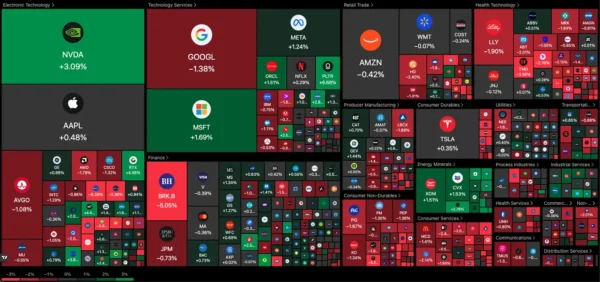
The global market reaction to the escalating conflict in the Middle East remains remarkably fragmented. U.S. equities successfully staged a “buy-the-dip” recovery overnight after an initial selloff. Both S&P 500 and NASDAQ closed with modest gains. In contrast, Asian markets told a darker story. South Korea’s Kospi tumbled nearly -5% as it caught up with the weekend’s escalations, while Japan’s Nikkei 225 shed over -2%. Meanwhile, Hong Kong and China are relatively steady.

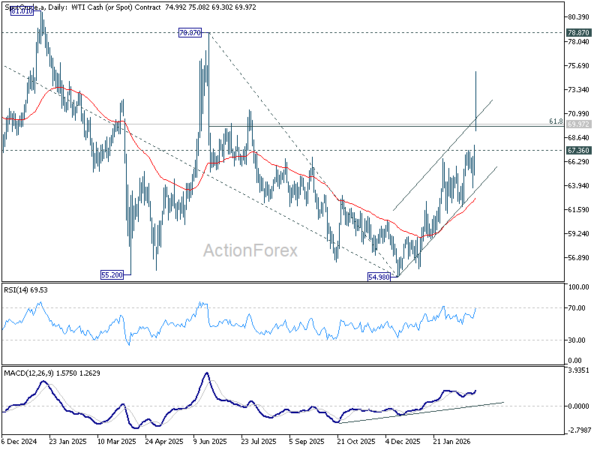
The “fear premium” in commodities is showing some signs of exhaustion. Gold briefly breached 5,400 mark but has since lost momentum, with upside resistance capped well below 5,600 record high. Similarly, WTI Crude Oil is gyrating in a tight range (71–73) below yesterday’s spike high, as traders weigh the potential for a Strait of Hormuz closure against current supply buffers and OPEC+ capacity.

Market pricing so far implies investors are leaning toward limited conflict scenario. Three broad paths are being weighed.

  • Surgical (1–3 Weeks): A “best-case” scenario — lasting one to three weeks — would involve collapse of Iranian command structure or rapid ceasefire under interim leadership.
  • Regime Transition (Up to 2 Months): A prolonged neutralization of “pockets of resistance” and dismantling of nuclear/missile infrastructure. This would sustain volatility but avoid systemic collapse.
  • Forever War (1+ Years): Most destabilizing is a descent into a multi-sided civil war, shifting from high-intensity air strikes to long-term regional instability, which would materially alter risk premia across energy, currencies and sovereign markets.

Current cross-asset behavior suggests markets are assigning low probability to “Forever War” scenario. Equity resilience and contained oil pricing indicate belief that escalation will be bounded rather than indefinite.

Central banks are also already evaluating implications. ECB Chief Economist Philip Lane warned today that prolonged conflict could both spike inflation and depress Eurozone output — a classic stagflation risk. Though, he signaled little appetite for tolerating higher inflation under such uncertainty. In Australia, RBA Governor Michele Bullock echoed inflation concerns, explicitly keeping rate hike on table this month due to oil shock risk.

In currency markets, Dollar remains undisputed safe-haven leader this week. Canadian Dollar follows, buoyed by oil support. Aussie ranks third after hawkish RBA rhetoric. Swiss Franc is weakest after intervention warnings from SNB Euro underperforms as traders front-run Europe’s structural exposure, while Kiwi lags and Sterling and Yen hold middle ground.

In Asia, at the time of writing, Nikkei is down -3.18%. Hong Kong HSI is down -1.00%. China Shanghai SSE is down -1.06%. Singapore Strait Times is up 0.86%. Japan 10-year JGB yield is up 0.061 at 2.125. Overnight, DOW fell -0.15%. S&P 500 rose 0.04%. NASDAQ rose 0.36%. 10-year yield jumped 0.086 to 4.048.

RBA’s Bullock reopens door to March hike as oil risks mount

RBA Governor Michele Bullock delivered a distinctly hawkish message at the AFR Business Summit today, warning markets not to assume a March rate hold is a done deal. She stressed that the upcoming meeting is “live,” pushing back against expectations that policy decisions are effectively pre-set or limited to quarterly moves.

Bullock highlighted that inflation remains elevated at 3.8% while unemployment at 4.1% still reflects tight labor market conditions. The Board, she said, will be “actively looking” at whether it needs to “move more quickly”, explicitly discouraging the view that the RBA only adjusts rates at predictable intervals.

Central to her remarks was the risk of a prolonged oil price spike stemming from escalating Middle East tensions. While she emphasized that it is too early to quantify the impact, Bullock warned that a supply-driven shock could add to inflation pressures and, critically, influence inflation expectations — a development the RBA is “very alert to.”

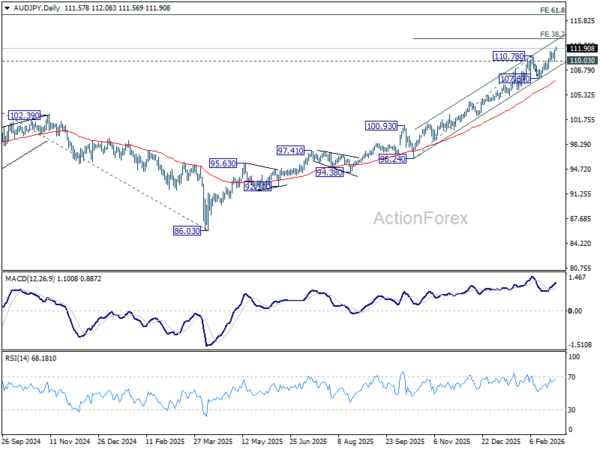
AUD/JPY breaks high after hawkish RBA shift, 113.22 next

Australian Dollar rallied broadly after RBA Governor Michele Bullock delivered hawkish remarks that reintroduced a genuine possibility of a rate hike at the March meeting. By describing the decision as “live” and warning against assuming a hold, Bullock unsettled prior market consensus and injected fresh upside risk into rate expectations. The shift immediately translated into stronger AUD performance across the board.

AUD/JPY led the advance, extending its uptrend and breached 112 level. The move reflects not only renewed tightening speculation from the RBA, but also relatively softer Yen dynamics amid delayed tightening expectations from Tokyo.

Technically, as long as 110.03 support holds, near-term bias remains firmly to the upside. The next target lies at 38.2% projection of 96.24 to 107.67 from 110.78 at 113.22, which aligns closely with the upper boundary of the near term rising channel. That area could present initial resistance and cap gains on first test, particularly if momentum indicators begin to stretch.
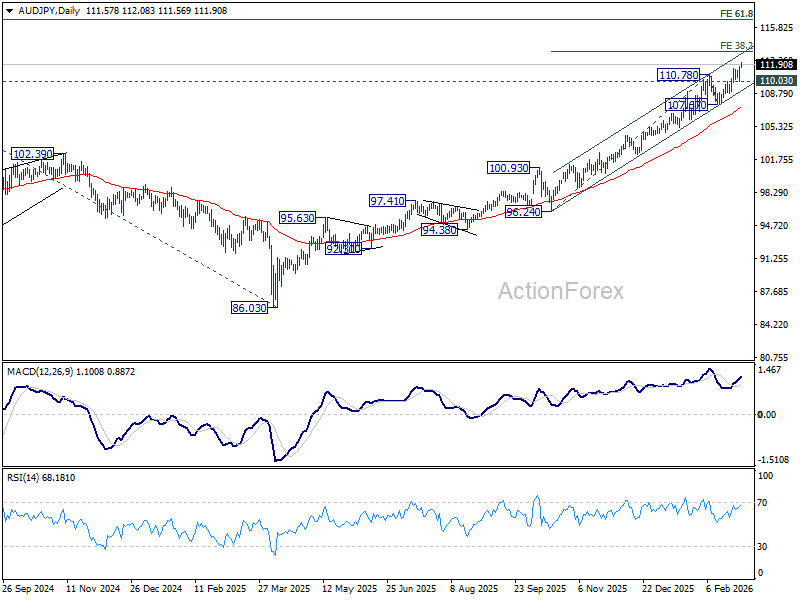
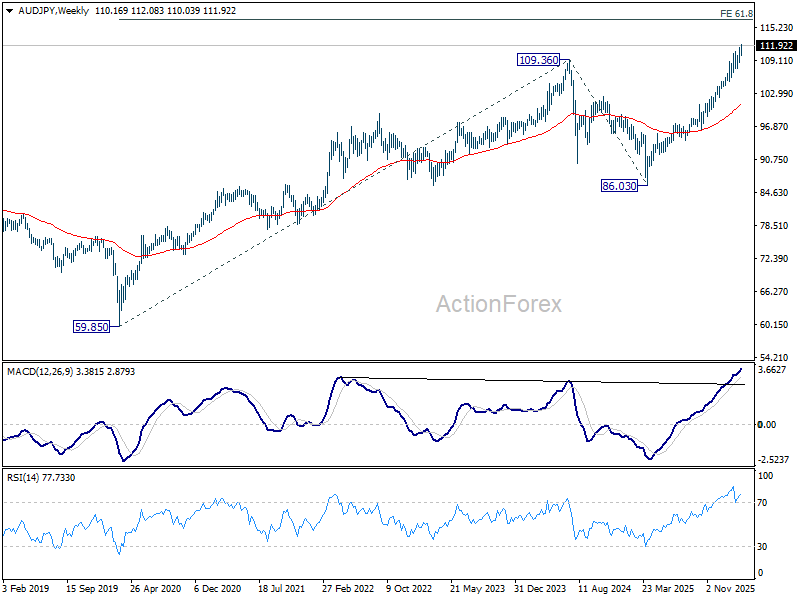
However, decisive break above 113.22 would open the path toward 61.8% projection at 116.65 before topping around there. That level represents a much more formidable barrier, coinciding almost precisely with the long-term fibonacci level, 61.8% projection of 59.85 (2020 low) to 109.36 (2024 high) from 86.03 (2025 low) at 116.62.
Euro under siege as Middle East war exposes fragility, EUR/CAD to dive to 1.57

While the military theater of the US-Israel-Iran conflict is centered in the Persian Gulf, its economic epicenter is arguably the Eurozone. The sharp decline in Euro this week is not merely a broad flight into Dollar safety. It reflects targeted repricing of Europe’s structural vulnerabilities at a moment of acute energy risk. Euro has emerged as primary casualty among major currencies, underperforming nearly all peers except Swiss Franc, which relative weakness is largely policy-driven following intervention warning from the SNB

The Energy Storage “Time Bomb”

The timing could hardly be worse. The EU enters March refill season with gas storage around 30%, significantly below roughly 40% seen in 2025 and 60% in 2024. That cushion has evaporated just as maritime energy routes face disruption risk.

With Strait of Hormuz under threat and major shippers such as Maersk and Hapag-Lloyd bypassing Suez Canal, replenishing inventories will come at steep premium. This looming import bill shock acts as direct devaluation pressure on Euro through deteriorating trade balance.

The Stability Proxy

Besides, Euro is treated as a proxy for Eurasian stability. Tehran’s declaration of “Total War” elevates non-financial risks that disproportionately affect Europe. The region’s economic architecture is deeply intertwined with Middle East energy and Asian trade corridors.

Closure or prolonged disruption of Suez Canal forces rerouting around Cape of Good Hope, effectively taxing every Euro-denominated export. Longer shipping times translate into higher freight costs, inventory bottlenecks and margin compression for European manufacturers.

At the sovereign level, rising energy costs and regional instability could renew fiscal strain. Migration pressures and potential need for renewed energy subsidies risk widening deficits.

Monetary Policy “Trapping”

The ECB now finds itself edging toward stagflationary dilemma. Surging natural gas prices are inflationary, yet function as regressive tax on consumers and businesses. Growth erosion could force policymakers to prioritize stability over price control. Markets might start to price in scenario where the ECB is compelled to shift its stance, and even pivoting toward easing again even as inflation risks jump.

The Failure of the 1.2000

Failure to break 1.2000 in EUR/USD now looks pivotal. Throughout 2025, Euro rallied from 1.03 toward 1.20 on hopes of industrial revival. That psychological ceiling proved insurmountable. The weekend escalation is starting to trigger capitulation among long-position holders. What had been narrative of recovery is morphing into unwind of crowded positioning.

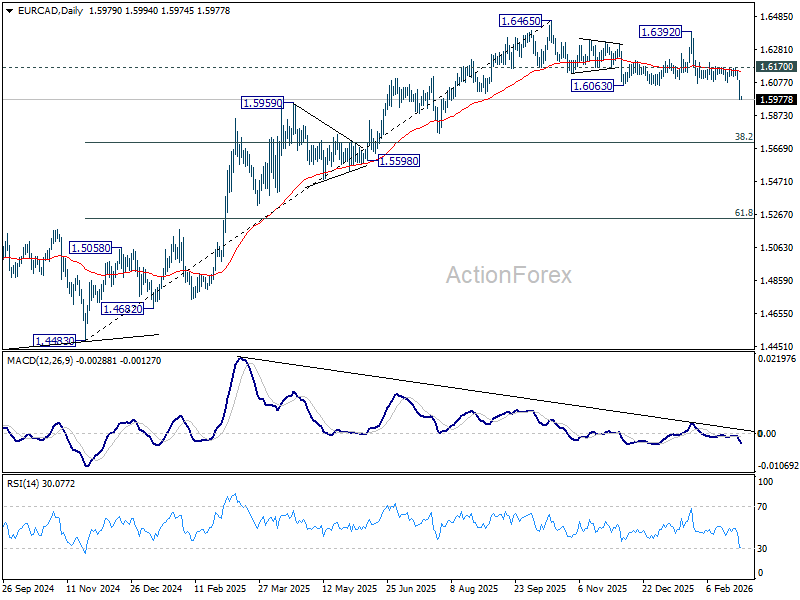
EUR/CAD to target 1.57

EUR/CAD is among the bigger movers this week, with Loonie being lifted by surging oil prices. Technically, fall from 1.6465 medium term top resumed by powering through 1.6063 support. Near term outlook will stay bearish as long as 1.6170 resistance holds.

For now, the fall from 1.6465 is seen as a correction to the five-wave rally from 1.4483. Deeper decline should be seen to 38.2% retracement of 1.4483 to 1.6465 at 1.5708. But strong support should be seen there to contain downside to bring rebound.

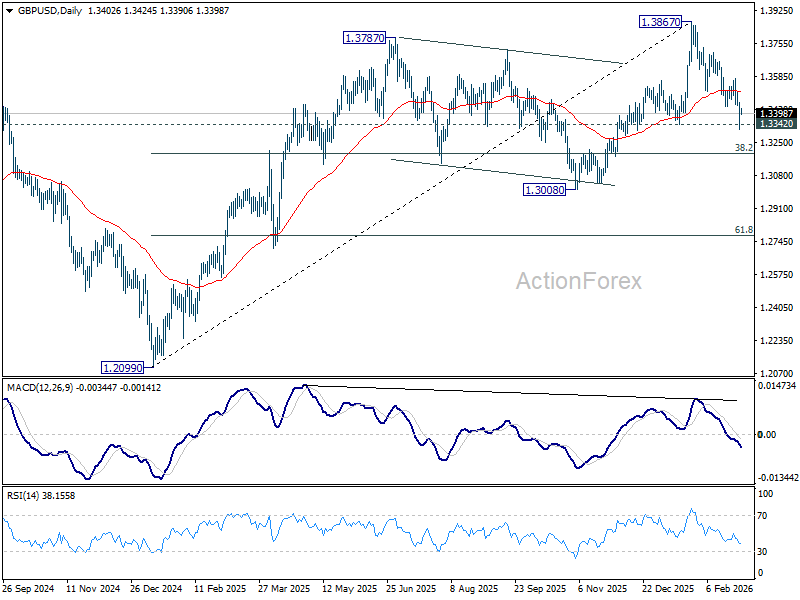
GBP/USD Daily Outlook

Daily Pivots: (S1) 1.3329; (P) 1.3393; (R1) 1.3470; More…

Intraday bias in GBP/USD stays on the downside as fall from 1.3867 is still in progress. Decisive break of 1.3342 structural support will argue that it’s already correcting the whole rise from 1.2099. In this case, deeper fall should be seen to 1.3008 support next. For now, risk will stay on the downside as long as 1.3574 resistance holds, in case of recovery.
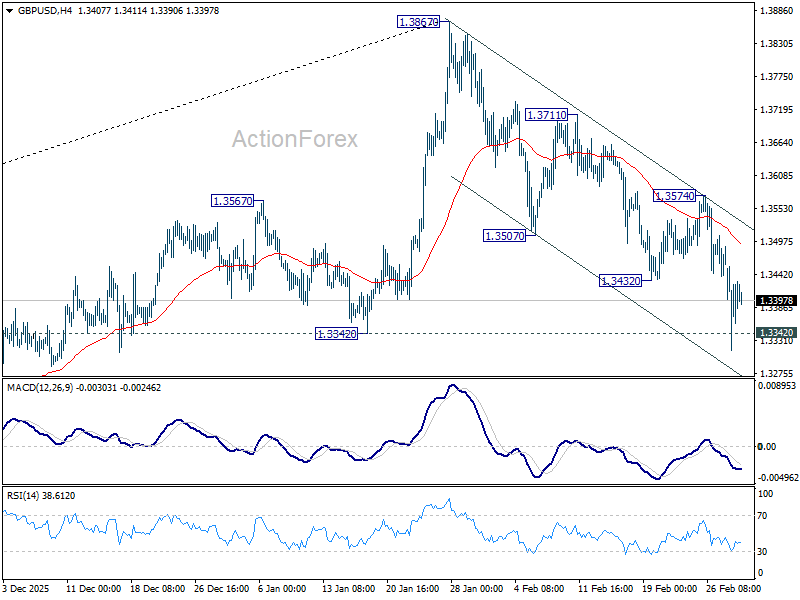
In the bigger picture, as long as 1.3008 support holds, rise from 1.3051 (2022 low) should still be in progress for 1.4284 key resistance (2021 high). Decisive break there will add to the case of long term bullish trend reversal. However, firm break of 1.3008 will raise the chance of medium term bearish reversal and target 1.2099 support next.
Economic Indicators Update

GMT CCY EVENTS Act Cons Prev Rev
21:45 NZD Building Permits Jan 1.90% -4.60% -4.50%
23:30 JPY Unemployment Rate Jan 2.70% 2.60% 2.60%
23:50 JPY Capital Spending Q4 6.50% 3.00% 2.90%
23:50 JPY Monetary Base Y/Y Feb -10.60% -10.20% -9.50%
00:01 GBP BRC Shop Price Index Y/Y Feb 1.10% 1.20% 1.50%
00:30 AUD Current Account (AUD) Q4 -21.1B -16.3B -16.6B -18.3B
00:30 AUD Building Permits M/M Jan -7.20% 5.60% -14.90%
10:00 EUR Eurozone CPI Y/Y Feb P 1.70% 1.70%
10:00 EUR Eurozone Core CPI Y/Y Feb P 2.20% 2.20%


Source link

Visited 1 times, 1 visit(s) today

Related Article

The currency market is pricing in a supply-side inflation shock

Global currencies swung widely on Tuesday as foreign exchange traders priced in the effects of an increasingly broad supply-side inflationary shock resulting from the Iran war. The US dollar index (DX-Y.NYB) jumped more than 1% in early trading, while the euro fell nearly 1% against the greenback and sterling slid about 0.8%. The dollar also

Marex reports solid Q4 2025 financial performance metrics

Marex reports solid Q4 2025 financial performance metrics

Diversified global financial services platform Marex Group plc (NASDAQ:MRX) today reported the Group’s preliminary unaudited financial results for the fourth quarter of 2025 (Q4 2025). Revenue increased by $156.5 million to $572.1 million (Q4 2024: $415.6m), reflecting strong performance across all operating segments. The largest contribution came from Agency and Execution (+$98.2m), supported by Market

Kraken launches NinjaTrader Connect platform for Prediction Markets

Kraken launches NinjaTrader Connect platform for Prediction Markets

Chicago based retail futures trading firm NinjaTrader, now a unit of Kraken parent Payward Inc, is getting into the ever-expanding Prediction Markets business. The company has announced the launch of NinjaTrader Connect, an end-to-end infrastructure platform that enables fintechs, brokerages, and trading platforms to offer regulated futures and prediction markets. NinjaTrader Connect provides broad market

Taurex gets $40 million capital injection from shareholder Oscar Hilt Tatum IV

Taurex gets $40 million capital injection from shareholder Oscar Hilt Tatum IV

Retail FX and CFDs broker Taurex has announced that the company successfully completed its Series C funding round, securing a $40 million capital injection to support its next phase of growth. The round was led by major shareholder Oscar Hilt Tatum IV, reinforcing strong long-term confidence in the company’s strategy and performance. The raised capital

DXtrade integrates theScreener investment intelligence and research

DXtrade integrates theScreener investment intelligence and research

Trading technology developer Devexperts has announced that its DXtrade flagship multi-asset trading platform and Switzerland based data analysis and intelligence provider theScreener have entered into a new partnership. Through the partnership, theScreener’s client‑centric investment intelligence and research will now be available via DXtrade. The integration will see brokers licensing DXtrade able to enrich their offering

EURJPY Elliott Wave: Corrective Pullback Confirms Bullish Trend

EURJPY Elliott Wave: Corrective Pullback Confirms Bullish Trend

The short-term Elliott Wave structure in EURJPY continues to indicate a bullish trend. Examination of the 45‑minute chart reveals that the pullback from the wave ((iii)) high unfolded in three distinct waves. This formation suggests a corrective nature rather than the beginning of a larger reversal. Thereby, it supports the expectations of further upside momentum.

Surging oil prices are rewriting the logic of forex trading! Wall Street’s bearish bets on the US dollar are beginning to waver.

JPMorgan’s bearish stance on the US dollar is being challenged by the significant threat of oil prices potentially breaking through $100. According to Zhitong Finance, the foreign exchange strategy team at JPMorgan, a Wall Street financial giant, stated that as military conflicts between the United States-Israel and Iran continue to escalate, causing significant disruptions to

AUD/JPY breaks high after hawkish RBA shift, 113.22 next

AUD/JPY breaks high after hawkish RBA shift, 113.22 next

Australian Dollar rallied broadly after RBA Governor Michele Bullock delivered hawkish remarks that reintroduced a genuine possibility of a rate hike at the March meeting. By describing the decision as “live” and warning against assuming a hold, Bullock unsettled prior market consensus and injected fresh upside risk into rate expectations. The shift immediately translated into

War Begins, Wall Street Unfazed (for Now!) – Dow Jones and US Stocks Outlook

War Begins, Wall Street Unfazed (for Now!) – Dow Jones and US Stocks Outlook

US Stock Benchmarks gapped lower at the open but have bounced higher significantly since. Investor sentiment remains elevated despite the new beginning of a rough conflict in the Middle East. Exploring Technical Levels for the Dow Jones, Nasdaq and S&P 500. Stock Markets have eased significantly during the Asian and European sessions, but it seems

Institutional FX trading volumes cool 5% in February 2026

Institutional FX trading volumes cool 5% in February 2026

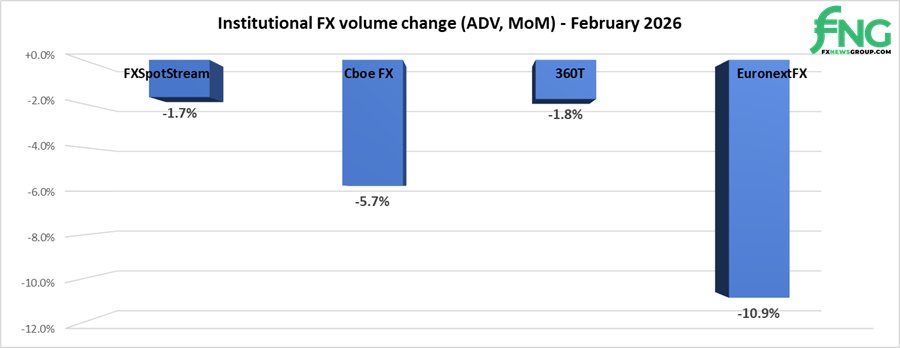
Following a record month of January to start off the year, things cooled somewhat during February 2026 in the institutional FX trading market. Each of FXSpotStream, Cboe FX, EuronextFX and Deutsche Borse’s 360T saw month-over-month trading volume declines of between 1% and 11% during February, as January’s wild currency market volatility gave way to more

A close-up shot of numbers and stock charts by Atlantic Ambience via Pexels

How 24/7 Automated Forex Systems Operate Across Global Markets

A close-up shot of numbers and stock charts by Atlantic Ambience via Pexels This is sponsored content.  Barchart is not endorsing the websites or products set forth below. The forex market is not the most difficult market to understand but it also isn’t the easiest. This might, at first, sound a bit off. How can

Middle East Situation Reshapes Forex Market Landscape

On Monday this week (March 2), influenced by the escalation of the situation in the Middle East, the US dollar opened stronger, with intraday gains expanding at one point. As of now, the increase has narrowed to approximately 0.5%. Compared to the market risk aversion sentiment triggered by the tensions in the Strait of Hormuz,

Retail Trading Enters New Maturity Phase: SpecFX Rebrands

Retail Trading Enters New Maturity Phase: SpecFX Rebrands

Sydney, Australia, March 02, 2026 (GLOBE NEWSWIRE) — The global retail trading industry is entering a more deliberate and regulated phase, marked by stronger oversight, greater operational transparency, and rising expectations from traders. Against this backdrop, SpecFX has officially rebranded as Spec Markets, signaling an expanded offering and a strategic shift toward long-term infrastructure, compliance,

ISM manufacturing beats forecast, prices jump to highest since 2022

ISM manufacturing beats forecast, prices jump to highest since 2022

US ISM Manufacturing PMI edged down from 52.6 in January to 52.4 in February, but the reading remained comfortably above expectations of 51.9 and firmly in expansion territory. The data point to continued resilience in the factory sector, with activity still consistent with moderate economic growth. The most striking development was the sharp surge in

WTI soars above 70 despite OPEC+'s "band aid" production hike

WTI soars above 70 despite OPEC+’s “band aid” production hike

On Sunday, the OPEC+ “V8” coalition took a proactive stance by accelerating production hikes to 206,000 bpd starting in April. This move—surpassing the 137,000 bpd initially anticipated—serves as a strategic pivot to buffer a market shaken by the sudden U.S./Israeli strikes on Iran. While the alliance officially points to “market fundamentals,” the timing is clearly

War premium lifts Silver, violent move possible if 100 gives way

War premium lifts Silver, violent move possible if 100 gives way

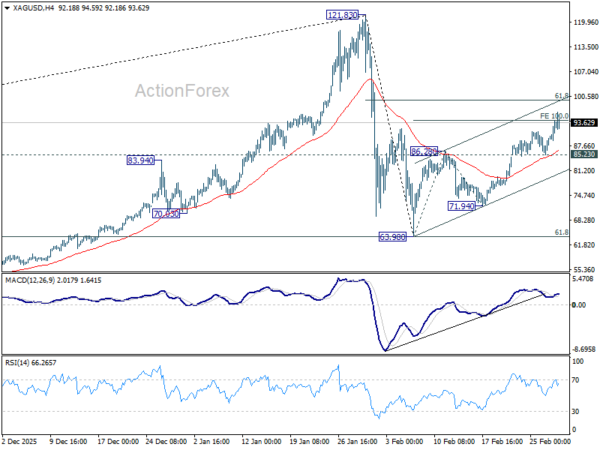
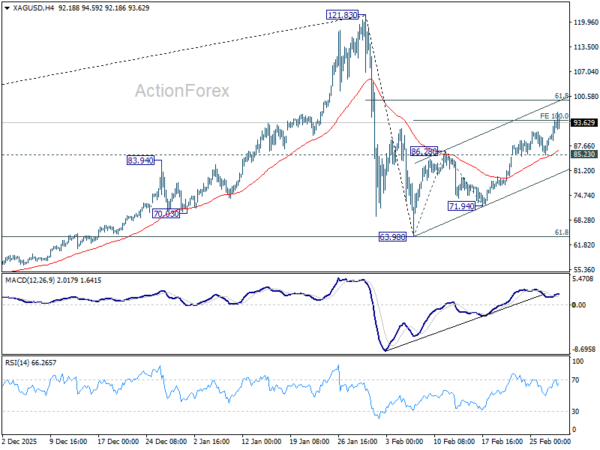
Silver edged higher as markets reacted to escalating tensions in Middle East, with US-Israel-Iran conflict driving aggressive safe-haven flows. Prices surged to an intraday high above 96 before easing slightly as traders locked in partial profits. Despite intraday consolidation, underlying bid remains intact as war premium continues to underpin precious metals. For now, further gains

EUR/AUD Daily Outlook - ActionForex

EUR/AUD Daily Outlook – ActionForex

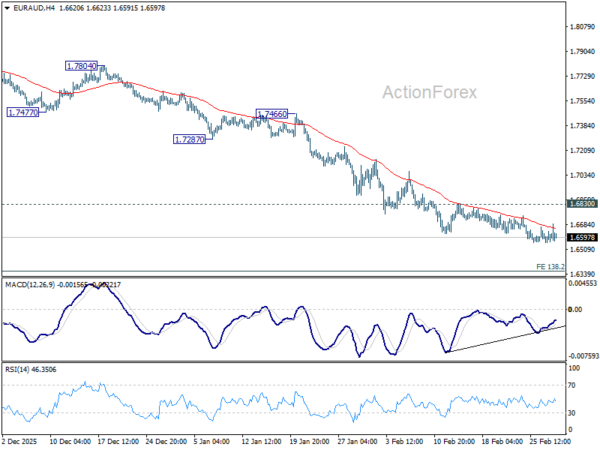
Daily Pivots: (S1) 1.6567; (P) 1.6604; (R1) 1.6647; More… Further decline is expected in EUR/AUD with 1.6830 resistance intact, despite some loss of downside momentum. Current fall should continue to 138.2% projection of 1.8554 to 1.7245 from 1.8160 at 1.6351. However, firm break of 1.6830 resistance will confirm short term bottoming, on bullish convergence condition

Safe-Haven Flows Build But No Panic, Focus Turns to Iranian Succession

Safe-Haven Flows Build But No Panic, Focus Turns to Iranian Succession

Markets opened the week with a clear but measured risk-off tone following dramatic escalation in Middle East tensions over the weekend. While safe-haven flows were evident in Asia, price action so far remains contained rather than disorderly. Investors are reacting, but not capitulating. Equity markets in the region reflected caution rather than panic. Japanese and

Image used for representational purposes only.

Rupee falls 21 paise to 91.29 against U.S. dollar in early trade amid Iran-Israel conflict

Image used for representational purposes only. | Photo Credit: Getty Images/iStockphoto The rupee depreciated 21 paise to 91.29 against the U.S. dollar on Monday (March 2, 2026), amid higher crude oil prices, a strong American currency and intense global volatility due to the escalated West Asia tension. Negative equity market sentiment and massive withdrawal of

EUR/USD Rejected at Resistance, Bears Eye Fresh Decline Ahead

EUR/USD Rejected at Resistance, Bears Eye Fresh Decline Ahead

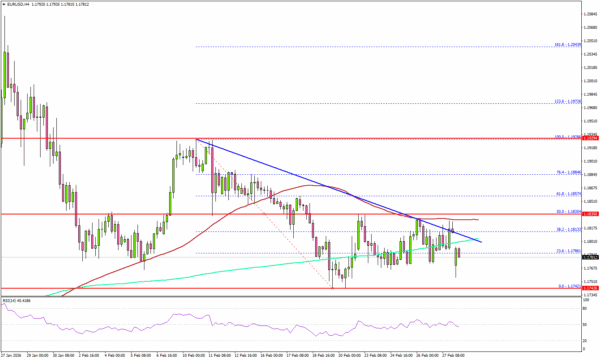
Key Highlights EUR/USD started another decline and traded below 1.1840. A key bearish trend line is forming with resistance at 1.1800 on the 4-hour chart. GBP/USD extended losses and traded below 1.3460. Crude Oil prices jumped above $74.50 before trimming some gains. EUR/USD Technical Analysis The Euro failed to stay above 1.1900 and declined against

0
Would love your thoughts, please comment.x
()
x