Five years after Covid, we scorn health workers, ignore vaccines and work in our offices – The Irish Times

How often do I think of Covid? Only about a dozen times a day, whenever I wash my hands. It was quite something, in my early 60s, to realise that an action I had been performing all my life had to be relearned. The automatic had to become conscious: more time spent kneading between the fingers, that twist of the thumbs, soap up beyond the wrist. But is this the only thing we learned to do better, the only dead habit we managed to slough off?

Five years ago today, the World Health Organisation announced it had found evidence that what it would call the Sars-CoV-2 virus could be transmitted from human to human. This was the moment when a vague disturbance from somewhere over the horizon began to press on our reality.

Do you remember how it felt, a week later, when the Centres for Disease Control in the US issued that visual image, created by the artists Alissa Eckert and Dan Higgins, of the virus itself – a grey ball flecked with yellow and orange spots and studded with red triangles?

First graphic of Covid-19 released by the US Centres for Disease Control and Prevention in January 2020. Image: Alissa Eckert and Dan Higgins/CDC

It was a simulation, a visual metaphor, but it made this abstract threat into a spiky mine floating towards us on an unstoppable tide.

Very soon it exploded into our mundane lives. It forced us to learn its own language: coronavirus, PPE, mRNA, social distancing, lockdown, immunocompromised, herd immunity, flattening the curve, test and trace, cocooning, ventilator. It sent us into surreal spaces, hangars and car parks and racecourses repurposed as vaccine injection centres.

We acquired tracing apps on our phones and accumulated cards with dates and batch numbers on them. For a while, the opening gambit in a conversation was no longer the weather but whether you’d got the Pfizer, the AstraZeneca or the Moderna vaccine.

And what most of us were certain of was that things could never be the same again. The experience was scary, heart-scalding, tragic. But it was also a circuit-breaker. It forced us to think about what really mattered – food, shelter, safety, company and connection, human interdependence, the physical environments to which we were suddenly and intensively confined. It heightened our awareness of the fragility – and thus the wonder – of the everyday.

You rummage in the pocket of an old coat and touch one of those crude cloth masks we used

But habit has reasserted its grip. Perhaps all we have really learned is our collective capacity for forgetting. This extraordinary experience recurs now as fragmentary flashbacks. You step on a queuing area in a supermarket that still has the two-metre social distancing marks on the floor. You rummage in the pocket of an old coat and touch one of those crude cloth masks we used before the disposable ones became ubiquitous.

You glimpse at the back of the medicine cabinet an out-of-date Covid test and feel again the violation of a cotton-tipped stick penetrating the secret and tender cavities of your nose.

But these are the flotsam of a receded tide. We have not moved on – we have simply moved back. There were four big things we were supposed to have salvaged from the pain of the pandemic, but these already feel like the uncanny and bewildering shades of last night’s uneasy dream.
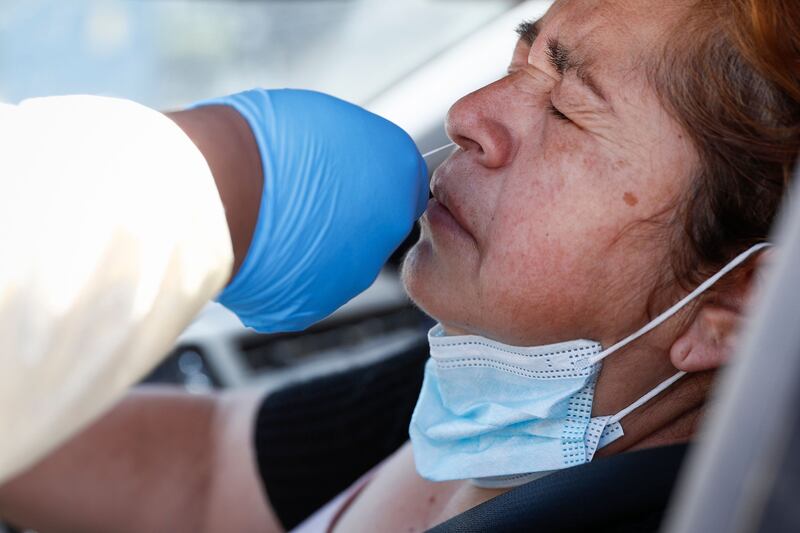
A healthcare worker takes a nasal swab sample to test for Covid in July 2022 in Los Angeles. Photograph: Caroline Brehman/EPA

The first and most searing lesson was the implicit cruelty of our system of care for older people. Covid was, in essence, a plague on the elderly: 91 per cent of those who died with the virus in Ireland were over 65. It was at its deadliest in sites of supposed care and safety: 29 per cent of all deaths in Ireland happened in nursing homes.

We have still not had a proper accounting for this disaster, but one truth is obvious: out of sight is out of mind. Segregating older people from their homes, families and communities makes them less visible and therefore more vulnerable. What have we done about this? Really nothing – there is no strategy to keep as many people in their own homes as possible.

My battle with Long Covid: I was in disbelief. Was I making it up? How could I not stand up while the kettle boiled? ]

Second, we seemed to have learned something fundamental about equality. The pandemic was a searchlight illuminating the work of all the people who are obscured by false hierarchies of status and value. The poorly paid nursing home staff – often immigrant women – who were the ones risking their own lives and holding the hands of the dying. The bus and truck drivers who kept the show on the road. The supermarket workers who kept the supply of food going.

There was a surge of gratitude towards them, a realisation of how much they should be valued.

But, in reality, the pandemic was a bonanza for billionaires: when it started, billionaires collectively owned 2 per cent of household wealth worldwide. By its end they owned 3.5 per cent. And the world had returned to taking labour for granted.

Assurances offered to everyone “trying to reconcile childcare, commuting and accommodation costs with quality of life” have faded

Third, recovery from the pandemic was one of the greatest triumphs in the history of science. The speed with which vaccines were created, developed and delivered was staggering. So was their effectiveness and safety. Yet we’ve gone back to not bothering with vaccines. As of last week, only 27 per cent of Irish people in their 60s had received their Covid booster – shockingly, fewer than one in 10 healthcare workers had done so.

Fourth: what happened to all that profound reflection on work-life balance and the need to end the waste of commuting and presenteeism? Last week, John McManus wrote in The Irish Times about a ruling by the Workplace Relations Commission that “will be seen by many as the final nail in the coffin of the promised right to remote working”. The assurances offered to everyone “trying to reconcile childcare, commuting and accommodation costs with the desire of a decent quality of life” have now faded into the pandemic twilight.

One of the symptoms of long-Covid is memory loss, so it is apt that a brain fog now shrouds so much of the coronavirus experience itself. The biggest lesson our governing systems have learned is how to wash their hands of what the pandemic taught us.


Source link

Visited 1 times, 1 visit(s) today

Related Article

Nvidia’s trillion-dollar run puts pressure on the bulls

BEIJING, CHINA – MAY 14: Nvidia CEO Jensen Huang (C) gestures as he prepares to depart following a welcome ceremony at the Great Hall of the People on May 14, 2026 in Beijing, China. President Trump is meeting with President Xi Jinping in Beijing to address the Iran conflict, trade imbalances, and the Taiwan situation

Permutations in Europe: What’s still at stake in final weeks of season?

There’s still plenty to play for across Europe as we head into the final matches of the club season. Here are all the title races, Champions League fights, and relegation battles left to be decided in the top leagues this month. This story will be updated until the end of the campaign. 👉 Jump to:EPL

Brewing a Better Half-Gallon Batch

Today I finally ran an experiment I’ve wanted to try for a long time. If you’re a professional barista—or you run a busy café—this may save you some time. Most coffee shops use 1–1.5 gallon batch brewers (Bunn, Curtis, Fetco, etc.). When I opened Short Sleeves Coffee, I intentionally avoided brewing full 1-gallon batches. I

5 Frozen Breakfasts Chefs Say Keep You Full All Morning

Chef-approved frozen breakfasts with more protein and better ingredients. Eating a healthy breakfast every morning is a great way to start the day, but most people don’t have time to cook. Whether you’re rushing out the door in the morning for work, taking the kids to school or both, there’s usually not much time in

CA scales back plan to ban student use of cell phones

By Carolyn Jones, CalMatters This story was originally published by CalMatters. Sign up for their newsletters. Until last month, California was poised to join nearly a dozen other states that ban cell phones in K-12 schools. But under pressure from school boards and administrators, lawmakers scaled back a bill that would have required such a

BulkQuant Launches AI Trading Bot for Crypto, Forex, and Stock Markets

BulkQuant Launches AI Trading Bot for Crypto, Forex, and Stock Markets

London, United Kingdom, May 15, 2026 (GLOBE NEWSWIRE) — BulkQuant has officially launched its AI trading bot platform designed for crypto, forex, and stock market traders seeking a simpler way to automate trading strategies across multiple financial markets. The platform combines AI-powered quantitative analysis, automated trade execution, portfolio monitoring, and adaptive risk management into a

IMF lauds resilient Hong Kong economy but warns of risks linked to Middle East war

IMF lauds resilient Hong Kong economy but warns of risks linked to Middle East war

The International Monetary Fund (IMF) has lauded the resilience of Hong Kong’s economy, noting a sustained recovery despite economic activity having yet to return to pre-Covid levels, while warning of downside risks stemming from escalating geopolitical tensions. It also urged Hong Kong to pursue medium-term financial reforms, including the introduction of a goods and services

Smithsonian Presidents Exhibit Reopens With Low-Key Trump Impeachment Mention

For the past year, the Smithsonian Institution has found itself in the awkward position of telling the nation’s story while being supported in part by a government that wants to narrow how that story is told. In December, the White House threatened to revoke funding to the institution if it did not hand over a

Marvel’s Daredevil Follow-up Is Already Dominating on Streaming

A follow-up to Daredevil: Born Again Season 2 on Disney+ has become a massive streaming success within days of its launch. The Punisher: One Last Kill has quickly climbed to the top of multiple charts, beating out other titles on the platform. The MCU television special follows the gun-toting vigilante, who finds himself targeted by

Is Now a Bad Time to Invest?

The market has been on a roll lately, with the S&P 500 (SNPINDEX: ^GSPC) setting new highs throughout May. If you think you missed your opportunity when the market bottomed in late March, don’t fret. The market hitting new all-time highs is not particularly rare and should not change your investment strategy. And if you

6 bids for Hong Kong land sale signal renewed confidence despite market caution

6 bids for Hong Kong land sale signal renewed confidence despite market caution

The Hong Kong government’s first land sale in the current financial year has drawn six bids, according to the Development Bureau, including those from the city’s largest developers, suggesting a more confident outlook for the residential property market. At the close of tender for Tung Chung Town Lot No 54 at Area 106A on Friday

Each Premier League team reranked: Man City rise; Chelsea, Liverpool collapse

Ryan O’Hanlon Close Ryan O’Hanlon ESPN.com writer Ryan O’Hanlon is a staff writer for ESPN.com. He’s also the author of “Net Gains: Inside the Beautiful Game’s Analytics Revolution.”  and  Bill Connelly Close Bill Connelly ESPN Staff Writer Bill Connelly is a writer for ESPN. He covers college football, soccer and tennis. He has been at

Trump departs China after two-day summit

Trump departs China after two-day summit

IE 11 is not supported. For an optimal experience visit our site on another browser. Trump Wraps China Summit With Xi Jinping: What Are the Results? 05:41 Xi gives Trump rare tour of secret garden at heart of Chinese government 01:04 Now Playing Trump departs China after two-day summit 01:01 UP NEXT Special Report: Trump

Carol Chow was facing a bankruptcy petition by five people over unspecified debts at the time of her death. Photo: Dickson Lee

Embattled Hong Kong developer sued for HK$130 million, days after founder’s death

A Hong Kong property developer has been sued for HK$130 million (US$16.6 million) over allegedly breaching guarantor obligations in two bond subscription agreements, becoming the latest lawsuit to implicate the embattled company and following its founder’s sudden death earlier this week. Lofter Group, known for its urban renewal projects across the city’s core districts, and

Trump’s China visit left chip export issue unresolved

This report is from this week’s The Tech Download newsletter. Like what you see? You can subscribe here. One look at the roster of U.S. execs that cozied up to U.S. President Donald Trump on the 20+ hours flight from Alaska to China on Wednesday and you get a sense of the American delegation’s key focus

Why the Cerebras IPO matters for the AI race with China

Why the Cerebras IPO matters for the AI race with China

Cerebras, an AI chipmaker, saw its shares nearly double on Nasdaq, closing up 70% with a $95B market cap. Cerebras’s powerful chips are key in the US-China AI tech race. Chris Buskirk, co-founder and chief investment officer of 1789 Capital, a key Cerebras investor, says the company’s IPO is geopolitically significant. On Thursday, shares of

Fitbit Air vs Whoop Strap Comparison: Price, Features and AI

The Google Fitbit Air is very much the talk of the fitness tracking town right now, not only because it’s the first new Fitbit device that we’ve had in years, but it’s also one of the first big brands to go head-to-head with the established Whoop Strap (if you don’t count the Polar Loop and

0
Would love your thoughts, please comment.x
()
x