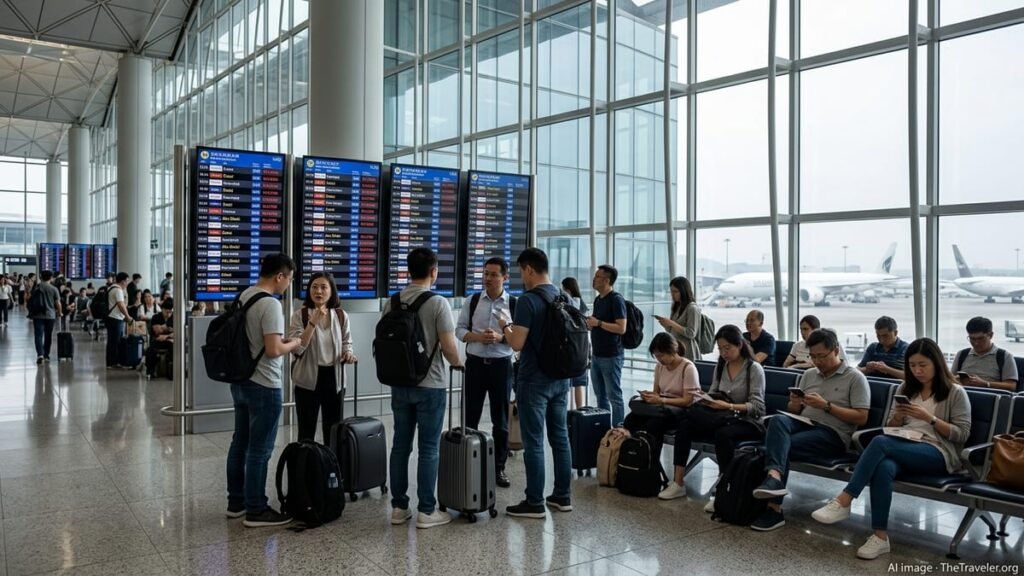
A sudden fire incident at Dubai International Airport has forced the last-minute cancellation of a Greek-organised repatriation flight bound for Athens, delaying the urgent return of Greek nationals and their pets amid already fragile air links across the Middle East.
Get the latest news straight to your inbox!
Repatriation Effort Disrupted by Fresh Airport Emergency
The cancelled flight was part of an expanding Greek airlift program designed to bring home citizens and long-term residents from Gulf states, with special arrangements for companion animals. Publicly available information on recent operations shows that Greece has been coordinating both commercial and chartered services from the region, including previous movements from Dubai and Abu Dhabi, to ease the backlog created by weeks of airspace disruption.
Reports from Dubai indicate that the new incident, described as a fire on or near airport infrastructure, triggered precautionary closures of sections of Dubai International Airport and a rapid reshuffling of departure slots. With runway availability constrained and priority given to emergency operations and previously delayed traffic, the Greek repatriation service from Dubai to Athens was among the flights removed from the schedule at short notice.
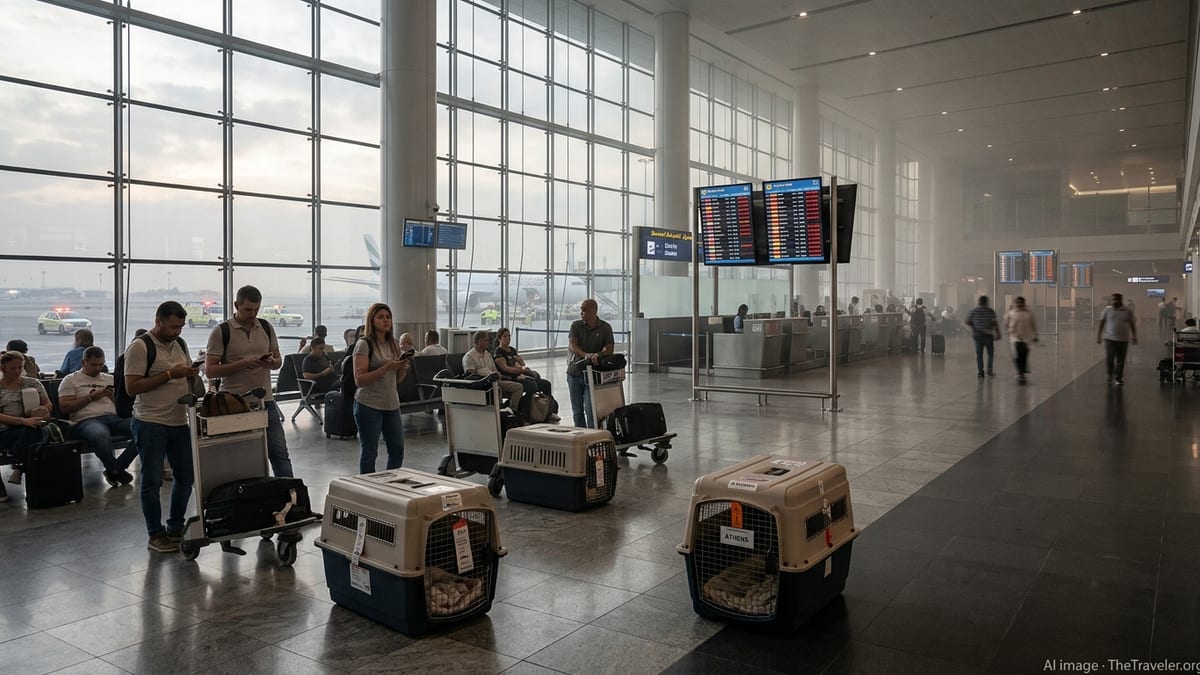
The decision to cancel rather than delay the flight has had a particular impact because the service had been tailored to accommodate passengers travelling with cats and dogs, mirroring a broader trend in recent Greek-organised evacuations that explicitly factor in companion animals. Earlier flights from Abu Dhabi to Athens specifically arranged for dozens of pets to travel alongside their owners, demonstrating how pet-inclusive repatriation has become a logistical and political priority.
According to travel and aviation coverage from the region, Dubai International has been operating with constrained capacity since late February due to conflict-related airspace restrictions affecting multiple Gulf hubs. The fresh fire episode has temporarily reversed a fragile improvement in traffic flows that had only just begun to stabilise with the resumption of limited scheduled and repatriation services.
Greek Nationals and Pets Face Renewed Uncertainty
The cancelled Dubai to Athens rotation had been widely seen among stranded Greek nationals as a critical opportunity to return home before the end of March, when many flexible rebooking windows and temporary waivers offered by airlines are due to expire. Travel advisories in recent days have already urged passengers transiting through the United Arab Emirates to monitor flights closely, as disruptions and rolling cancellations remain common.
For passengers travelling with animals, the setback is especially acute. International pet transport requires extensive paperwork, vaccinations, health certificates and, in some cases, narrowly timed tests that must align precisely with travel dates. When a carefully coordinated repatriation flight is cancelled at the last moment, many of these time-sensitive preparations risk expiring, forcing owners to restart the process or seek emergency veterinary appointments in an already tense environment.
Online discussions among residents and expatriates in Dubai over recent days highlight the growing anxiety around pet travel options. Some travellers report that certain long-haul services have temporarily restricted the carriage of animals, even when flights for human passengers operate. In that context, a dedicated, pet-friendly repatriation rotation from Dubai to Athens had taken on symbolic importance for Greek nationals unwilling to leave their animals behind.
The interruption leaves Greek consular services and airline partners seeking new options in a tight window. With Gulf airspace still subject to evolving security considerations and capacity constraints at multiple hubs, there is limited flexibility to simply insert an additional widebody service configured for both human passengers and pet transport at short notice.
Fire Adds Strain to Already Disrupted Gulf Aviation Network
The fire at Dubai International further complicates a regional aviation picture that has been unsettled since late February, when attacks and heightened tensions led to partial airspace closures across several Middle Eastern states. Coverage from regional media and aviation data providers describes a patchwork of suspended, rerouted and reduced-frequency services affecting flights through Dubai, Abu Dhabi, Doha, Kuwait City, Bahrain and other key hubs.
In the United Arab Emirates, airlines and airport operators had been gradually restoring a limited set of routes, including select European services and repatriation flights designed to move stranded travellers home. Updated schedules for early and mid March show incremental increases in frequencies to destinations such as Athens, alongside continuing advisories for passengers not to travel to airports without confirmed flight status.
The new emergency at Dubai International has forced operators to revisit those schedules yet again. Flight-status trackers, airline bulletins and passenger accounts point to a pattern of cascading delays, diversions and cancellations as carriers work around narrowed runway availability and safety investigations. For travellers waiting on repatriation flights rather than standard commercial services, these sudden shifts can be particularly disruptive because alternative departures are less frequent.
Industry analysis notes that Dubai is a critical connecting point for Greece-bound traffic from Asia and Australasia, as well as a key origin for Greek nationals living and working in the Gulf. Any operational setback at the airport therefore reverberates quickly through Greek travel corridors, increasing pressure on other hubs and on Greece’s own capacity to stage additional return flights.
Greece’s Broader Airlift Shows Demand for Pet-Inclusive Evacuation
The cancelled Dubai rotation comes just as Greece has been highlighting the success of recent repatriation missions that explicitly made space for pets. According to published reports from Athens, special flights from Abu Dhabi have already brought home more than a hundred Greek nationals and dozens of animals, with images from Athens International Airport showing emotional reunions as dogs and cats emerged from transport crates.
Greek officials have previously framed these operations as a response to public expectations that evacuation and repatriation plans should reflect the bond between people and their animals. Domestic media coverage has emphasised that many Greek nationals in the Gulf had been reluctant to board early repatriation options that prohibited pets, choosing instead to wait for services where animals could be carried in the hold or in the cabin under controlled conditions.
Animal-welfare organisations in Greece have welcomed these developments, while also warning that capacity remains limited compared to demand. The sudden loss of a planned Dubai to Athens sector underscores that even well-intentioned, pet-inclusive policies depend on a fragile aviation environment in which unexpected incidents, such as fires or security scares at major hubs, can interrupt carefully laid plans.
As the Middle East conflict continues to affect civil aviation, the experience of Greek nationals and their pets in Dubai illustrates the intersection of safety, logistics and emotional considerations. Future repatriation planning is likely to factor in not only the need for redundant routing options, but also clearer communication around pet policies so that travellers can make timely, informed decisions.
What Stranded Travellers Can Expect Next
For the Greek nationals and their animals who had been booked on the cancelled flight, the immediate priority is rebooking. Airline advisories across the region in recent days have pointed to expanded fee waivers, allowing passengers with tickets issued before the current disruption to change travel dates without penalties within a set period. However, availability on remaining services, particularly those equipped and authorised to carry pets, is expected to be tight.
Travel industry guidance recommends that passengers awaiting repatriation from Dubai remain in close contact with both their airline and the relevant Greek diplomatic channels, using official communication platforms rather than relying solely on social media chatter. Given the potential for further operational surprises while investigations continue into the fire incident, travellers are also being urged not to proceed to the airport unless they hold written confirmation of an operating flight.
For now, the halted Dubai to Athens repatriation flight stands as a reminder of how quickly circumstances can change in a volatile airspace environment. Even as Greece demonstrates that pet-inclusive evacuation is possible, the combination of conflict-related restrictions and sudden airport emergencies continues to test the resilience of international travel corridors linking the Gulf and Europe.