Summary created by Smart Answers AI
In summary:
- Tech Advisor warns that smartwatch water resistance ratings like 5ATM+IP68 don’t guarantee safety for swimming, especially in salt water or chlorinated pools.
- IP certification tests use only fresh, still water, while real-world conditions like seawater can cause severe internal corrosion and component damage.
- Even premium models like Samsung’s Galaxy Watch 5 Pro can fail after ocean swimming, though some water-damaged devices may be repairable or covered under warranty.
Most smartwatches these days have a high IP rating and are therefore considered to be largely waterproof. However, a recent example shows why it’s not a good idea to go swimming when you’re wearing one.
A Reddit user named mangoed went for a swim in the sea, confident that the Samsung Galaxy Watch 5 Pro he was wearing could handle it. It’s 5ATM+IP68 rated. The ‘6’ means it’s completely sealed from dust, and the ‘8’ is one of the highest water resistance ratings available: it’s protected from immersion in water for a substantial period of time. Its ‘5ATM’ rating means it can withstand pressure equivalent to a water depth of 50 metres. All of that could make you think it was perfectly safe for a quick dip in the sea.
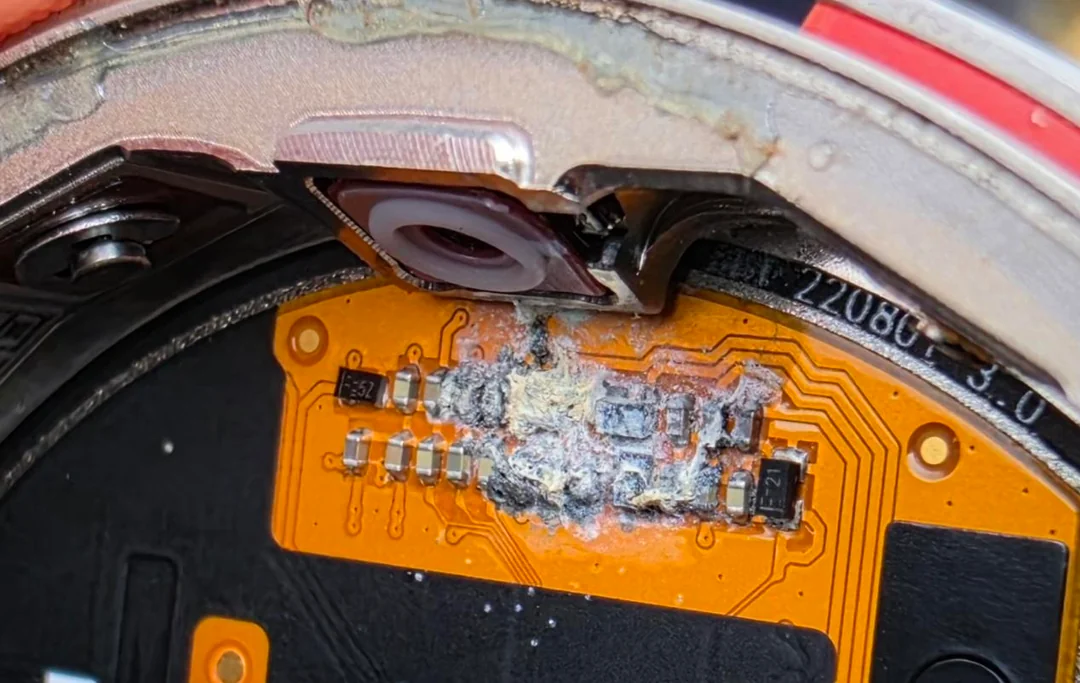
But surprise! That doesn’t mean you can actually wear it for swimming, especially in the sea. The person in the example above found that his watch stopped working. When he got home, he removed the back and found that a considerable amount of salt had built up inside.
He also discovered signs of wear on the haptic motor due to corrosion, while individual metal parts of the watch appeared to be rusting. He was able to clean and repair it but his experience is a salutary lesson for all.
What IP certification actually means
Here’s what many people forget: IP certification of the vast majority of devices refers to tests carried out in clean, fresh, still water. This means that your smartwatch can sustain damage in salty, chlorinated or moving water.
Although the Samsung website confirms the ratings of its smartwatches and says that most models can be used in swimming pools and shallow water, it adds a lot of caveats. Here are some, quoted directly from the site:
- “Do not stay submerged underwater”
- “Do not swim in fast-moving water”
- “Water resistance feature of Galaxy Watch/Fit is not permanent. Be sure to check water resistance regularly at an authorised Samsung Electronics service centre”
- “Disinfectants or salt in pool water or seawater can affect water resistance performance”
So, not only can sea swimming affect your watch, but a visit to the swimming pool could too. That’s because chlorinated water can be just as damaging to the sensitive parts of a smartwatch, or even cause short circuits, as Android Authority notes.
Reddit / mangoed
Other contaminants in the water, for example in natural lakes, can have similarly damaging effects on your devices. No matter what the manufacturer promises, the vast majority of devices are not 100% waterproof.
Of course, there may be exceptions. The Honor Watch 5 Pro, which we’re using as the cover image for this article, is reportedly explicitly designed for use in swimming pools and for swimming in the sea, according to the manufacturer. However, we can’t verify this, as the watch is currently only available in China.
In any case, although price could be a factor, it’s not a guarantee. The Galaxy Watch 5 Pro belonging to the unfortunate Reddit user is a high-quality, if older model. Cheaper models generally have an even lower protection rating and are definitely not suitable for swimming.
Check out our top recommendations in our round-up of the best smartwatches we’ve tested.
What to do if your watch stops working
Even if your smartwatch has ended up in water and is non-responsive, there’s still hope. The Reddit user mentioned above managed to save his watch by cleaning the salt-encrusted parts with a solution of isopropyl alcohol. He was then able to carefully wipe off the salt, dry the watch, and subsequently recharge and use it again.
He also noted that most of the water had likely entered through the microphone and perforations in the pressure sensor. It might therefore be possible to seal these areas before a swim – but we wouldn’t recommend it.
If you’re not able to repair a water-damaged watch, you can try returning it to the manufacturer if it’s within warranty. If the manufacturer states in official product specifications that the watch is waterproof, you can at least hope for a refund or repair. Otherwise, it could end up being a very expensive dip.
This article originally appeared on our sister publication PC-WELT and was translated and adapted from German.