Even as global markets brace for a potential oil shock, a quieter, more calculated story has been unfolding in Beijing, one that helps explain why prices refuse to fall and why volatility is here to stay.
Warnings are already flashing. Larry Fink, chief executive of BlackRock, has said oil surging to 150 dollars a barrel “could trigger global recession” as tensions in West Asia threaten supply lines.
Several brokerages, including Macquarie, Kotak Securities and Nuvama Institutional Equities, now see prices stabilising at elevated levels and potentially climbing towards 120 to 150 dollars if disruptions persist.
But while traders fixate on chokepoints like the Strait of Hormuz, China has spent months quietly preparing for exactly this kind of turmoil and building a buffer against it.
Customs and shipping data since early 2025 show China importing far more crude than its domestic demand requires. In January and February this year alone, the country built up a surplus of roughly 1.24 million barrels per day after accounting for refinery runs, pointing to a deliberate choice to store rather than consume.
Buying cheap
Much of that intake has come from heavily discounted and politically sensitive sources. Beijing has ramped up purchases from Russia, Iran and Venezuela, producers facing Western sanctions, allowing it to secure crude at prices well below global benchmarks.
According to energy expert Anas Alhajji the stockpiling allows China to capitalize on lower prices resulting from Western actions. “As the world’s largest oil importer and primary buyer of these redirected flows, China has effectively turned geopolitical restrictions into an opportunity for enhanced energy security and cost savings.”
Most of those barrels were secured when Brent hovered just above 60 dollars a barrel. As prices now surge, that earlier buying spree gives Beijing a powerful cost advantage over other major importers.
Secret oil stash
Where that oil is going is just as important as where it came from.
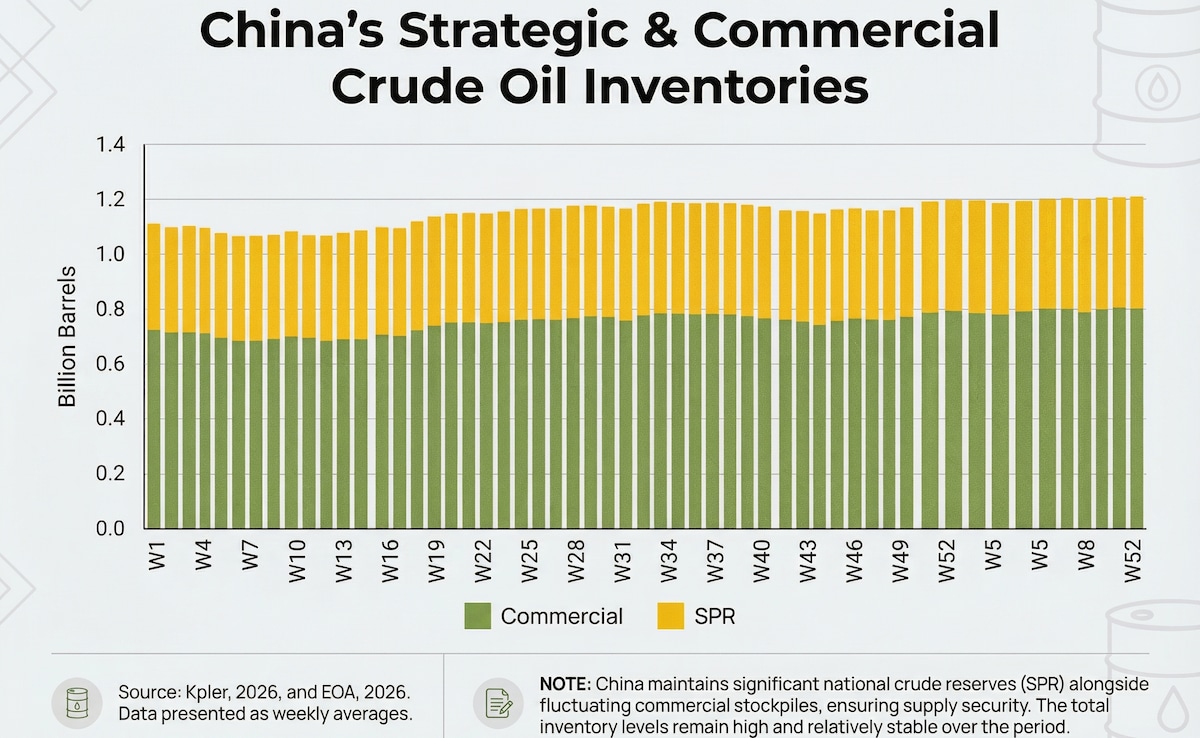
Over the past decade, China has built a sprawling, two tier storage system that blends government controlled strategic petroleum reserves with vast commercial tanks run by state owned enterprises.
Some of these reserves sit in underground caverns designed for security and long term storage, while others are in above ground tank farms spread across coastal and inland hubs.
Analysts estimate the combined capacity at roughly 1.1 to 1.2 billion barrels, with more expansion underway.
In practice, this is not a passive reserve in the Western sense. Rather than waiting for textbook emergencies, Beijing has used its storage system as an active market tool, buying aggressively when prices are low or discounted and holding back supply when markets tighten.
That behaviour is already reshaping how oil trades.
By absorbing more than 1 million barrels per day of surplus supply through 2025 and into 2026, China has helped put a floor under crude, keeping benchmarks elevated even when broader demand indicators soften. At the same time, those barrels remain largely ring fenced within its borders, reducing the buffer available to other importers and embedding a geopolitical premium into prices.
The leverage this creates is significant.
In the short term, China enjoys a clear arbitrage. It burns cheap oil bought in the past while rivals scramble for expensive spot cargoes. Over the longer term, it gains control over timing. If Beijing slows imports and leans on inventories, it can quickly swing the global balance from tight to looser supply, sending prices lower. If it keeps buying on dips, it can help reinforce any price floor.
That makes China not just the world’s largest buyer of crude, but a player with the potential to move prices from both the demand and the supply side, without a word of official guidance.
For OPEC Plus and Western policymakers, this is a new complication. Production cuts, sanctions and strategic reserve releases now have to be calibrated against a third, largely opaque force: China’s decisions on when to add to, or draw down from, its own giant reserve system.
China did not need to know the precise timing or shape of the Iran crisis to see that the age of cheap, predictable oil was ending. By building stocks early and turning its storage into a strategic tool, Beijing prepared for volatility.