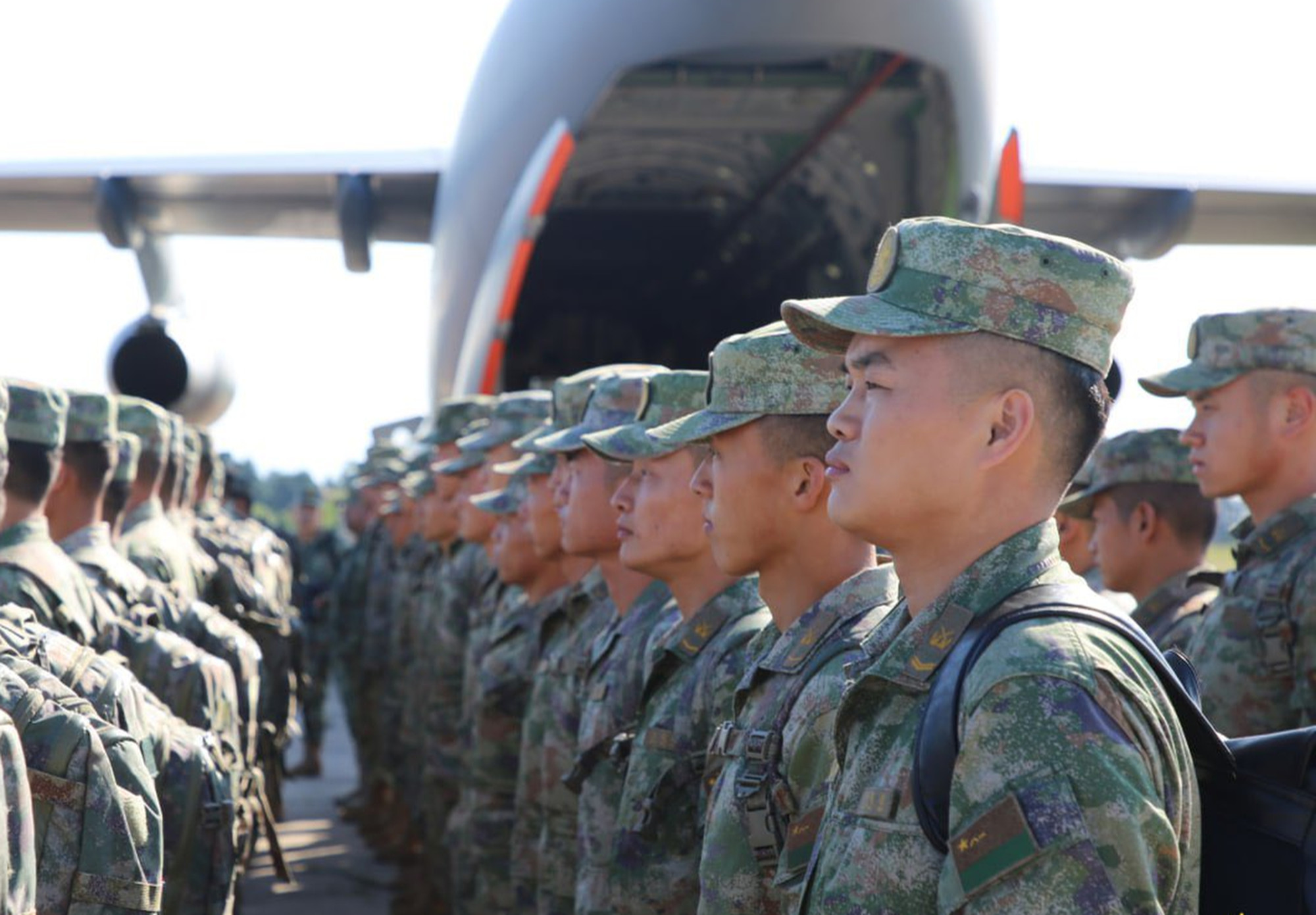
It is the first time China has sent military personnel to Belarus for training. Their last known joint exercise was the 2018 Eagle Assault held in Shandong province, eastern China.
Last month, Belarus’ Chief of General Staff Pavel Muraveyka threatened to use tactical nuclear weapons “if the country’s sovereignty and independence are threatened”. He also accused Warsaw of inciting the situation on the border of their two countries, where there has been a surge of illegal crossings from Belarus into Poland.
While China has called for direct peace talks between Russia and Ukraine in recent weeks, Beijing has not condemned the Russian invasion and has deepened ties with Moscow since the war began.
Analysts say this week’s exercise is a sign of China’s closer military ties not just with Belarus but also Russia, and it will add to concerns among EU and Nato members – especially Poland.
Benjamin Barton, an associate professor at the University of Nottingham’s Malaysia campus, said it was “somewhat surprising” for China to send troops for drills on Europe’s doorstep.
“China has always maintained a certain degree of caution when dealing with Russia and Putin’s enthusiasm for Russia and China to put up a common front against the US and its allies – something Beijing has been unwilling to do,” he said.
Martin Sebena, a lecturer at the University Hong Kong who specialises in China-Europe relations, said given their timing and location, the drills were likely to create “perceptions of Chinese support for Russia and Russia’s allies” in Europe.
“The exercise will overlap with the Nato summit [to be held in Washington from Tuesday to Thursday] and takes place on the … border where Belarus for many months has ‘weaponised’ migrant flows to pressure Poland – and by extension, the EU and Nato,” Sebena said.
“It adds two extra layers to the Polish perception. First, the Poles have been reducing train transport from China via the Malaszewicze hub [near Brest] in fears of it being used for tariff circumvention, while China has worked hard to increase train-based overland trade from western China to Europe – with this hub being basically the only place where those trains enter through the EU,” he said.
Zsuzsa Anna Ferenczy, assistant professor at National Dong Hwa University in Taiwan, said EU-China ties were “on a downward spiral”.
“China’s continuous support to Russia in the aggression against Ukraine has intensified Europe’s will to address security risks related to trade with China, which hurt European interests,” Ferenczy said.
“Pulling Belarus closer into China’s orbit eventually also helps Russia in keeping pressure on Europe’s own neighbourhood. While it is not in Beijing’s interest to add more oil to the fire in its ties with Europe, a Belarus more aligned with China and its world view may further intensify EU-China tension.”
Senior Colonel Zhou Bo, a retired PLA officer and senior fellow at Tsinghua University’s Centre for International Security and Strategy in Beijing, said the exercise with Belarus had “nothing to do with the situation in Ukraine” and was just the latest Chinese joint military drill.
“China is not going to get involved in the Russia-Ukraine conflict in any way,” he said. “We won’t even provide military equipment … so how could we possibly have our troops directly involved? That’s impossible.”
Former PLA instructor Song Zhongping said China and Belarus had a long tradition of military cooperation and had sought to step up joint efforts to combat terrorism in recent years.
Additional reporting by Sylvie Zhuang