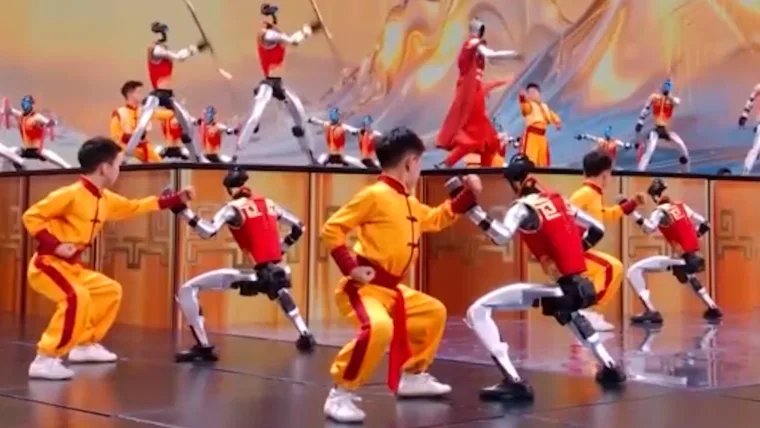
Humanoid robots have taken part in the world’s first fully autonomous martial arts performance to mark the Lunar New Year. In new footage from the 2026 Spring Festival Gala in Beijing, Unitree Robotics’ G1 and H2 machines can be seen performing complex acrobatics and wielding weapons.

The robots’ performance is a marked improvement on demonstrations at the same festival in 2025, where the machines looked stiff and clumsy, with clunky transitions between different routines.
Company representatives said the improvements result from artificial intelligence (AI) improvements alongside new lidar (light detection and ranging) processing, alongside mechanical upgrades to the robots themselves. They represent an advancement in the field of embodied AI, in which scientists attempt to give robots tools to better understand and navigate the physical world.
The year of the fire horse
“The performance draws its inspiration from a tribute to traditional Chinese martial arts,” Unitree representatives said in a technical blog post. “The concept centers on fusing the martial arts spirit with modern technology, using robotic performances to present the power and beauty of Wushu [the Chinese term for martial arts] while conveying the message of cultural inheritance and innovation. It aims to showcase Chinese Kung Fu culture alongside technological progress to the world.”
Company engineers had been preparing for the performance since November 2025. Scientists pretrained a stunt-motion model using extensive training data from an array of stunts, which subsequently improved the standard of fine-tuning to get the robots up to speed.
They also upgraded the cluster control platform — a system for coordinating dozens of robots at once that involves network communication, different operating systems, embedded devices and software engineering elements. This allowed for end-to-end automation, from AI-planned choreography planning to the real-time multirobot coordination, with millisecond-level synchronization.
In terms of robotic motion, the engineers ensured that the robots could navigate their environment, which involved a lidar-based localization algorithm that could improve how accurately they positioned themselves. Another pretrained high-speed-movement model then ensured they could track their target positions stably and quickly and complete the desired movement with human-like gaits.
The machines’ design also played a role in the improvements. The engineers upgraded the motors to boost maximum performance and then configured them to adapt to the new movements. Examples of specific improvements include higher power density for core joint motors, optimized limb robustness, and more dextrous hands.
Although the martial arts display was designed primarily for entertainment, company representatives said the movements and actions demonstrate real-world utility. For example, the cluster control platform could be a key step in enabling several robots to coordinate within a variety of environments without human intervention.