China’s New Five-Year Plan Specifically Targets Quantum Leadership And AI Expansion

Insider Brief

  • China’s new five-year policy blueprint prioritizes artificial intelligence and quantum computing as central technologies for economic growth, scientific leadership, and strategic competition.
  • The plan calls for expanded investment in scalable quantum computers, the development of an integrated space-earth quantum communication network, and large computing infrastructure to support advanced AI systems.
  • Officials also outlined broader science initiatives—including humanoid robotics, 6G networks, brain-machine interfaces, and nuclear fusion—while aiming to strengthen domestic innovation amid technology tensions with the United States.
  • Image: China’s news service

China has placed quantum technology and artificial intelligence (AI) at the center of its next five-year national development strategy, signaling a push to secure leadership in emerging computing and advanced science.

Analysts are labeling this a strong statement of both the potential of these technologies to promote national security and economic goals, but also China’s willingness to go it alone on frontier technologies.

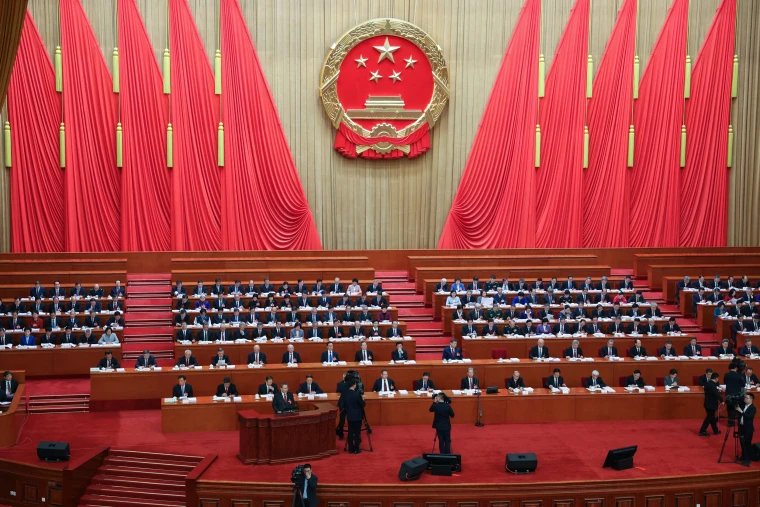
According to Reuters, the policy blueprint released alongside the opening of the National People’s Congress lays out an aggressive plan to expand the use of AI across China’s economy while accelerating research in quantum computing and related frontier technologies. Beyond Beijing’s broader effort to compete with the United States in advanced technologies, the strategy addresses structural economic pressures, including labor shortages and an aging population.

Responsive Image

The over-arching priority seems to be AI, according to Reuters. The five-year blueprint mentions AI more than 50 times and includes a sweeping “AI+ action plan” aimed at integrating the technology across industries, Reuters reported. The plan also identifies quantum computing, humanoid robots, 6G communications and brain-machine interfaces as priority areas for future investment.

Chinese officials described these technologies as part of what the government calls “new quality productive forces,” a term used to describe advanced industries expected to drive economic growth in the coming decades.

The strategy also calls for increased spending on basic research and a stronger pipeline of scientific talent, as Beijing seeks to strengthen its domestic innovation system. According to Reuters, the government aims to accelerate progress in foundational science while turning more discoveries into commercially viable technologies.

The plan calls for policymakers to expand AI adoption across sectors ranging from manufacturing and healthcare to logistics and robotics. The government intends to deploy AI agents capable of performing tasks with minimal human oversight and experiment with robots in industries facing labor shortages, according to Reuters.

China’s focus on AI reflects rapid progress by domestic developers in recent years. Reuters indicates that companies such as DeepSeek have emerged as important players in building advanced AI models, contributing to a broader push by Beijing to reduce reliance on foreign technologies.

To support that growth, the plan calls for the creation of “hyper-scale” computing clusters powered by large supplies of electricity. These data-center-style facilities are expected to provide the massive computing capacity required to train advanced AI models and process large volumes of data.

The government also intends to support open-source AI communities, a move aimed at encouraging broader participation in developing software tools and algorithms.

Reuters added that China plans to increase investment in scalable quantum computers and pursue the construction of an integrated space-earth quantum communication network.

China has already invested heavily in quantum communication networks and satellite-based experiments designed to test ultra-secure data transmission. Expanding those capabilities into a large-scale network linking space and ground systems would represent a significant technological milestone.

Beyond computing, the five-year plan outlines several other science initiatives tied to China’s long-term technology ambitions. Reuters reported that the blueprint calls for breakthroughs in nuclear fusion technology, the development of a reusable heavy-lift rocket, and progress toward building a lunar research station.

The strategy underscores Beijing’s broader goal of becoming a global leader in advanced science and engineering. According to Reuters, the government plans to accelerate work on “key core technologies” and achieve decisive progress in fields that underpin future industrial competitiveness.

The emphasis on domestic innovation comes amid continuing technology tensions between China and the United States. Export controls imposed by Washington on advanced semiconductor technology have limited Chinese access to some high-performance chips used in AI development. Beijing has responded with restrictions on certain critical minerals and rare earth materials used in manufacturing.

These geopolitical pressures have reinforced China’s determination to develop homegrown capabilities in computing, semiconductors, and other strategic technologies, according to Reuters.

China’s five-year plan is the government’s central economic and industrial roadmap, setting national priorities, funding targets and policy directions that guide development across sectors for the next five years.

Following its release at the National People’s Congress, ministries, provincial governments and state agencies will translate the blueprint into detailed implementation plans, funding programs and specific projects tied to the strategy’s technology and economic goals.

Source link

Visited 1 times, 1 visit(s) today

Related Article

Why Europe Can’t Afford to Lose Its Largest Nuclear Plant to Russia

US Votes Against IAEA Ukraine Grid Resolution, Breaking With Allies — UNITED24 Media

The United States voted against an International Atomic Energy Agency (IAEA) board resolution on attacks on Ukraine’s power grid, according to Reuters on March 5. The vote at the International Atomic Energy Agency’s 35-nation Board of Governors in Vienna put the US alongside Russia, China, and Niger. This marked the first time the United States

Treasury Secretary Scott Bessent in front of a Ronald Reagan portrait

Trump administration weighs asking China to cut Iran, Russia oil purchases

EQT President and CEO Toby Z. Rice joins ‘Mornings with Maria’ to discuss the sudden rise in oil and natural gas prices as the Middle East conflict rages. The U.S. is reportedly considering asking China to curb its purchases of oil from America’s adversaries, like Iran and Russia, ahead of President Donald Trump’s trip to Beijing

Thousands Of Passengers Suffer In Asia As Thailand, China, India, Türkiye, Indonesia, Sri Lanka, And UAE Cancel 1,222 And Delay 2,124 Flights, Grounding Air India, Emirates, Air China, Batik Air, Pegasus, And Others In Dubai, Kolkata, Bangkok, Beijing, And More

Thousands Of Passengers Suffer In Asia As Thailand, China, India, Türkiye, Indonesia, Sri Lanka, And UAE Cancel 1,222 And Delay 2,124 Flights, Grounding Air India, Emirates, Air China, Batik Air, Pegasus, And Others In Dubai, Kolkata, Bangkok, Beijing, And More

Home » Latest Travel News » Thousands Of Passengers Suffer In Asia As Thailand, China, India, Türkiye, Indonesia, Sri Lanka, And UAE Cancel 1,222 And Delay 2,124 Flights, Grounding Air India, Emirates, Air China, Batik Air, Pegasus, And Others In Dubai, Kolkata, Bangkok, Beijing, And More Published on March 6, 2026 Image generated with Ai

China’s rubber-stamp advances tech independence plan • The Register

China’s government has again made reducing reliance on imported digital technology a major goal. The renewed push came at the “Two Sessions”, China’s parliament that sits for just two weeks each year, and convened this week. One of the big moments at the Two Sessions is the delivery of the annual Government Work Report by

Man looks on at a Chinese submarine

Chang warns Chinese subs operating ‘very close’ to US homeland

Gatestone Institute senior fellow Gordon Chang joins ‘Mornings with Maria’ to react to China ramping up submarine production, backing Iran and raising alarms over U.S. reliance on Chinese drones and AI competition. Gordon Chang urged the United States to treat China as an “enemy combatant” Thursday, warning that Chinese submarines are operating “very close” to

tsmc

China seeks to enhance rare earth advantages, take ‘extraordinary measures’ to achieve semiconductor breakthroughs — new five-year plan marks doubling down on technological self-reliance

China has just released the latest draft of its 5-year plan, which is set to be approved during the next full session of the National People’s Congress from March 5 to 12, 2026. This document lays out the plans and policies that the central government will implement in the next five years, from 2026 through

Decent Holding launches AI senior care arm in China

Decent Holding launches AI senior care arm in China

Decent Holding (Nasdaq: DXST) on March 5, 2026 launched an AI-powered senior health and community care platform via subsidiary Suncare, targeting China’s aging market and the broader silver economy. The platform integrates AI monitoring, chronic disease management, IoT smart care, rehabilitation services and O2O community centers. Early pilots have deployed

Pro-Maduro protestors in Caracas

Trump’s China summit with Xi Jinping just got a lot more complicated

BEIJING — President Donald Trump’s looming meeting with China’s Xi Jinping will face new tensions after U.S.-Israeli strikes on Iran that killed its China-friendly supreme leader. It’s the second time in two months that the United States has taken military action against one of China’s key economic partners, after its surprise capture in January of

ET logo

Bulk carrier claiming to be Chinese passes through Hormuz Strait

A bulk carrier signaled it was Chinese-owned as it transited the Strait of Hormuz this week, highlighting how vessels are trying to ensure safe passage through the waterway during the war in the Middle East. The Iron Maiden changed its destination signal to “CHINA OWNER” from “For Orders” early Thursday as it made a break

A high-tech digital financial scene with glowing teal and cyan elements. In the background, a screen displays a volatile line graph. In the foreground, numerous stacks of gold coins are arranged on a dark, reflective surface that also shows abstract glowing data points. Behind the coins, several tall, glowing teal bar graphs, resembling digital skyscrapers made of light, rise sharply, depicting market growth.

Two Forces That Will Make or Break China Tech Investing in 2026

24/7 Wall St. (24/7 Wall St.) Quick Read Invesco China Technology ETF (CQQQ): up 14.5% over 12 months, down 8.5% past month. Top 4 holdings Tencent (TCEHY), PDD Holdings (PDD), Baidu (BIDU) at 7.26%, Meituan (3690.HK) represent ~30% of portfolio. US-China trade tensions and concentrated AI exposure will determine whether CQQQ continues recovering from China’s

GM050309_26X Asia chip companies-WEB

AI’s ‘spillover effect’ and China’s tech insurance bid

Hello from Yifan, sending this week’s #techAsia from Nikkei headquarters in Tokyo. As much as I’m enjoying the warmer-than-expected weather in the Japanese capital and hoping to see some early cherry blossoms, I do feel I’m missing out on the increasingly urgent debate in Silicon Valley over what role artificial intelligence should play in warfare.

Lisa Visentin

China’s latest blueprint aims to close US technology gap and break old habits

Save You have reached your maximum number of saved items. Remove items from your saved list to add more. Save this article for later Add articles to your saved list and come back to them anytime. Got it AAA Beijing: Before an audience of dutifully applauding cadres at Beijing’s Great Hall of the People, Chinese

China Lowers GDP Growth Target For 2026 To 4.5-5%; Lowest Since 1990s | Economy News

Last Updated:March 05, 2026, 10:09 IST Presenting the annual work report, Chinese Premier Li Qiang said the government will aim for growth between 4.5% and 5% this year and will strive for better results in practice. China’s latest growth target signals one of the most cautious economic outlooks in recent years. China on Thursday lowered

Chinese Premier Li Qiang delivers a work report during the opening session of the National People's Congress (NPC)  at the Great Hall of the People in Beijing.

China sets lowest growth target since 1991 as economy struggles to keep momentum

BEIJING — China announced its lowest growth target in 35 years Thursday as the world’s second-biggest economy struggles with challenges at home and growing uncertainty around the world. This year, China will aim for gross domestic product growth of 4.5% to 5% “while striving for better in practice,” Premier Li Qiang, China’s No. 2 official,

UK police arrest three men on suspicion of spying for China | Police News

Husband of a lawmaker from Prime Minister Keir Starmer’s ruling Labour Party among those arrested, local media report. Listen to this article | 3 mins info Published On 4 Mar 20264 Mar 2026 Click here to share on social media share2 Share plus2googleAdd Al Jazeera on Googleinfo British police have arrested three men suspected of spying for

Brexit and beyond

Labour MP Joani Reid’s husband arrested on suspicion of spying for China

Sign up to our free Brexit newsletter for our analysis of the continuing impact of Brexit on the UK Sign up to our free newsletter for the latest analysis on Brexit’s impact Sign up to our free newsletter for the latest analysis on Brexit’s impact Three men – one of whom is the partner of

Europe's door to Chinese tech investment is still ajar

Europe’s door to Chinese tech investment is still ajar

Europe has learned to block Chinese acquisitions of strategic assets. Chinese factories in Europe now pose harder economic security challenges. Europe has become more alert to the risks posed by Chinese foreign direct investment (FDI) in sensitive technologies. The 2010s were a European garage sale of high-tech firms to China, enabling Chinese investors to acquire

0
Would love your thoughts, please comment.x
()
x