OVER THE past half-century, China has conjured vast wealth out of widespread poverty. Now comes the vexing part: how to pass it on to the next generation. For China, this poses a new and underappreciated risk. On its current trajectory, the first great intergenerational transfer in China’s modern history will widen inequality, cement privilege and breed resentment. The government, devoted to “common prosperity”, is shockingly insouciant about what that will mean.
Illustration: The Economist/Xinmei Liu
In 1978, on the eve of China’s economic take-off, the average household’s assets were worth barely $1,500 in today’s money. Now, that figure has reached about $170,000, a hundred-fold real increase. Alas, the fruits are uneven. The richest 10% of the population now own nearly 70% of China’s total private wealth, roughly equal with America and well above most advanced economies, according to the World Inequality Database. And the richest 10% are, like most of China, rapidly ageing. Their heirs are in line for windfalls.
Dig deeper
Across the rich world, increasing hereditary wealth is creating a class more inclined to search out tax loopholes than to strive or innovate. China will have those problems and more. First, its inheritocracy is brand new. It was only in the 1990s, when China allowed homeownership, that people started to accumulate a lot of assets. A business boom got going at the same time, minting millions of millionaires—and hundreds of billionaires. Of those worth at least 5bn yuan ($720m), 23% were over 60 in 2016. Today, 49% are that old.
Another uniquely Chinese feature is society’s demographic structure. Although some ultra-rich families flouted the government’s one-child policy, most urban dwellers abided by it. The assets of two parents are thus about to go to a single heir. New clubs and matchmakers have sprung up to help the richest couple with each other, magnifying their inherited advantage.
And a last factor is slowing economic growth. Even as wage gaps have narrowed slightly, wealth is starting to matter more. This represents an abrupt transition for China, from an era when people believed anyone could prosper through hard work to a bleaker acceptance that what really counts is the right “amniotic fluid”, as one person quips in our briefing this week. Meanwhile, steep declines in property prices have hurt almost all middle-class Chinese, for whom housing was their biggest asset. The uber-wealthy, with more diversified portfolios, have emerged in better shape.
The most severe consequence may be a new fault line in society. For years Chinese people were inveterate optimists, believing in the fundamental fairness of life, even when the poorest faced long odds. Recent surveys have shown a marked rise in pessimism—and, given the difficulties of monitoring public opinion in China, they may be understating that trend.
One concern for the government is social instability, though it has tools to suppress unrest. Another is that young adults may choose to withdraw from the rat race or sit back on their wealth. With youth unemployment over 16%, some are questioning the endless competition that can make life in China so stressful. As the great inheritance plays out, the go-getter spirit that fuelled the country’s rise may ebb. Persistent inequality will also add to economic imbalances: the tendency of the well-off to spend less of their income than the poor helps explain China’s low consumption rate.
Despite President Xi Jinping’s talk of greater equality, official thinking is woefully behind the curve on inheritance. The Communist Party, bizarre as it might sound, is opposed to a significant redistribution of wealth. It has a Thatcherite moral objection to handouts, worrying that they will make people lazy. It would instead prefer strong economic growth, whereby gains are more evenly shared. But ignoring accumulated wealth will ensure that deep inequality becomes ingrained.
The solution need not be radical. China should focus on taxing capital, a glaring hole in today’s fiscal system. It has neither an inheritance tax nor a recurring property tax, and its capital-gains tax is riddled with exemptions. Its income tax is also hobbled by complexity. Combined with cuts to consumption levies, the result is that China’s total tax revenue, excluding social-security contributions, has declined over the past decade, from 18% to 13% of GDP, about three-quarters the rate of peer countries. Observers fret that Mr Xi is returning China to Marxism; few notice that, perhaps unwittingly, he has made it a partial tax haven.
Since the early 1990s China has often promised to consider introducing an inheritance tax, yet has not done so. It has also moved at a glacial pace on levying a property tax. Why the delay? Some officials cite the fear that taxes may weigh on growth and that the wealthy may shift their fortunes abroad. Neither argument is persuasive. If inequality keeps rising, it can damage growth, too. And China is well-placed to stop an exodus of wealth with strict capital controls.
A more compelling explanation is that the Communist Party fears the political fallout. Taxing wealth requires assets to be reported. This has bedevilled the launch of a property tax, in part because many corrupt officials own several homes. Forcing political elites to come clean would expose pervasive graft—and trigger a pre-emptive wave of home sales when the property market is weak. Beyond officialdom, there is a need to justify higher taxes to the public, particularly to the rich who stand to lose the most. Mr Xi’s inaction on taxes is a reminder that, for all his power, he is still wary of stirring up resistance.
Piketty to Peking
China’s leaders, sometimes celebrated for their technocratic brilliance, have consistently been slow to correct obvious mistakes. They were too hesitant to end the one-child policy, to deflate the property bubble and to retreat from their zero-covid strategy. Once again, they face a slow-moving but easily visible problem: the transfer of vast riches. The danger is that they wake up in a decade or two to see that they have nurtured a permanent wealthy elite on top of a disillusioned society.
Subscribers to The Economist can sign up to our Opinion newsletter, which brings together the best of our leaders, columns, guest essays and reader correspondence.
Russia on Thursday (Mar 12) accused the United States and its Western allies of whipping up “hysteria” about Iran’s nuclear ambitions, as tensions flared at the United Nations over Washington’s military campaign Operation Epic Fury against Tehran. China also slammed the US, calling it the “instigator” of the Iranian nuclear crisis. US envoy to the
Kimi Antonelli was not penalized for impeding Lando Norris in SQ2 of the Chinese Grand Prix. The Italian driver originally qualified in second place for Saturday’s Sprint, and can keep his position. After SQ2, the Mercedes driver was investigated for impeding Norris, but was not handed a three-place grid penalty. That is because the defending
Leaked internal documents indicate China may be interested in Russia’s Ka-52 attack helicopters, according to Militarnyi on March 12. The report described the material as correspondence linked to AAC Progress, the Russian plant that builds the Ka-52. They point to a foreign customer identified only as “156” and to export work tied to 48 helicopters.
Gasgoo Munich- The 2026 Formula 1 season brings the most sweeping regulatory overhaul in the sport’s history. With the widespread adoption of active aerodynamics and a sharp increase in MGU-K energy recovery power, racing braking systems face a fresh set of challenges. As the core supplier of braking systems for F1, Brembo recently detailed its
A report from Tsinghua University shows the share of its graduates entering manufacturing and energy has risen for six consecutive years, with the number joining those sectors increasing 19.1% for the Class of 2025 and 11% year on year for the Class of 2024. Manufacturing jobs were once viewed as blue-collar work by graduates from
Sign up to our free weekly IndyTech newsletter delivered straight to your inbox Sign up to our free IndyTech newsletter Sign up to our free IndyTech newsletter China’s drug regulator has granted approval for a pioneering brain-computer interface (BCI) system, marking the world’s first commercial authorisation for such a device. The technology, developed by Borui
Pupils try out a TCM consultation robot in Jinhua, Zhejiang province. SHI BUFA/FOR CHINA DAILY China is accelerating efforts to modernize its traditional Chinese medicine industry, including embedding artificial intelligence to boost research and development and expand access to quality TCM services, as policymakers seek to transform the centuries-old sector into a technology-driven industry with
George Russell edged out his Mercedes team-mate Kimi Antonelli to top Chinese Grand Prix practice as the Silver Arrows continued their strong start to the 2026 season. In the weekend’s sole practice session before Sprint Qualifying later on Friday, live at 7.30am on Sky Sports F1, Russell’s time of 1:32.741s put him a tenth clear
Kazakhstan has dropped plans to use Russian turbines at the Ekibastuz GRES-2 power station and has chosen Chinese equipment instead, according to RBC-Ukraine on March 12. The notice stated that Kazakhstan had revised the construction plan for the plant’s third power unit and decided against Russian turbines and generators. Chinese company Harbin Electric International became
March 12 (Reuters) – The U.S. and Western allies clashed with Russia and China on Thursday over Iran’s nuclear intentions, as Washington sought at the United Nations to further justify the war it launched on Iran two weeks ago. At a meeting of the 15-member U.N. Security Council, which is chaired this month by the
Home » Latest Travel News » Thousands Of Passengers Trapped Around Asia Today As Thailand, Japan, India, China, UAE, And Qatar Cancel 568 And Delay 2,075 Flights, Disrupting Thai Airways, Japan Airlines, IndiGo, Flydubai, And Others In Bangkok, Tokyo, Beijing And More Published on March 13, 2026 Image generated with Ai Thousands of passengers left
Chinese financial institutions are dramatically increasing loans to technology companies following Beijing’s commitment to aggressively expand artificial intelligence across the economy. Banks are developing specialized lending programs for tech startups while reducing real estate financing, though analysts warn of potential risks. Financial institutions across China are redirecting their lending focus toward technology companies and innovative
China wrapped up its most important political meetings of the year on Thursday, a weeklong gathering that signaled Beijing’s determined push for advanced-tech self-sufficiency and a shift from its reactive posture in its rivalry with the West. The Two Sessions—the plenary meetings of the National People’s Congress and the Chinese People’s Political Consultative Conference—set China’s
India has asked China to allow the sale of some urea cargoes as the war in the Middle East curtails the nation’s gas supplies, threatening fertilizer production in the agricultural powerhouse. India’s request comes just as it eased investment rules for bordering countries to support local manufacturing, a step largely aimed at China that signals
China’s February power battery installations dropped 24.6% year-on-year to 26.3 GWh, impacted by the timing of the Chinese New Year holiday. Despite the slump in installations, total battery production and export volumes continued to show year-on-year growth. China Monthly Power Battery Installations 2024-2026 (GWh) Month 2024 2025 2026 January 32.3 38.8 42.0 February 18.0 34.9
BEIJING (AP) — While much of the world’s attention is on the Iran war, that hasn’t stopped China from moving ahead with national priorities with global repercussions. Not that China doesn’t care about the war and its impact on energy supplies and geopolitics. But for the world’s second largest economy, its growing rivalry with the
The Chinese government has moved to ban all fuel exports amid a worsening supply crunch because of the severe disruption in tanker traffic in the Strait of Hormuz. The ban covers gasoline, diesel, and jet fuel, unnamed sources told Reuters. The restrictions will take immediate effect, applying to all cargoes that had not passed through
Microsoft Corp. has stepped up its investment in Africa’s digital ecosystem as part of its broader strategy to expand artificial intelligence adoption across emerging markets, even as Chinese technology firms quietly move to capture a significant share of the continent’s AI potential. The US technology giant plans to train three million Africans in AI skills
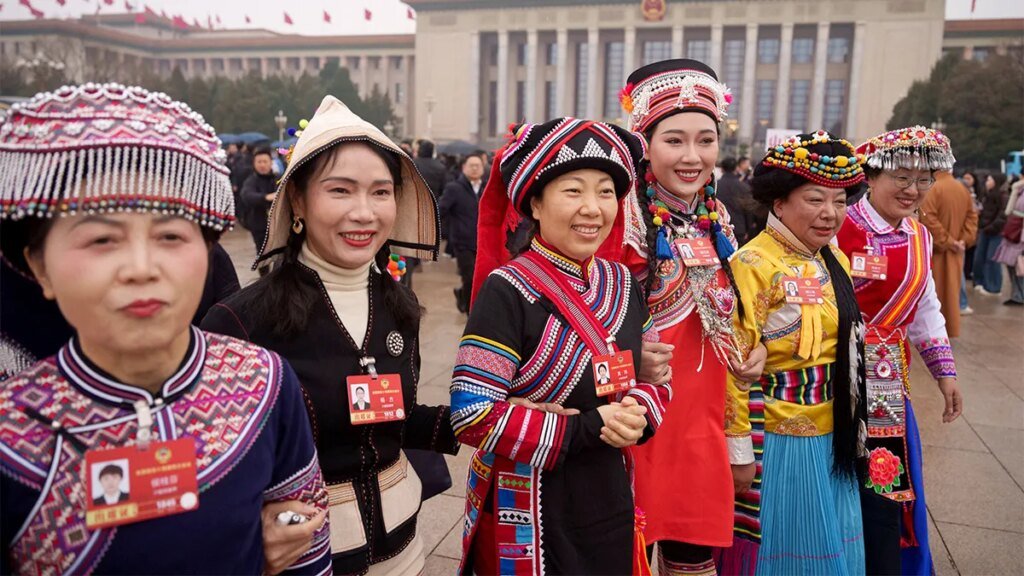
NEWYou can now listen to Fox News articles! China’s top legislature on Thursday passed an “Ethnic Unity and Progress Promotion Law,” formalizing Beijing’s long-running push to strengthen national identity and ethnic integration. The legislation was approved at the closing meeting of the fourth session of the 14th National People’s Congress during its annual parliamentary gathering
Microsoft Corp. has stepped up its investment in Africa’s digital ecosystem as part of its broader strategy to expand artificial intelligence adoption across emerging markets, even as Chinese technology firms quietly move to capture a significant share of the continent’s AI potential. The US technology giant plans to train three million Africans in AI skills