BEIJING—Despite Latin America’s evolving rightward political shift, China’s investments in green-tech sectors in the region are growing—and rapidly. The sale of what the Asian giant calls the “new three”—solar panels, lithium-ion batteries, and electric vehicles (EVs)—to countries across the hemisphere is surging, even as more traditional infrastructure projects have declined in recent years.
Under its “Green Belt and Road” framework, China’s policy banks and state-owned enterprises (SOEs) have underwritten massive solar, wind, and hydroelectric projects across the region—as well as the power grids necessary to connect them to customers, thereby supporting the so-called energy transition. According to the Latin America and the Caribbean Academic Network on China (RedALC-China), between 2010 and 2024, China invested almost $34 billion in 70 renewable energy projects in the region. The scope extends from upstream mining of key resources such as lithium to downstream local manufacturing.
The trend is likely to accelerate in the coming year, even as the U.S. seeks to displace China’s influence in the region and several countries have elected right-wing presidents in recent months. The three key forces driving China’s strategy are as present as ever: its domestic industrial overcapacity, its need for new markets, and its related stance on global supply chains.
The scale of what China needs to offload is enormous. Consider one example: The world’s total installed electricity capacity from all forms of generation was about 10 terawatts in 2024, and today China can produce a terawatt’s worth of solar panels alone every year. These new peaks in Chinese supply are intersecting with Latin America’s growing demand for green tech, especially clean energy and EVs. In the region, as total spending on clean energy projects—renewables, grids, energy efficiency, and electrification—was projected to have reached $70 billion last year, the IEA projects that investments in the sector will exceed $110 billion by 2035, offering an even larger opportunity.
As China and Chinese enterprises seek to capitalize on these opportunities, the best way for Latin America to realize the benefits of these investments will be to ensure that its institutions are prepared to manage potential downsides.
What China sees
While Chinese state-sponsored loans from China Development Bank and Ex-Im Bank to Latin America have fallen dramatically over the last 10 years, Chinese foreign direct investment (FDI) “has soared” across the developing world as Chinese firms gain experience overseas, according to Boston University’s Global Development Policy Center.
For its part, Latin America is an attractive destination specifically for Chinese green tech investment. This stems from a range of factors. First, the region faces strong demand for clean energy expansion, public transit electrification, and industrial upgrades, but insufficient local capital often limits the capacity to meet these needs. Latin American markets also impose fewer geopolitical restrictions and less regulatory resistance on Chinese firms than those in Europe or the U.S.
For China, investing in manufacturing, such as downstream battery and EV production, serves multiple goals. It enables Chinese companies to position themselves as job creators and industrial partners rather than simply as exporters or commodity importers, thereby enhancing political acceptance and consumer legitimacy. As China pursues the region’s globally significant reserves of strategic minerals such as lithium, copper, and nickel, downstream investment helps build the commercial and diplomatic relationships that ultimately facilitate securing access to upstream resources through mining. It also strengthens China’s control over the entire value chain, and helps Chinese firms avoid tariffs and satisfy local-content requirements that are increasingly common in Brazil, Mexico, and other markets.
How Latin America can benefit
For many countries in the region, Chinese engagement provides the resources and technical know-how to accelerate energy transitions and the adoption of new technologies. This is part of the broader Latin American aim of moving beyond commodity exports to advance up the value chain—in this case, as a “green engine” of sustainable growth.
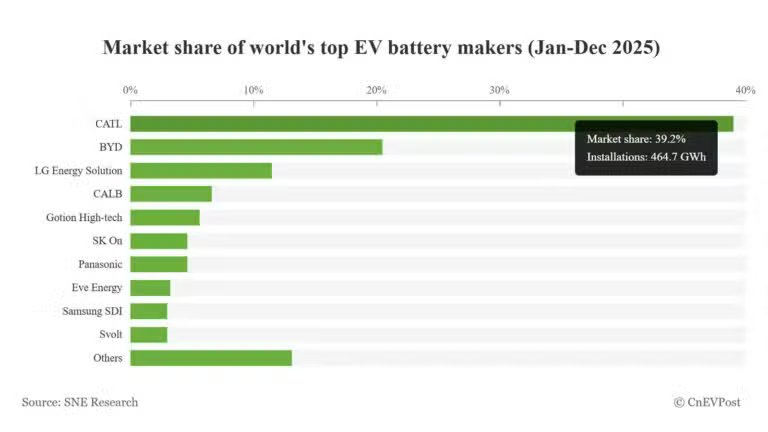
The growing footprint of Chinese carmaker BYD illustrates these trends. The company opened a massive new plant in Camacari, in Brazil’s Bahia state, in October. The factory, built on a former Ford site, is BYD’s biggest-ever investment outside of Asia, and is projected to create about 20,000 jobs—and safeguard its 74% market share in Brazil’s EV market. The company already had electric buses and battery facilities in Campinas, Brazil, and Antofagasta, Chile, and countries such as Colombia and Uruguay have made bulk purchases of BYD electric buses. For its part, Peru has been courting BYD with a plan to build industrial parks near the Chinese-built Chancay mega-port. In Brazil, Mexico, and Colombia, most EV sales are already Chinese imports, and in recent months, more than 80% of EV sales in Brazil have been Chinese.
Meanwhile, due to China’s skyrocketing domestic production of solar and wind energy devices, Latin America will continue to receive competitive offers from Chinese companies to install generation capacity. In Argentina, the Chinese Ex-Im bank helped fund Latin America’s largest solar array, a massive 300-megawatt project built primarily by Chinese firms. Chinese companies have also built large wind farms in places like Coquimbo in Chile and northeast Brazil.
Chinese enterprises also have an interest in resolving another critical bottleneck in the region. Many Latin American nations have ample renewable resources but lack the grid infrastructure to deliver that energy where it’s needed. According to CSIS, Chinese companies are stepping in to build that connective tissue. Chinese firms control all of Lima’s electricity distribution; two-thirds of that in Chile; and about 12% of electricity generation and distribution in Brazil.
Avoiding pitfalls
Dampening the optimism surrounding these projects, questions of governance, sustainability, and sovereignty persist. In several cases, large-scale Chinese-backed projects have sparked local opposition, revealing the tension between developmental promises and environmental or social costs.
Ecuador’s Coca Codo Sinclair hydroelectric dam, the largest Chinese-led infrastructure project in the region to date, is a good example. Initially hailed as a symbol of green cooperation, the project was later riddled with reports of structural defects, cost overruns, and environmental degradation affecting local communities. Similarly, the Kirchner-Cepernic hydroelectric dams on Argentina’s Santa Cruz River, backed by Chinese funding, have faced legal and environmental scrutiny over potential harms to Patagonian ecosystems.
The challenge ahead is to transform this engagement from a “project-based partnership” to a “governance-based partnership” where transparency, accountability, and local agency are as integral as investment flows. The Coca Codo Sinclair dam stands as a cautionary tale: Without inclusive and robust governance, such projects risk perpetuating extractive, top-down development patterns.
China’s green-tech engagement with Latin America embodies both promise and peril. On one hand, it delivers much-needed patient capital, technology, and policy momentum for a region that has struggled to satisfy its demand for green investment. On the other, it brings the risk of unfavorable deals and ESG harms. The future of this engagement will hinge not on the quantity of investments, but on the quality of the institutions managing them.
ABOUT THE AUTHOR

Yanran Xu
Reading Time: 4 minutesXu is an associate professor and the director of the Global Governance and International Affairs program at Renmin University of China.
Tags: China and Latin America, green technology, renewable energy
Any opinions expressed in this piece do not necessarily reflect those of Americas Quarterly or its publishers.