China’s film market has reached 12 billion yuan (about 1.7 billion U.S. dollars) in box office revenue as of Sunday, with holiday releases expected to sustain growth.
A Chinese film expert hailed the market’s resilience despite pressure from new AI-driven entertainment formats, saying the 2026 results are broadly in line with expectations and stronger growth is likely during upcoming holiday periods.
According to data from online platforms, China’s three-day Qingming Festival holiday box office from Saturday to Monday, including pre-sales,surpassed 200 million yuan (about 29 million U.S. dollars) on Sunday. A day earlier, the country’s total box office for 2026 had already surpassed 12 billion yuan, maintaining its lead as the world’s largest single-market box office.
In an exclusive interview China Media Group (CMG), Hu Jianli, secretary-general of the China Film Critics Association, said the market has withstood the impact of emerging forms of visual entertainment in the AI era.
“Amid disruptions from the rise of new forms of visual entertainment in the AI era, China’s film market has managed to hold up under pressure. Generally speaking, I think the 12 billion yuan total is in line with expectations,” he said.
Hu said the strong box office performance of the domestic racing-comedy “Pegasus 3” was driven by consistent film quality and the strength of its franchise, while the success of “Blades of the Guardians” highlighted the appeal of Wuxia, a genre of Chinese fiction or cinema featuring the adventures of martial artists in ancient China.
“‘Pegasus 3’ has grossed more than 4.3 billion yuan (about 625 million U.S. dollars) in box office, surpassing its previous two installments. Overall, its strong box office performance can be attributed to a combination of consistent quality and the strength of its IP. ‘Blades of the Guardians’, on the other hand, is a Wuxia film that achieved a box office surge purely on the back of strong word of mouth, showcasing the unique appeal of this distinct Chinese genre,” he said.
Hu said he is optimistic about the performance of emotionally driven films during the Qingming Festival holiday, adding that compelling storytelling could produce surprise hits.
“More than a dozen Chinese and foreign productions have been released during the Qingming Festival holiday. I am personally optimistic about the performance of these emotionally resonant films during this special period, when people remember and honor their departed loved ones. If a story is well told and able to resonate with audiences, there is potential for dark horse hits to emerge,” he said.
Looking ahead to the upcoming May Day holiday, running from May 1 to 5, Hu said that if box office performance remains strong and total revenue in the first half of the year exceeds 20 billion yuan (about 2.9 billion U.S. dollars), it would meet expectations.
“If the May Day holiday box office performs strongly and total revenue for the first six months exceeds 20 billion yuan, that would be basically in line with expectations,” he said.
Qingming Festival, or Tomb Sweeping Day, falls on April 5 this year. It is a traditional Chinese festival during which people pay tribute to the dead and worship their ancestors.

China’s 2026 box office hits12 billion yuan as holiday releases drive gains
The China-Kazakhstan (Lianyungang) Logistics Cooperation Base has handled more than 20,000 twenty-foot equivalent units (TEUs) of cargo since the start of 2026, with more than 240 China-Europe (Central Asia) freight trains dispatched, according to Nanjing Customs.
Since its official launch in July 2014 as the first physical project under the Belt and Road Initiative, the base has operated more than 7,744 China-Europe (Asia) freight trains, carrying more than 667,000 TEUs of containers.
It now runs six international rail routes covering Central Asia, China-Kyrgyzstan-Uzbekistan, China-Russia and the Trans-Caspian corridor, with access to five outbound ports including Alashankou and Khorgos.
The rail network serves multiple destinations across Asia and Europe, transporting a wide range of goods including automobiles and auto parts, chemical products, household appliances, textiles and garments, and electronic equipment.
The base plays a vital role in ensuring stable industrial and supply chains for Belt and Road partner countries and continues to support high-quality economic development across the Eurasian region.
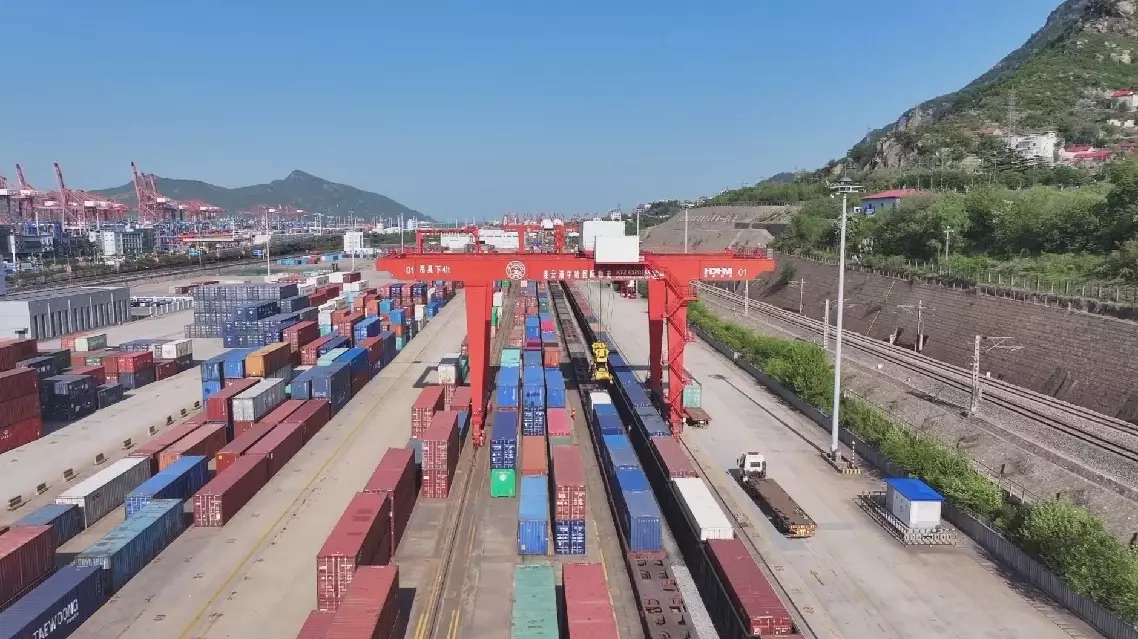
China-Kazakhstan logistics base handles over 20,000 TEUs in early 2026