Xi Jinping could absorb Taiwan.
Lai Ching-te could declare Taiwan independence.
Donald Trump would defend Taiwan if China attacks.
Two of these assumptions hold. One is the lie — and which one you choose likely depends on your politics.
This week, Beijing sharpened the question once again.
On January 1, Chinese President Xi Jinping used his New Year television address to declare that China’s “reunification” with Taiwan was “unstoppable”, invoking what he called a shared “bond of blood and kinship” across the Taiwan Strait.
The remarks came days after Chinese forces wrapped up large-scale military drills around the island.
China announced new military drills to warn against Taiwan’s independence on Monday. (Credit: Chinese People’s Liberation Army)
For the first time, those drills combined air, naval and Rocket Force units, applying pressure from multiple directions — a display that reignited a familiar concern, long flagged by the Pentagon, about rising risk in the Taiwan Strait.
Washington knows it will not provide absolute clarity on Taiwan’s defence.
Beijing knows Taiwan will not become a Chinese province any time soon.
Taipei knows formal independence is unattainable without catastrophic cost.
An unspoken understanding of these three factors now structures the politics of the Taiwan Strait.
Strategy not hesitation
For Taiwan, restraint is often misread as ambiguity or timidity.
In reality, it is a governing strategy shaped by public opinion and lived experience.
Across multiple polls over the past decade, the clearest and most consistent majority position of the Taiwanese people has not been for independence or reunification, but for maintaining the status quo.
Taiwanese voters understand that a formal declaration of independence would not strengthen Taiwan’s position. It would fracture domestic consensus, collapse international support, and give Beijing a ready-made justification for escalation. Independence, in the legal sense, is therefore widely understood as unattainable without unacceptable cost.
As a result, Taiwan’s autonomy today is expressed less through constitutional claims than through everyday governance: competitive elections, the uninterrupted functioning of democratic institutions, and steady international engagement conducted within known limits.
Taiwanese President Lai Ching-te has deliberately avoided symbolic gestures on sovereignty.
He knows his party’s task is not to redefine Taiwan’s status, but to preserve the conditions under which Taiwan’s existing autonomy can continue to function.
Acts of Taiwanisation, while politically resonant, also intersect with domestic electoral competition, regardless of whether they are framed as steps toward formal separation.
For Lai, a prolonged easing of China-US tensions may stabilise the region — but it also risks undercutting the security urgency that sustains domestic political support.
In this sense, independence has become something Taiwan practises rather than proclaims.
But modest signs of warmth between Washington and Beijing — including Trump’s repeated description of Xi as a “good friend” — can unsettle supporters who question how much room Lai really has to manoeuvre within the triangle.
His approval ratings through late 2025, according to Taiwan Public Opinion Foundation surveys, have sat in the low-to-mid 40 per cent range, with disapproval slightly higher — evidence of a divided electorate, but also of a cautious one.
For Taiwan, a prolonged easing of China-US tensions may stabilise the region, but it also risks undercutting the security urgency that sustains domestic political support. (Reuters: Evelyn Hockstein)
Squeezing the timeline
Beijing’s strategy reflects an equally unsentimental assessment.
Despite increasingly explicit rhetoric under Xi’s rule, China has not moved towards invasion. Instead, it has normalised pressure.
Over the past two years, the People’s Liberation Army (PLA) has conducted frequent large-scale exercises around Taiwan, routinely sending dozens of aircraft and naval vessels across the median line that once served as an informal buffer.
These operations are designed to erode old boundaries and signal inevitability, while carefully avoiding actions that would clearly trigger war.
Military pressure is paired with legal warfare, economic coercion and psychological operations.
Trade restrictions are imposed selectively. Diplomatic space is narrowed incrementally. Taiwan’s international participation is challenged wherever possible.
The pattern is deliberate. It aligns with China’s broader strategic preference: squeeze, not seize.
At the same time, Beijing deploys softer tools — historical narratives, cultural framing and propaganda — not to persuade Taiwanese to embrace reunification, but to narrow what they can realistically imagine as possible.
The objective is not absorption tomorrow. It is control over time.
Taiwanese President Lai Ching-te has deliberately avoided symbolic gestures on sovereignty. (Reuters: Ann Wang)
Turning Taiwan into a Chinese province by force would come at extraordinary cost. Even a successful invasion would expose China to sweeping sanctions, long-term diplomatic isolation and the burden of governing a hostile population of 23 million people.
Reunification remains an ideological claim and a legitimacy marker for the Chinese Communist Party (CCP), but it is not a politically survivable outcome in the near term.
Xi’s challenge is therefore not how to reunify Taiwan, but how to ensure that failure to do so is never clearly attributed to him.
Ambiguity as insurance
A hypothetical conflict serves a purpose for all three sides: it prevents the other two from moving too close to one another.
The US has no intention of abandoning Taiwan. But it also has no intention of binding itself to an automatic war commitment on a timeline it does not control.
Strategic ambiguity persists not because it is elegant, but because clarity would impose responsibility — and risk — that Washington prefers to avoid.
Under Trump, this logic is no longer softened by diplomatic language.
Trump approaches security in transactional terms, repeatedly framing alliances around cost, contribution and return. Alignment must be demonstrated, not assumed.
Taiwan’s value is therefore measured in concrete terms: defence spending, industrial cooperation and strategic usefulness.
To sustain US support, Taiwan must also sustain a narrative: a credible China threat and a looming security nightmare. The nightmare does not need to arrive. It only needs to remain believable.
Taiwanese voters understand that a formal declaration of independence would not strengthen Taiwan’s position. (Reuters: Ann Wang)
In 2024 and 2025, Taiwan committed roughly US$40 billion in additional defence spending, pushing military expenditure towards 3 per cent of GDP and locking in major US weapons purchases.
These sales matter militarily, but they matter politically as well. They signal seriousness and ease the pressure in Washington to treat Taiwan as a liability rather than an asset.
As long as the status quo holds, Washington maintains influence in the Taiwan Strait without making an irreversible commitment.
Escalation without rupture
China’s response to deepening US-Taiwan alignment is marked by anger and restraint.
Too little pressure risks normalising separation while too much pressure strengthens Taiwan’s case in Washington. The result is a calibrated approach: escalation without rupture, coercion without war.
Military drills intensify, but stop short of blockade. Rhetoric hardens, but communication channels remain open.
This produces a paradox. Tension rises, but outcomes remain static. Preparation accelerates, but decisive moves are deferred.
All three sides appear to be preparing for a conflict they are simultaneously trying not to own.
The triangle holds — for now — because each actor understands the others’ limits.
Loading
Under pressure at home
This strategic triangle, for decades, has increasingly shaped Taiwan’s domestic governance.
Authorities have revoked visas and deported pro-Beijing influencers who openly advocated Chinese military action, arguing that such speech crosses legal red lines when it incites violence against Taiwan’s sovereignty.
Nationality laws barring mainland-born citizens from holding public office without renouncing Chinese citizenship have been strictly enforced.
The mainland-linked social media platform RedNote has faced tighter scrutiny amid concerns about influence operations.
These measures are limited, contested and legally framed. They do not amount to authoritarianism. But they reflect a democracy operating under constant strategic pressure, increasingly alert to internal vulnerabilities under external threat.
The strain is also visible in Taiwan’s external rhetoric. When Taiwan’s foreign minister Lin Chia-lung framed the government’s position on Palestine using the language of “enemy states”, it unsettled diplomats who worried that Taipei was importing distant global conflicts into an already precarious strategic narrative.
The episode illustrated how narrow Taiwan’s diplomatic margin for error has become and how easily global issues are refracted through the China lens.
China shows a parallel insecurity on the global stage. Despite its ambition to reshape international order, Beijing responds to criticism with censorship, narrative control and diplomatic defensiveness.
It speaks the language of global leadership, but governs as a power deeply uneasy with external judgement.
The US, particularly under Trump, has stepped back from global stewardship altogether. Alliances are treated less as shared commitments than as cost centres. International leadership is framed as a burden rather than a responsibility.
All three claim global relevance, but govern with visible discomfort under sustained global scrutiny.
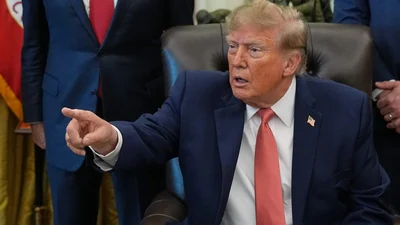
Donald Trump approaches security in transactional terms, repeatedly framing alliances around cost, contribution and return. (AP: Alex Brandon)
A system that works until it doesn’t
This is why the Taiwan Strait feels permanently tense yet structurally frozen.
The system holds not because it is stable, but because it is politically useful.
It allows China to apply pressure without war, Taiwan to consolidate autonomy without provocation, and the US to maintain influence without commitment.
But this is not equilibrium. It is postponement.
The triangle is held together not by trust or shared vision, but by a shared aversion to blame — fear of being the leader who miscalculated, provoked too far, or failed to act at the critical moment.
That makes the system resilient in the short term, but brittle over time.
The real danger is not that one side suddenly believes the lie, it is that circumstances leave a leader no choice but to act as if it were true. That is when shared denial stops containing risk — and starts creating it.