Toplines
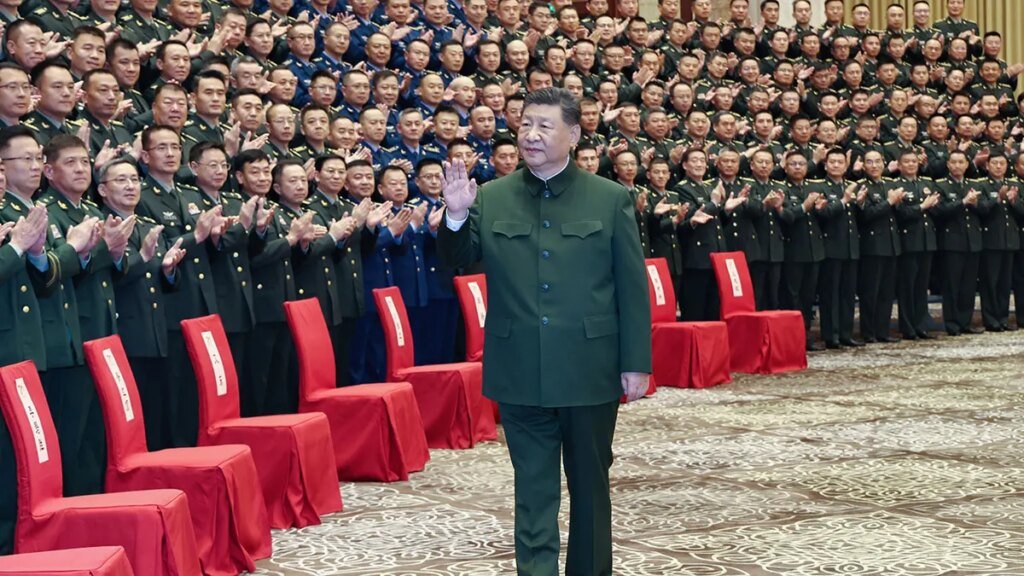
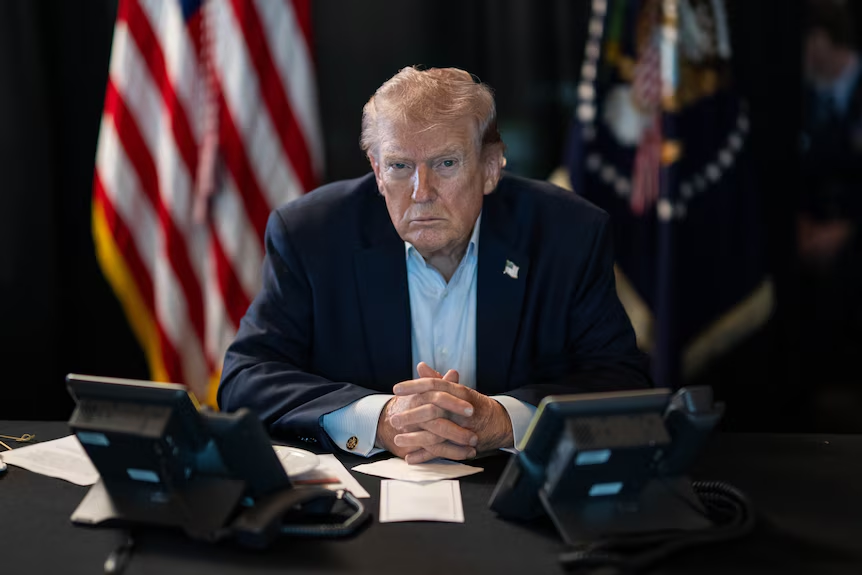
US President Donald Trump announced on March 17 that he would delay his planned talks with CCP General Secretary Xi Jinping to prioritize the conflict in Iran. US Treasury Secretary Scott Bessent met with PRC Vice Premier He Lifeng on March 15 and 16 to discuss issues related to US-PRC trade, including the prospect of a “Board of Trade” that would manage bilateral trade and investment, as a precursor to the Trump-Xi summit.[1] Both sides reported that the talks were productive, though they did not announce any new initiatives or purchasing commitments. The Bessent-He talks followed a March 11 announcement from US Trade Representative Jamieson Greer on new Section 301 investigations into unfair trade practices that could impose new tariffs on several countries, including the PRC.[2] The PRC Ministry of Commerce rejected these investigations on March 13, and He reiterated PRC concerns over the investigations and other US trade restrictions.[3]
Trump announced on March 16 (and confirmed on March 17) that he would delay the summit with Xi “five or six weeks” to prioritize the conflict in Iran.[4] The White House confirmed that the PRC agreed to Trump’s request on March 18.[5] The United States and the PRC have not yet announced the new date for the Trump-Xi summit at time of writing. The delay in the Trump-Xi summit will extend the trade dispute between the two states, but the demands of each side are unlikely to change significantly. The impact of the Iran conflict and disruption of trade through the Strait of Hormuz will continue to impact both the PRC and the United States prior to the summit. The PRC will likely attempt to exploit any US economic and political discontent with the conflict in future negotiations to ensure that it can obtain the best possible terms.
Taiwanese think tank Doublethink Lab published a report revealing that a PRC state-affiliated firm compiled information on tens of thousands of prominent Taiwanese people, including 170 politicians, to support PRC cognitive warfare and election interference campaigns in Taiwan. Doublethink Lab published a report on March 4 that found that the PRC firm GoLaxy compiled an extensive database of Taiwanese politicians, political parties, and influential individuals to monitor and influence Taiwanese public opinion, especially during elections.[6] Doublethink Lab based the report on leaked documents obtained by Vanderbilt University around August 2025.[7] The database includes detailed files on 170 Taiwanese politicians including President William Lai Ching-te, former president Tsai Ing-wen, foreign minister Lin Chia-lung, and Taiwan People’s Party (TPP) founder Ko Wen-je. It also includes records of tens of thousands of prominent Taiwanese academic, business, and religious figures; around 75 political parties; nearly 1,500 companies, 13,000 religious groups, nearly 24,000 civic organizations; and 23 million household registration records — roughly Taiwan’s entire population.[8] The database included categorization and search functions for individuals and organizations that included ideology, address, and “attitude toward China.” The leaked documents also showed that GoLaxy produced a weekly report on Taiwanese public opinion in the months before Taiwan’s January 2024 presidential and legislative elections.[9]
The GoLaxy database shows an extensive effort to support PRC narrative warfare and election interference in Taiwan, including using artificial intelligence (AI). GoLaxy spun off from the Institute of Computing Technology at the Chinese Academy of Sciences (CAS), the PRC’s premier state-owned research institution.[10] GoLaxy aimed to create a “smart propaganda system.” GoLaxy sought for greater guidance and funding from state agencies, including the Cyberspace Administration of China, the Central Propaganda Department, the Science and Technology Commission of the Central Military Commission, and the Ministry of State Security.[11] GoLaxy seeks to create a system of online bots to automatically produce targeted PRC propaganda based on the data collected by its machine learning platform.
The PRC will very likely try to use AI-backed narrative warfare to shape the outcomes of Taiwan’s upcoming local and presidential elections and promote political division in Taiwan. ISW-CDOT previously reported on audio leaks that appeared to show members of the then PLA Strategic Support Force and a PRC tech firm discussing how to boost the Han Kuo-yu’s 2018 Kaohsiung mayoral campaign.[12] Han served as Kaohsiung’s mayor until 2020 and is now the speaker of the Taiwan’s Legislative Yuan (LY). The GoLaxy files also showed that the company was tracking US politics using a database of US political figures and prominent elites, including all members of Congress and 2022 Congressional candidates. It is unclear the extent to which the firm attempted to influence US elections and public opinion, however.
Key Takeaways
- US-PRC meetings: US President Donald Trump announced on March 17 that he would delay his planned talks with CCP General Secretary Xi Jinping to prioritize the conflict in Iran.
- PRC narrative warfare: Taiwanese think tank Doublethink Lab published a report revealing that a PRC state-affiliated firm compiled information on tens of thousands of prominent Taiwanese people, including 170 politicians, to support PRC cognitive warfare and election interference campaigns in Taiwan.
Cross-Strait Relations
Taiwan
Taiwan’s LY allowed the Executive Yuan (EY) to sign four expiring US arms Letters of Offer and Acceptance (LOAs) before the broader supplemental defense budget finishes review. The opposition Kuomintang (KMT) remains willing to preserve existing US arms sales even as it continues to reject Lai administration spending requests. The LY passed a motion on March 13 authorizing the Cabinet to sign four US weapons agreements that would provide equipment including High Mobility Artillery Rocket Systems (HIMARS), Javelins, Tube-launched, Optically-tracked, Wire-guided (TOW) missiles, and M109A7 self-propelled howitzers, before the March 15 deadline.[13] The four packages are worth about 9 billion US dollars and are part of a broader 11 billion US dollar arm package announced in December.[14]
A bipartisan group of 37 US lawmakers expressed concerns over delays in reviewing the special budget in February.[15] The LY agreed on February 24 to discuss the administration’s special budget and the KMT and TPP proposed versions.[16] The KMT and TPP versions of the budget are significantly smaller than the administration’s version. The KMT and TPP collectively hold a majority within the LY, making it likely that some reduced version will ultimately pass review. The LY’s actions indicate that they are receptive to US pressure and prioritize maintaining US ties over continuing partisan disputes. ISW-CDOT assessed that passing a reduced defense budget could signal to the United States that domestic politics may limit future efforts to enhance Taiwan’s deterrence capacity. Taiwan’s inability to increase its defense spending could delay Taiwanese military modernization and decrease US confidence in Taiwan’s desire and ability to provide for its own defense.
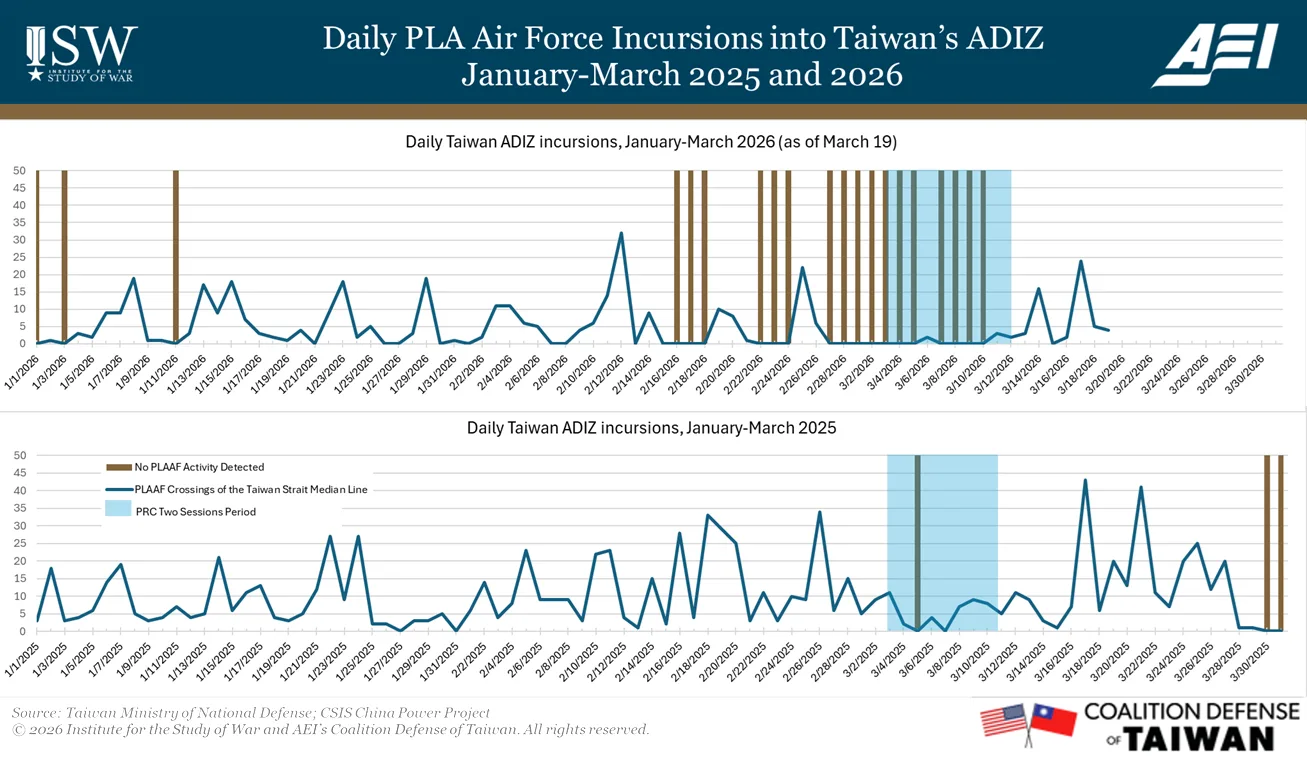
The PLA Air Force (PLAAF) resumed activity around Taiwan after the PRC’s “Two Sessions” concluded. Recent PLAAF activity and incursions into Taiwan’s Air Defense Identification Zone (ADIZ) continued at very low levels, however, which supports ISW-CDOT’s assessment that declining ADIZ incursions may indicate a new trend in the PRC’s military coercion of Taiwan. PLAAF incursions into Taiwan’s ADIZ have significantly declined since January 2026, including 17 days between February 15 and March 15 with no PLAAF activity near Taiwan.[17] The longest pause in PLAAF activity roughly coincided with the PRC’s annual National People’s Congress (NPC) and the Chinese People’s Political Consultative Conference (CPPCC), the Two Sessions, which lasted from March 4 through 12. The PLAAF resumed daily activity around Taiwan on March 11, indicating that the Two Sessions was likely a significant factor in the pause in activity. PLAAF activity around Taiwan often declines around the Two Sessions and other key political events.[18] The PLA normalized near-daily aerial sorties across the median line of the Taiwan Strait, into Taiwan’s de-facto ADIZ, to erode Taiwan’s threat awareness and to signal displeasure with Taiwanese government actions.
Low levels of PLAAF activity around Taiwan continue to indicate that the PLAAF may be shifting its coercion strategies targeting Taiwan even after the Two Sessions, however. The PLAAF carried out fewer than five daily incursions into Taiwan’s ADIZ on most days since March 11, much lower than the same time last year.[19] The PLA normalized an average of over 300 ADIZ incursions per month when President Lai took office in May 2024, but this monthly total fell below 200 in January and February 2026, and will likely be even lower in March. [20] The Eastern Theater Command PLAAF may have hit its maximum peacetime operational capacity and is now reducing the volume of its operations around Taiwan.[21] Reducing daily PLAAF operations around Taiwan can free up resources to focus on other priorities, such as enhancing joint combat operations, and restore the utility of ADIZ incursions as a means of short-term political signaling.
A new PRC law on ethnic unity could supplement the PRC’s means of persecuting supporters of Taiwanese independence. It is unlikely to significantly expand PRC lawfare against Taiwan, however. The PRC NPC passed a law on March 12 to promote “ethnic unity and progress.”[22] The law mostly focuses on promoting a common Chinese identity among all ethnic groups in the PRC through education, media, technology, infrastructure, language policy, and other means. The law also establishes civil and criminal penalties against individuals and organizations that “undermine national unity and progress or create national separatism against the People’s Republic of China,” even if those individuals are outside the territory of the PRC. [23] Taiwanese Mainland Affairs Council (MAC) deputy minister Shen Yu-chung said that the PRC could use the law to punish supporters of Taiwanese independence, because the law is vague about what constitutes “undermining national unity” and allows for extraterritorial prosecution.[24]
The law may provide Beijing with an additional legal basis for persecuting Taiwanese independence supporters but is unlikely to significantly expand Beijing’s Taiwan coercion measures. The PRC does not consider Taiwanese people to be a separate ethnic group and the law only briefly mentions promoting “Chinese” identity on both sides of the Taiwan Strait.[25] The PRC’s 2005 Anti-Secession Law already criminalizes Taiwanese “separatist” activities and allows Beijing to prosecute Taiwanese “separatists” in absentia. The PRC has used that law, along with new legal clarifications it issued in 2024, to justify criminal investigations against Taiwanese people deemed “Taiwan independence diehards,” including currently serving government officials.[26] PRC officials and state media have called for severe penalties for Taiwanese “separatists,” up to the death penalty, and advocated pursuing them anywhere in the world. [27]
Taiwanese authorities sentenced a senior Taiwanese Coast Guard Administration (CGA) official to fourteen years in prison on March 11 for crimes including leaking sensitive national security information to PRC officials. PRC espionage operations likely target the CGA to obtain sensitive defense information and enable the PRC’s coercive activities against Taiwan. Taiwanese authorities detained then-Director of the Duty Command Center of the CGA’s Kinmen-Matsu-Penghu Branch Chuang Tsung-hui in May 2025.[28] The CGA dismissed Chuang from his post after his detention, authorities indicted him on national security and corruption charges in August 2025, and convicted him on March 11.[29] Chuang’s charges include leaking CGA duty rosters for the Kinmen area, personnel files, ship deployment schedules, and data from radar installations to PRC officials in exchange for bribes.[30]
Taiwanese authorities sentenced a CGA officer, surnamed Lee, to seven years and eight months in prison in January for passing sensitive information to a PRC intelligence agency from 2022 to 2024 in exchange for cryptocurrency bribes worth around 18,500 US dollars.[31] Taiwanese authorities also sentenced a former commander in the CGA’s Intelligence Division and an official in the clerical division to eight months in prison in 2022 for sending secret documents to PRC officials for pay.[32] PRC efforts to acquire information about CGA personnel and ship deployments likely enable the PRC’s repeated illegal maritime incursions around Kinmen and other Taiwanese outlying territories, which erode Taiwanese jurisdiction and sovereignty over its territory and reduce Taiwanese threat awareness.[33]
Taiwan has sought to raise awareness of the PRC’s espionage recruitment tactics among Taiwanese citizens and deter future operations by publicizing and punishing PRC espionage activities. Taiwanese President William Lai Ching-te announced a seventeen-point plan to counter national security threats posed by the PRC in March 2025, including recommendations to amend and update anti-espionage laws and restore the military trial system to prosecute members of Taiwan’s military recruited to spy for the PRC.[34] Taiwan’s National Security Bureau also released reports on PRC espionage recruitment tactics and online political interference operations in January 2025 and January 2026, respectively.[35]
The US Navy’s P-8A Poseidon aircraft transited the Taiwan Strait in international airspace on March 11 to assert freedom of navigation rights in international airspace.[36] Spokesperson for the US Seventh Fleet Matthew Comer stated that this action demonstrated US commitment to “a free and open Indo-Pacific.”[37] This is the first publicly reported US aerial transit of the Taiwan Strait in 2026. PRC media outlet Global Times reported that the PLA naval and air forces tracked and monitored the transit.[38]
Northeast Asia
Japan
The Japanese Maritime Self-Defense Force (JMSDF) is improving its air and missile defense capabilities through technological cooperation with the United States. Bolstering this capability will allow the JMSDF to take on a greater role in deterring PRC and North Korean regional aggression. US defense company Lockheed Martin delivered the second of two AN/SPY-7 radar systems to Japan on March 12.[39] The radar system will be used on the JMSDF’s two Aegis system-equipped vessels (ASEV).[40] The Aegis System is an integrated network of sensors, computers, and interceptors designed to enhance surface vessel’s ability to intercept aerial targets.[41] The AN/SPY-7 can track several targets simultaneously at greater ranges than existing radar systems in service with the JMSDF.[42]
Fielding multiple ASEVs equipped with advanced radar systems will enhance Japan’s missile defense network against threats from the PRC and North Korea. The ASEV can displace 14,000 tons, carry an armament of 128 vertical launch system (VLS) cells, and perform anti-air, anti-surface, and land-attack missions with this large VLS armament. US Navy Arleigh Burke-class destroyers have used the Aegis system and the SM-3 missile to intercept multiple ballistic missiles over Turkey during the United States’ conflict with Iran, illustrating the value of sea-based ballistic missile defenses.[43] The PRC and North Korea field ballistic missiles capable of striking Japan during a conflict.[44]
Deploying ASEVs as a key component of Japan’s missile defense network will also likely improve Japan’s efforts to combat PRC attempts to establish military dominance in the Western Pacific.[45] The ASEV will be the first vessel in the JMSDF that can rival the PRC’s principal surface combatant, the Type 055 destroyer, in size and armament.[46] Japan could use the ASEV to enhance its ability to contest PLA Navy (PLAN) control of the sea in areas the PRC has frequently operated during peacetime, such as the Miyako Strait and the Western Pacific astride the sea lines of communication (SLOCs) between Japan, Taiwan, and Guam.[47] Japan can diminish the PRC’s ability to use its surface fleet to break key connections between the US and its allies in the region and use larger assets to dissuade Japanese military modernization or support for Taiwan by preventing the PLAN from operating in these areas uncontested.
Oceania
Australian authorities convicted an Australian national on March 13 for writing reports on sensitive economic and national security topics for PRC Ministry of State Security (MSS) agents. The MSS’s tactics in this case follow a pattern seen in multiple global espionage operations. A suspected MSS agent approached businessman Alexander Csergo through LinkedIn in 2021 while Csergo was working in the PRC.[48] The suspected MSS operative posed as an employee at a think tank and offered to pay Csergo for “consulting” work.[49] Csergo agreed to compile reports on topics including lithium mining, defense, and the Australia-United Kingdom-United States (AUKUS) trilateral partnership from 2021 to 2023, when he returned to Australia.[50] Australian authorities arrested Csergo in March 2023 and convicted him of reckless foreign interference for supporting a PRC intelligence operation by writing and sending the reports.[51] Csergo’s defense argued that all the information he provided to the MSS was publicly available, but the court found that Csergo’s actions were illegal under Australian law.[52]
Recent PRC espionage operations targeting the United States, NATO member states, and US partners in the Pacific have used similar recruitment tactics. Cases included PRC intelligence agents’ recruitment of US Navy sailor Jinchao Wei in 2022, Greek Air Force Colonel Christos Flessas in 2025, and several Philippine defense staffers from 2023 to 2024 to divulge sensitive defense information.[53] PRC intelligence agents commonly approach targets through LinkedIn and other professional networking sites, posing as employees at consultancies or research firms and offering to pay targets to write reports on innocuous topics before eventually asking them to pass sensitive defense and national security-related information.[54]
Australian authorities have recently prosecuted several other cases of PRC foreign interference. Australia convicted businessman and former Liberal Party political candidate Di Sanh “Sunny” Duong and sentenced him to two years and nine months in prison in February 2024 for seeking to influence a government minister through political donations on behalf of the PRC.[55] Australian authorities also charged one PRC national in August 2025 and two others in February 2026 with reckless foreign interference for covertly gathering information on the Canberra branch of Guan Yin Citta, a Buddhist group banned in the PRC, on behalf of the PRC Public Security Bureau [56]
Iran
The PRC is continuing to push for the reopening of the Strait of Hormuz and attempting to mediate the war in Iran via diplomatic engagements. ISW-CDOT continues to observe little to no evidence of material support to Iran beyond humanitarian aid. The PRC is attempting to leverage the war to advance its own regional agenda. The PRC announced emergency humanitarian aid to Jordan, Lebanon, and Iran on March 17.[57] The PRC likely seeks to project an impression of neutrality and is using foreign aid to balance its relationships with multiple Middle Eastern states. The PRC likely aims to show rhetorical and humanitarian support to Iran while avoiding the reputational costs that could stem from providing military aid to Iran or assisting military efforts to reopen the Strait of Hormuz. Transits through the Strait of Hormuz have dropped to near-zero amid the conflict; some tankers bound for the PRC have passed through the strait, however.[58]
The PRC is using the Iran conflict to advance its security agenda in its own region, notably against Taiwan and Japan. The PRC stockpiled oil before the conflict broke out in February 2026 and is taking advantage of global oil shortages to coerce its neighbors economically.[59] PRC TAO spokesman Chen Binhua said that if Taiwan agreed to “peaceful reunification” the PRC would “provide Taiwan compatriots with stable and reliable energy and resource security, so that they may live better lives.”[60] This rhetoric echoes previous PRC efforts to sway Taiwan toward “reunification” via economic means.[61] Hong Kong-based outlet South China Morning Post (SCMP) similarly published an article detailing Japan’s use of its strategic oil reserves and highlighting Japan’s vulnerability to PRC economic coercion.[62]
Latin America
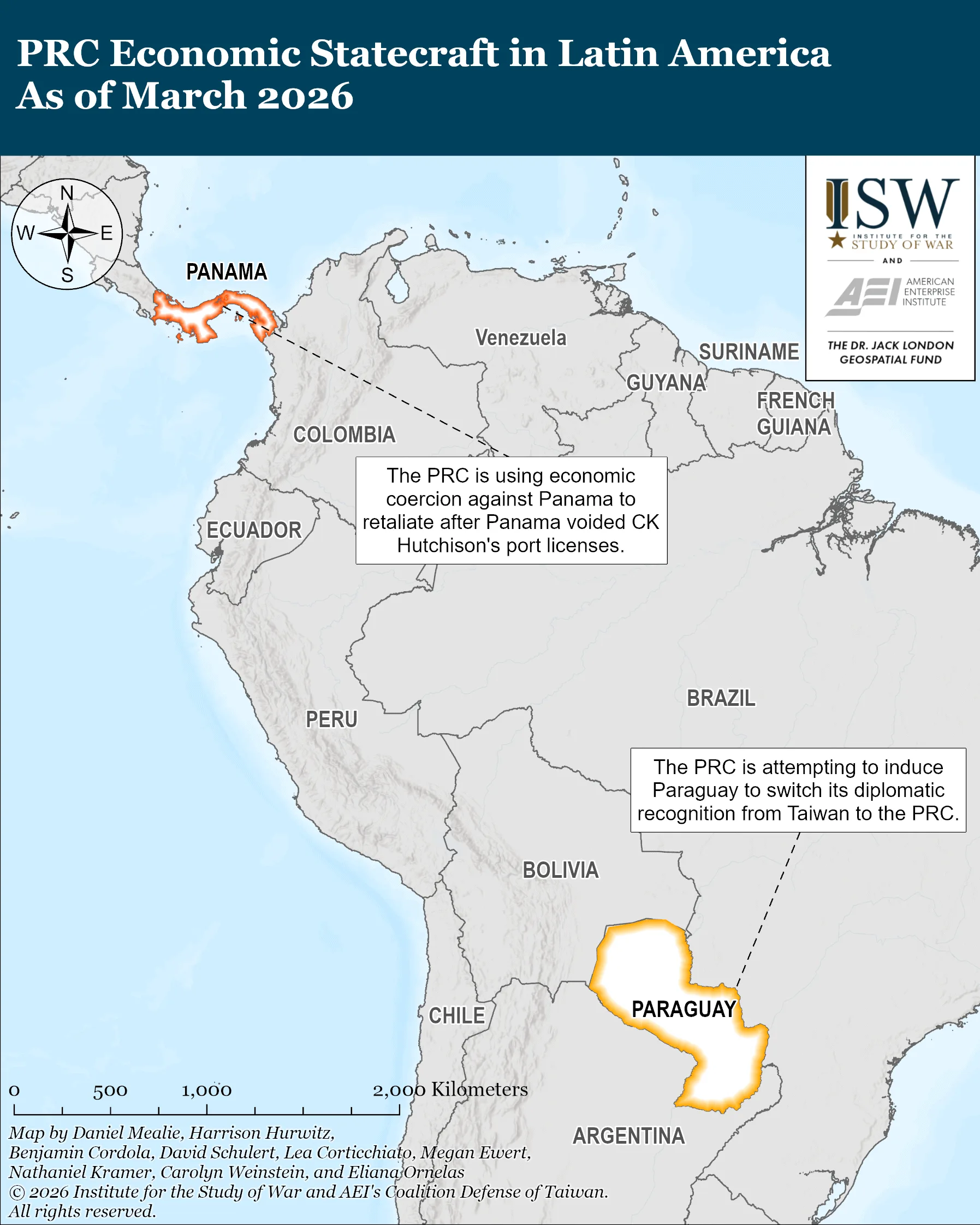
The PRC is applying economic pressure to Panama following Panama’s decision to void CK Hutchison’s Panama Canal ports contracts. PRC shipping megacorporation COSCO announced on March 10 it would suspend arrivals and departures at Balboa Port, one of two ports at either end of the Panama Canal formerly managed by Hong Kong-based CK Hutchison.[63] Panama had previously ruled CK Hutchison’s contracts over the two ports unconstitutional and announced in February 2026 that it would requisition the ports.[64] APM Terminals, a unit of global shipping firm Maersk, is currently administering the ports for a period of up to 18 months following Hutchison’s ouster.[65] Panamanian Minister for canal affairs Jose Ramón Icaza Clément said on March 13 that COSCO represents four percent of Balboa Port’s goods and that he hoped COSCO would reverse its decision.[66]
An anonymous source similarly told SCMP that the PRC would heighten its inspections against Panama-flagged vessels entering PRC ports.[67] SCMP reported that since the PRC Ministry of Transport summoned shipping companies Maersk and Mediterranean Shipping Co (MSC) to discuss “international business conduct,” Panama-flagged vessels have gone from 20 percent of ship detentions to 73.7 percent relative to the same period last year.[68] Prolonged detentions by the PRC could deter shipowners from maintaining the Panamanian registry, another form of economic coercion.[69]
The PRC’s economic coercion against Panama reflects the PRC’s view of the Panama Canal as strategically significant. US policymakers have expressed concern that the PRC could block the canal, a central lifeline of US trade, in a conflict with the United States.
Taiwan accused the PRC of attempting to induce Paraguay to switch its diplomatic recognition to the PRC. The PRC frequently attempts to poach Taiwan’s diplomatic allies as a means of eroding international support. Reuters on March 14 published an article detailing PRC efforts to sway Paraguayan officials to change Paraguay’s recognition from Taiwan to the PRC using inducements such as luxury tours and banquets.[70] Reuters found that at least nineteen Paraguayan lawmakers have visited the PRC since late 2023, as well as five journalists.[71] The PRC does not trade directly with Paraguay, which must route exports to the PRC through Brazil and Argentina, due to its recognition of Taiwan.[72] PRC efforts to poach Taiwan’s diplomatic allies, including through economic and diplomatic coercion, reflect a broader effort to erode support for Taiwan internationally. The PRC frequently uses economic means — both inducements and coercion — to sway trade partners to embrace diplomatic ties.[73] Taiwan maintains twelve diplomatic allies worldwide, including Paraguay.[74]
The PRC likely fears losing diplomatic recognition across Latin America as other regional countries reconsider their ties with the PRC. Panama withdrew from the PRC’s global Belt and Road Initiative in 2025 and Honduras is similarly reevaluating its ties with the PRC after it decided to recognize the PRC over Taiwan in 2023.[75]

[1] https://asia.nikkei dot com/economy/trade-war/us-and-china-weigh-new-mechanism-for-managing-trade-investment
[2] https://ustr.gov/about/policy-offices/press-office/press-releases/2026/march/ustr-initiates-section-301-investigations-relating-structural-excess-capacity-and-production
[3] http://english.scio.gov dot cn/pressroom/2026-03/16/content_118384921.html; https://asia.nikkei.com/economy/trade-war/us-and-china-weigh-new-mechanism-for-managing-trade-investment
[4] https://www.nbcnews.com/politics/trump-administration/trump-delays-china-trip-focus-war-iran-rcna263874
[5] https://www.reuters.com/world/asia-pacific/white-house-says-china-agreed-postpone-trumps-beijing-trip-2026-03-18/
[6] https://medium.com/doublethinklab/the-rise-of-ai-in-prc-influence-operations-nine-takeaways-from-the-golaxy-documents-2d6617a753e5 ; https://www.taipeitimes dot com/News/front/archives/2026/03/18/2003854013
[7] https://www.vanderbilt.edu/national-security/wicked-problems-lab/golaxy/ ; https://www.nytimes.com/2025/08/05/opinion/china-ai-propaganda.html
[8] https://www.taipeitimes dot com/News/front/archives/2026/03/18/2003854013
[9] https://medium.com/doublethinklab/the-rise-of-ai-in-prc-influence-operations-nine-takeaways-from-the-golaxy-documents-2d6617a753e5
[10] https://medium.com/doublethinklab/the-rise-of-ai-in-prc-influence-operations-nine-takeaways-from-the-golaxy-documents-2d6617a753e5
[11] https://medium.com/doublethinklab/the-rise-of-ai-in-prc-influence-operations-nine-takeaways-from-the-golaxy-documents-2d6617a753e5
[12] https://understandingwar.org/research/china-taiwan/china-taiwan-update-january-2-2026/
[13] https://focustaiwan.tw/politics/202603130007
[14] https://www.reuters.com/world/china/taiwan-parliament-authorises-government-sign-stalled-us-arms-deals-2026-03-13
[15] https://www.reuters.com/world/china/us-lawmakers-step-up-pressure-taiwan-parliament-approve-defence-spending-2026-02-13/
[16] https://www.reuters.com/world/china/taiwan-parliament-discuss-stalled-special-defence-budget-next-week-2026-02-24/
[17] https://x.com/MoNDefense ; https://understandingwar.org/research/china-taiwan/china-taiwan-update-march-13-2026/
[18] https://x.com/MoNDefense ; https://x.com/BrianTHart/status/2030056804982329543
[19] https://docs.google.com/spreadsheets/d/1qbfYF0VgDBJoFZN5elpZwNTiKZ4nvCUcs5a7oYwm52g/edit?gid=1177684118#gid=1177684118 ; https://x.com/MoNDefense
[20] https://understandingwar.org/research/china-taiwan/china-taiwan-update-march-6-2026/
[21] https://jamestown.org/military-implications-of-pla-aircraft-incursions-in-taiwans-airspace-2024/
[22] https://www.news dot cn/politics/20260313/748e7a2db7764d82b4259c9e1256082e/c.html
[23] https://www.news dot cn/politics/20260313/748e7a2db7764d82b4259c9e1256082e/c.html
[24] https://www.taipeitimes dot com/News/taiwan/archives/2026/03/13/2003853746
[25] https://www.news dot cn/politics/20260313/748e7a2db7764d82b4259c9e1256082e/c.html
[26] https://understandingwar.org/research/china-taiwan/china-taiwan-update-november-17-2025/
[27] https://understandingwar.org/research/china-taiwan/china-taiwan-update-november-17-2025/
[28] https://www.taipeitimes dot com/News/taiwan/archives/2025/08/26/2003842693; https://news.ltn.com dot tw/news/society/paper/1746469
[29] https://news.ltn.com dot tw/news/society/paper/1746469; https://www.taipeitimes dot com/News/taiwan/archives/2025/08/26/2003842693; https://news.ltn.com dot tw/news/society/paper/1746469
[30] https://www.judicial.gov dot tw/tw/cp-1888-1506587-abb5a-1.html; https://www.taipeitimes dot com/News/taiwan/archives/2025/08/26/2003842693; https://news.ltn.com dot tw/news/society/paper/1746469
[31] https://www.taiwannews.com dot tw/news/6277224
[32] https://www.taipeitimes dot com/News/taiwan/archives/2024/01/26/2003812653
[33] https://www.aei.org/articles/china-taiwan-update-january-23-2026/; https://understandingwar.org/research/china-taiwan/china-taiwan-update-january-23-2026/
[34] https://www.aei.org/articles/china-taiwan-weekly-update-march-21-2025/; https://understandingwar.org/research/china-taiwan/china-taiwan-weekly-update-march-21-2025/; https://www.taiwannews.com dot tw/news/6058791
[35] https://www.taiwannews.com dot tw/news/6014701; https://www.taipeitimes dot com/News/front/archives/2026/01/12/2003850442
[36] https://www.reuters.com/world/china/us-navy-aircraft-transits-taiwan-strait-ahead-trumps-planned-china-visit-2026-03-11/
[37] https://www.scmp dot com/news/china/military/article/3346400/us-navy-patrols-taiwan-strait-xi-trump-summit-triggering-pla-manoeuvres
[38] https://www.globaltimes dot cn/page/202603/1356797.shtml
[39] https://www.navalnews.com/naval-news/2026/03/lockheed-martin-delivers-second-shipment-of-asev-shipsets-and-an-spy-7v1-equipment-to-japan/
[40] https://www.businessinsider.com/japan-building-warships-to-counter-north-korean-missile-threat-2022-12; https://www.navaltoday.com/2026/03/16/lockheed-martin-delivers-new-an-spy-7v1-radar-equipment-to-japan/
[41] https://www.navy.mil/Resources/Fact-Files/Display-FactFiles/Article/2166739/aegis-weapon-system/
[42] https://www.radartutorial.eu/19.kartei/07.naval2/karte051.en.html; https://www.lockheedmartin.com/en-us/products/spy-7.html; https://www.radartutorial.eu/19.kartei/07.naval/karte003.en.html
[43] https://x.com/sentdefender/status/2032437546936926660
[44] https://news.usni.org/2026/03/16/north-korea-fires-10-missiles-over-sea-of-japan-in-latest-multiple-rocket-launcher-system-test; https://www.businessinsider.com/new-pentagon-maps-show-the-reach-of-chinas-expanding-missile-force-2025-12
[45] https://understandingwar.org/research/china-taiwan/china-taiwan-update-march-13-2026/
[46] https://news.usni.org/2026/03/11/chinese-navys-new-type-055-destroyers-join-taiwan-focused-command
[47] https://understandingwar.org/research/china-taiwan/china-taiwan-update-march-13-2026/; https://understandingwar.org/research/china-taiwan/china-taiwan-weekly-update-december-12-2025/; https://understandingwar.org/research/china-taiwan/china-taiwan-weekly-update-june-16-2025/
[48] https://www.abc.net.au/news/2026-03-13/nsw-alexander-csergo-foreign-interference-guilty-verdict/106451102
[49] https://www.abc.net.au/news/2026-03-13/nsw-alexander-csergo-foreign-interference-guilty-verdict/106451102
[50] https://www.abc.net.au/news/2026-03-13/nsw-alexander-csergo-foreign-interference-guilty-verdict/106451102
[51] https://www.abc.net.au/news/2026-03-13/nsw-alexander-csergo-foreign-interference-guilty-verdict/106451102; https://www.smh.com.au/national/australian-expat-was-chinese-spy-asset-jury-finds-20260313-p5oaag.html; https://www.afp.gov.au/crimes/espionage-and-foreign-interference
[52] https://www.afp.gov.au/crimes/espionage-and-foreign-interference
[53] https://www.aei.org/articles/china-taiwan-update-march-13-2026/; https://understandingwar.org/research/china-taiwan/china-taiwan-update-march-13-2026/; https://www.justice.gov/opa/pr/former-us-navy-sailor-sentenced-200-months-spying-china; https://www.aei.org/articles/china-taiwan-weekly-update-august-29-2025/; https://understandingwar.org/research/china-taiwan/china-taiwan-weekly-update-august-29-2025/; https://www.aei.org/articles/china-taiwan-update-february-13-2026/; https://understandingwar.org/research/china-taiwan/china-taiwan-update-february-13-2026/; https://www.newsweek.com/greece-nato-military-officer-arrest-china-spying-11509451
[54] https://www.aei.org/articles/china-taiwan-update-march-13-2026/; https://understandingwar.org/research/china-taiwan/china-taiwan-update-march-13-2026/
[55] https://www.abc.net.au/news/2024-02-29/di-sanh-duong-jailed-foreign-interference-alan-tudge/103526200; https://www.abc.net.au/news/2023-12-19/sunny-di-sanh-duong-foreign-interference-chinese-communist-party/103247096
[56] https://www.aei.org/articles/china-taiwan-update-march-1-2026/; https://understandingwar.org/research/china-taiwan/china-taiwan-update-march-1-2026/; https://www.afp.gov.au/news-centre/media-release/chinese-national-charged-foreign-interference-offence-canberra; https://www.afp.gov.au/news-centre/media-release/two-further-chinese-nationals-charged-foreign-interference-canberra
[57] https://www.globaltimes dot cn/page/202603/1357106.shtml
[58] https://www.wsj.com/livecoverage/stock-market-today-dow-sp-500-nasdaq-03-17-2026/card/hormuz-crossings-paralysed-but-china-bound-ships-keep-moving-tJLyPHyGeYfpJXflVNtw?mod=Searchresults&pos=7&page=1
[59]https://www.nytimes.com/2026/03/10/business/china-iran-oil.html; https://www.reuters.com/markets/commodities/china-boosted-crude-stockpiles-start-2026-is-not-using-them-2026-03-17/;
[60] https://www.reuters.com/world/china/china-makes-energy-security-reunification-offer-taiwan-amid-middle-east-war-2026-03-18/
[61] https://www.reuters.com/world/china/china-ramps-up-business-charm-offensive-towards-taiwan-alongside-political-2025-04-22/
[62] https://www.scmp dot com/economy/global-economy/article/3346499/japan-taps-oil-reserves-iran-war-spreads-could-it-give-china-leverage?module=top_story&pgtype=homepage
[63] https://www.bloomberg.com/news/articles/2026-03-11/china-s-cosco-halts-panama-port-operations-as-tensions-rise
[64] https://understandingwar.org/research/china-taiwan/china-taiwan-update-march-1-2026/
[65] https://www.reuters.com/world/china/panama-hopes-chinas-cosco-will-resume-operations-balboa-port-minister-says-2026-03-13/
[66] https://www.reuters.com/world/china/panama-hopes-chinas-cosco-will-resume-operations-balboa-port-minister-says-2026-03-13/
[67] https://www.scmp dot com/economy/global-economy/article/3346767/papers-please-china-raises-pressure-panama-amid-canal-row-ship-inspection-wave
[68] https://www.scmp dot com/economy/global-economy/article/3346767/papers-please-china-raises-pressure-panama-amid-canal-row-ship-inspection-wave
[69] https://www.reuters.com/world/americas/panama-removes-over-650-ships-registry-amid-sanctions-stricter-rules-2025-06-02/; https://www.scmp dot com/economy/global-economy/article/3346767/papers-please-china-raises-pressure-panama-amid-canal-row-ship-inspection-wave
[70] https://www.reuters.com/world/china/how-china-is-wooing-paraguays-political-class-away-longtime-ally-taiwan-2026-03-14/
[71] https://www.reuters.com/world/china/how-china-is-wooing-paraguays-political-class-away-longtime-ally-taiwan-2026-03-14/
[72] https://www.reuters.com/world/china/how-china-is-wooing-paraguays-political-class-away-longtime-ally-taiwan-2026-03-14/
[73] https://globaltaiwan.org/2024/08/why-countries-abandon-taiwan-indicators-for-a-diplomatic-switch/#:~:text=The%20PRC%20frequently%20exploits%20their%20poor%20economic,in%20exchange%20for%20recognizing%20the%20%E2%80%9COne%2DChina%20Principle
[74] https://www.aspistrategist.org.au/taiwan-has-12-diplomatic-partners-left-wholl-drop-it-next/
[75] https://www.scmp dot com/news/china/diplomacy/article/3297689/panama-pulls-out-chinas-belt-and-road-initiative-president-mulino-says; https://www.theguardian.com/world/2025/dec/19/honduras-rethinking-china-ties