Toplines
The People’s Republic of China (PRC) conducted large-scale military exercises that simulated a blockade of Taiwan from December 29-30. The exercise—named Justice Mission 2025—was the second exercise of its kind in 2025. The PLA began conducting blockade exercises around Taiwan with increasing frequency after Taiwanese President William Lai Ching-te’s inauguration in May 2024.
Justice Mission 2025 rehearsed operational elements of a campaign to isolate Taiwan while using the rehearsal to enhance the PRC’s political and psychological pressure on Taiwan and its allies. The exercise emphasized the use of naval and coast guard assets to enforce a blockade of Taiwan and rehearsed counter-intervention operations. The exercise did not involve PLA Navy aircraft carriers, suggesting that it was intended to practice only part of a larger blockade operation. The exercise reportedly included rehearsals of amphibious and air assault operations off Taiwan’s east coast as well as long-range rocket fire. PRC propaganda emphasized the blockade aspects of the exercise, but it may also have been intended to practice combining blockade/interdiction missions with operations that would support a decapitation strike or invasion of Taiwan. The PRC used the exercises as a coercive signal intended to weaken Taiwanese morale and deter Taiwanese leaders from policies that support Taiwanese sovereignty and self-defense.
The ISW-CDOT December 31 Special Report provides additional information and analysis on the exercises.
The US Department of Defense released the 2025 China Military Power Report (CMPR) on December 23. The report discussed major developments over 2024, focusing primarily on PLA technological developments and the Chinese posture toward Taiwan. The CMPR is a congressionally mandated annual review of observed military and security developments involving the PRC from the previous year. The 2025 CMPR detailed developments including PLA technological modernization, posture changes toward Taiwan and the South China Sea, and the impacts of widespread purges within the PLA and PRC defense industry.[1]
The PRC appeared to emphasize improving its ability to project power in the first and second island chains, integrating artificial intelligence (AI) and cyber capabilities into existing systems, and incorporating lessons learned from the war in Ukraine. The CMPR reported that the PRC seeks to produce six additional aircraft carriers by 2035 for a total of nine. The PRC is also continuing to develop its sixth-generation aircraft and new airborne early warning and control aircraft capable of anti-jamming and passive detection. The CMPR also reported on the PLA Rocket Force’s new DF-27 intercontinental ballistic missile, which possesses a maximum range of 8,000 kilometers. This range would allow the PLA to strike anywhere in the Pacific as well as parts of the Northwestern continental United States. Additional areas of PRC investment reported include unmanned systems, AI-based technology, cyber and electronic warfare capabilities, and biotechnology.
The CMPR also included a discussion of the PLA purges that occurred throughout 2024. These purges impacted every PLA service and major PRC defense industry entities. The report stated that the widespread purges likely indicate a lack of trust between CCP and PLA leadership, which may impact the PLA ability to reach its modernization goals. The report stated that CCP General Secretary Xi Jinping’s decision to replace PLA Rocket Force leaders with individuals from the PLA Air Force and Navy likely indicates that Xi values party and personal loyalties over experience. The report postulates that the extent of PLA leadership turnover could also impact trust between newer recruits and PLA leadership, which would negatively impact overall PLA effectiveness.
The CMPR placed a significant emphasis on the multi-domain PRC coercion of Taiwan. The report detailed PRC operations in the diplomatic, information, military, and economic domains that seek to unify Taiwan with the PRC through a mix of “positive inducements and targeted pressure short of war.” The CMPR identifies four main campaigns for the PRC to unify with Taiwan: a short-of-war coercion campaign, a joint firepower strike campaign, a joint blockade campaign, and a joint island landing campaign. The CMPR identifies the joint island landing campaign as the most attractive option for the PRC, despite the risks posed, due to its decisiveness.
The CMPR characterizes PLA developments in 2024 as posing a significant threat to the United States, Taiwan, and other Indo-Pacific states. The United States, Japan, and Taiwan have all emphasized the importance of increased defense spending and an expanding military presence in the Indo-Pacific to counter the PLA and malign PRC behavior.
Cross-Strait Relations
Taiwan
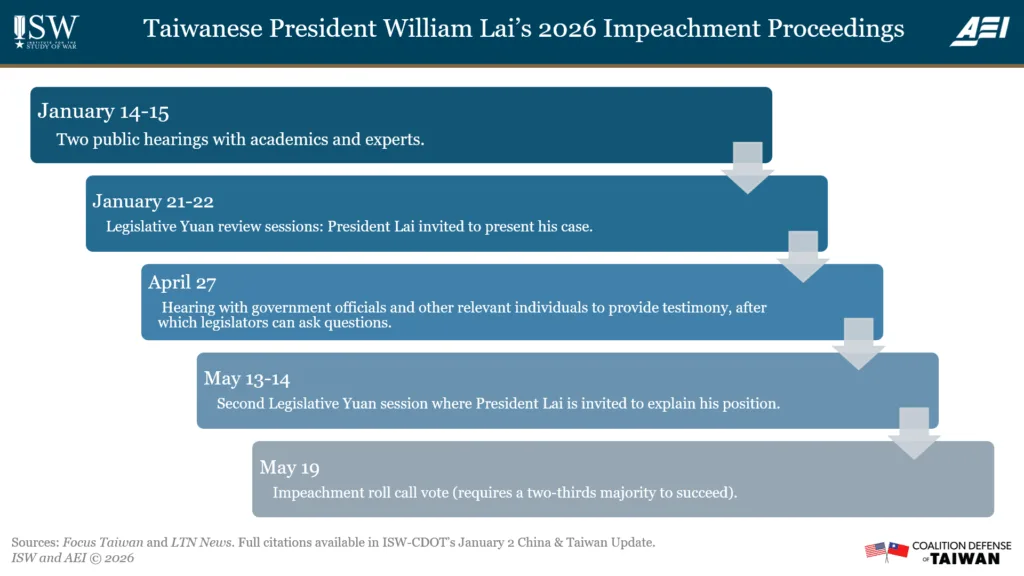
Taiwan’s Legislative Yuan (LY) voted 60-51 to begin impeachment proceedings against Taiwanese President William Lai Ching-te for not promulgating a law passed by the LY, which is a first in modern Taiwanese history. These efforts are unlikely to succeed because the LY lacks sufficient votes to successfully remove Lai from office. The opposition-controlled LY passed amendments to the Act Governing the Allocation of Government Revenues and Expenditures on November 14, 2025, which would give local governments a larger share of public revenue.[2] The presidential cabinet announced its unprecedented refusal to countersign the legislation on December 15.[3] The LY initiated impeachment proceedings against Lai in response. Taiwanese law requires a two-thirds majority in the LY for impeachment motions to be submitted to the Constitutional Court, and then the Constitutional Court must pass the motion with a two-thirds majority for Lai to be removed from office.[4] The opposition Kuomintang (KMT)-Taiwan People’s Party (TPP) coalition does not have 76 votes in the 113-seat legislature to successfully impeach Lai. The roll call vote is scheduled for the day before Lai’s second inauguration anniversary, suggesting that this effort is largely symbolic.
The LY Judiciary and Organic Laws Committee voted on December 18 to petition the Control Yuan to impeach Premier Cho Jung-tai.[5] Cho defended his refusal to countersign bills passed by the LY and noted that the LY could hold a vote of no-confidence to remove him from office.[6] A vote of no confidence would allow Cho to request President Lai to dissolve the LY and require new elections to be held, however.[7] Cho had previously stated his intention to not countersign a pension reform bill, but he has now stated that the cabinet will countersign the bill and refer it to the Constitutional Court.[8] Cho maintains the cabinet’s right to refuse its countersignature.[9]
Japanese media outlet Yomiuri Shimbun reported on December 27 on leaked documents indicating that the PRC is using AI to influence foreign elections, including in Hong Kong and Taiwan.[10] The PRC could use these technologies to influence Taiwan’s 2026 and 2028 elections to elect candidates favorable to PRC policy positions. Yomiuri Shimbun reported on documents leaked by Vanderbilt University’s Institute of National Security that revealed that the PRC company GoLaxy attempted to shift public opinion during foreign elections.[11] The report stated that GoLaxy conducted network surveillance operations and identified key influencers in target states. GoLaxy then creates fictional characters replicating the speech patterns and content to engage in conversations and often spread misinformation. GoLaxy and other companies with ties to the PRC could use these technologies to influence public opinion and falsely suggest that PRC-aligned thinking is prevalent within target populations. Yomiuri Shimbun reported that GoLaxy conducted influence efforts in past Hong Kong and Taiwanese elections, and suggested that they could be used in Taiwan’s upcoming elections. GoLaxy denied that it was creating a “bot network” or otherwise working to influence elections in August.[12]
Yomiuri Shimbun’s report also referenced leaked audio recordings that Taiwanese officials allege reveal PRC efforts to influence the 2018 Kaohsiung mayoral election of Han Kuo-yu. Han is the current president of Taiwan’s LY. The report alleges that these recordings are of a PLA Strategic Support Force official and a representative from a PRC technology firm discussing the creation of millions of bot accounts, likely to promote Han Kuo-yu’s candidacy. The report did not accuse Han of any direct collaboration with the PRC, and Han denied any PRC interference into the 2018 election.[13] Han’s policies as mayor reflected a pro-PRC stance, particularly in terms of economic engagements. Han’s pro-PRC policies were cited as a major reason for his removal from mayoral office in June 2020.[14]
Taiwan is holding its next set of local elections in November 2026, and its next set of presidential and legislative elections will occur in 2028. Taiwan has previously voiced its concerns about PRC interference in its elections and has called for education efforts to increase awareness of PRC disinformation tactics.[15] The PRC will likely conduct disinformation and bot campaigns ahead of Taiwan’s elections to support CCP-friendly candidates.
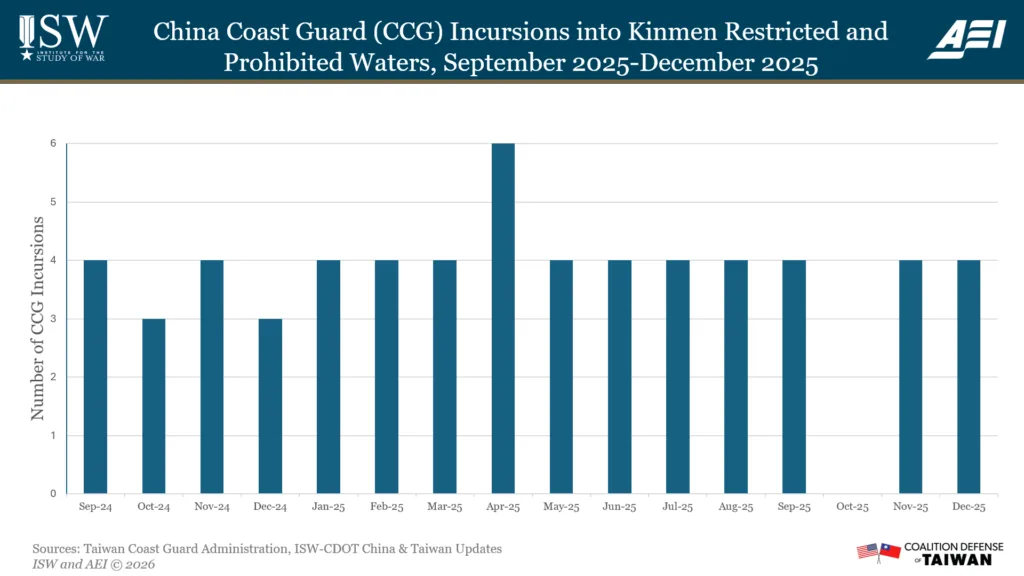
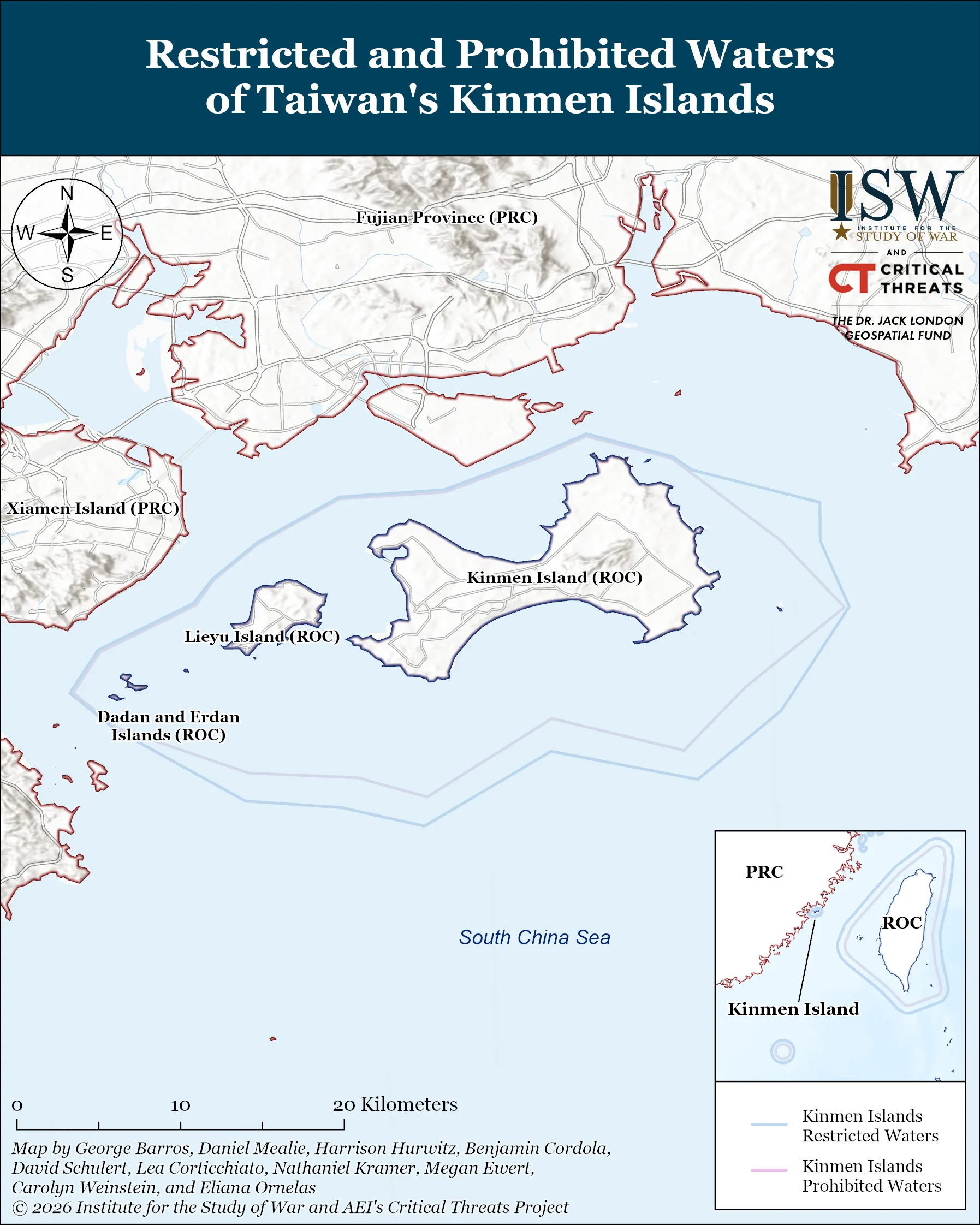
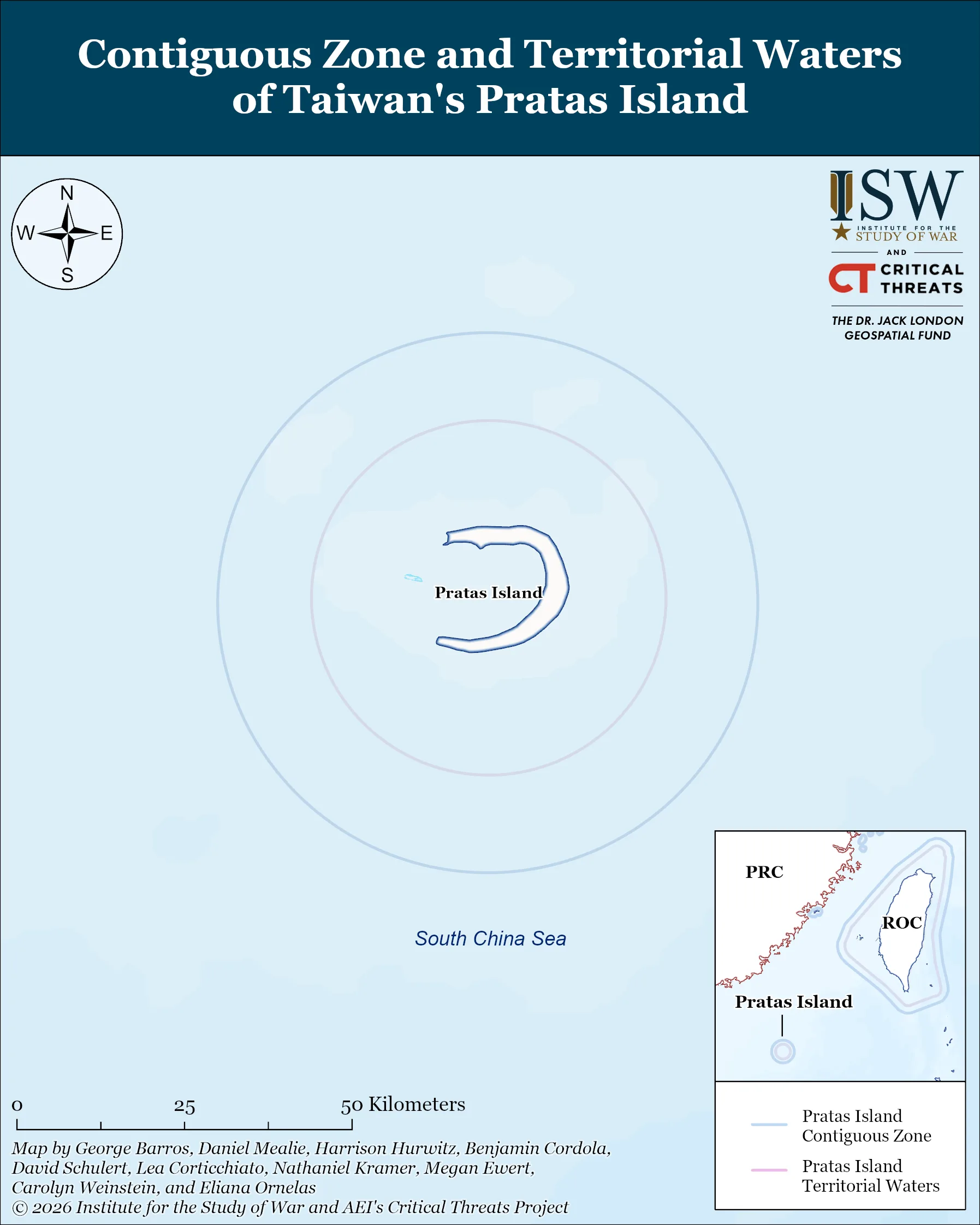
The China Coast Guard (CCG) conducted four patrols into waters around Taiwan’s Kinmen Islands in December 2025 with unusual variation in timing and tactics, including one that intruded in “prohibited” waters for the first time in over a year. The CCG also patrolled in Taiwanese-administered waters around Matsu, Wuqiu, Pratas, and Taiwan during the Justice Mission 2025 exercise from December 29-30. CCG ships patrolled in Kinmen’s restricted waters on December 11, 18, 22, and 25.[16] The December 11 incursion followed a typical pattern of four CCG ships entering simultaneously in pairs and patrolling for exactly two hours in the restricted waters south of Kinmen.[17] The other three patrolled for less than two hours each and followed less typical patterns. Four CCG ships on December 18 crossed in single file through Kinmen’s restricted waters and into its prohibited waters, which are functionally equivalent to territorial waters. This is the first time that Taiwan reported the CCG violating Kinmen’s prohibited waters since May 2024. The December 25 incursion featured only three instead of the usual four ships, and the December 18, 22, and 25 incursions all ended at irregular times (such as 4:17pm) instead of their usual “round” numbers.[18] The unusual timing and variation in sailing patterns likely indicate that the CCG is trying to make its operations less standardized to test Taiwan’s response, improve operational surprise, and practice different types of island quarantine maneuvers. The location of the CCG patrols south of Kinmen is where the ships would need to be positioned to cut the island group from Taiwan. It is also possible that the three recent patrols ended early because Taiwan succeeded in expelling them, however. Two CCG ships also patrolled around Pratas Island on December 19, according to ship-tracking data from Starboard Maritime Intelligence.
CCG patrols around Taiwanese outlying islands aim to normalize the PRC “law enforcement” presence, erode Taiwanese control, legitimize PRC sovereignty, and facilitate a future blockade or seizure of those islands in the future. Kinmen is a Taiwanese island group with about 140,000 people located less than two miles from the coast of the PRC. Pratas is a Taiwanese atoll south of the Taiwan Strait that has a military and coast guard presence but no permanent civilian population. The PRC began patrols into Kinmen’s waters in February 2024 and into Pratas’ waters in February 2025. ISW-CDOT was able to confirm 46 Kinmen incursions and 32 Pratas incursions in 2025, based on ship tracking data and Taiwanese coast guard reports.
The CCG also conducted patrols encircling Taiwan’s outer islands of Pratas, Wuqiu, and Matsu on December 29 and 30, concurrent with the Justice Mission 2025 military exercise. It announced the Wuqiu and Matsu patrols and published maps of them, which showed that the patrol groups came within 1.3 nautical miles of Matsu and within 1.6 nautical miles of Wuqiu.[19] These distances put the patrols within the islands’ prohibited waters.[20] CCG patrols around Wuqiu and Matsu in recent years have almost always coincided with major blockade drills or exercises and are not normalized like the patrols around Kinmen. Maps displayed by Taiwan’s Ministry of National Defense (MND) showed at least two CCG ships around each of Matsu, Wuqiu, and Pratas, though most of these ships had their transponders turned off and thus were not visible on ship-tracking software.[21]
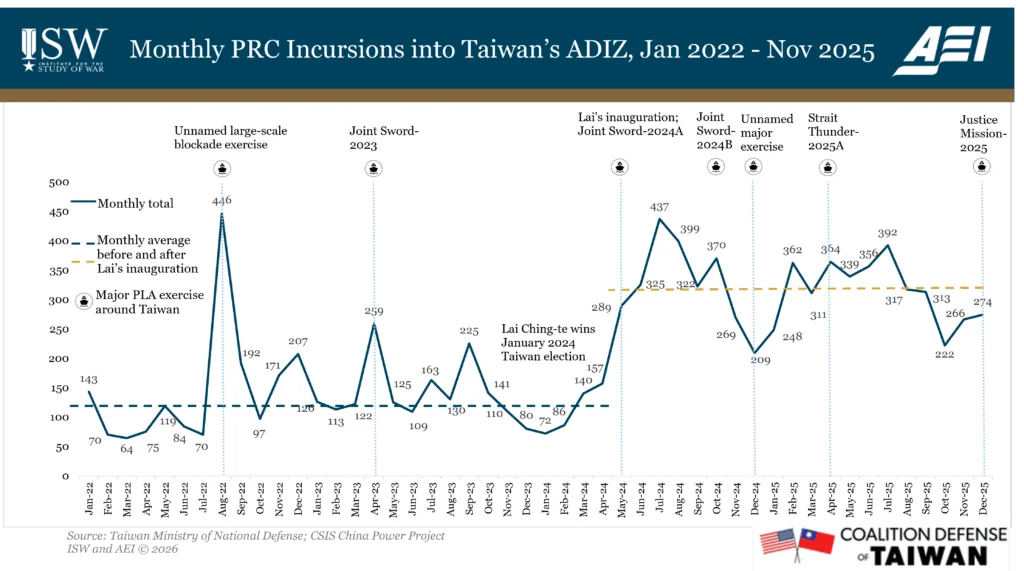
The PLA conducted 274 sorties into Taiwan’s Air Defense Identification Zone (ADIZ) in December 2025. One hundred and twenty-five of the sorties occurred in the two days of the Justice Mission 2025 military exercise, however, making the incursion frequency outside the exercise much lower than the recent monthly average. The PLA increased its incursions into Taiwan’s ADIZ since President Lai took office in May 2024 to an average of over 300 per month, which is over double the monthly average for the past two years. The incursion total in December 2025 is less than half the recent average when excluding the two-day military exercise. This is similar to patterns observed in the last two years, when incursions declined significantly in the fall and winter. The PRC uses these incursions to erode Taiwan’s threat awareness and signal displeasure at political developments in Taiwan. The high volume of aerial activity that it has normalized around Taiwan since Lai’s inauguration makes it difficult for Taiwan to detect and promptly respond to real military threats when they appear.
The PRC flew six high-altitude balloons through Taiwan’s ADIZ in December 2025, at least three of which flew directly over the island. The PRC has flown such balloons over Taiwan around the same time for the past three years, likely to conduct surveillance and atmospheric monitoring. Taiwan’s MND reported that one PRC balloon flew through Taiwan’s ADIZ on December 5, one on December 6, two on December 25, one on December 29, and two on December 31.[22] The MND detected balloons on December 6, 25, and 31 moving directly over Taiwan at altitudes between 31,000 and 50,000 feet, which is far below the typical altitude of weather balloons and aircraft.[23] The MND also reported a balloon at 19,000 feet in Taiwan’s ADIZ on November 24, the first such report of the season.[24] The PRC periodically sent such balloons over Taiwan between November and April in 2023-2024 and 2024-2025, reaching a near-daily frequency in the weeks around Taiwan’s elections in January 2024.[25] The balloons are another means of straining Taiwan’s threat response and awareness, like other ADIZ incursions. The low altitude of the balloons suggests that their primary function is to conduct surveillance over Taiwan. The balloons can float directly over Taiwan’s territory without provoking a military response, unlike conventional manned and unmanned aircraft.
China
The PRC is continuing its corruption investigations and leadership changes within the PLA and PRC defense industry. The PRC is continuing to emphasize loyalty and ideological purity within the PLA, which could indicate that purges will continue. CCP General Secretary Xi Jinping promoted Yang Zhibin to general and commander of the Eastern Theater Command (ETC) and Han Shenyang to general and commander of the Central Theater Command (CTC) on December 22.[26] Yang previously served as vice commander of the ETC. Yang replaced former ETC Commander Lin Xiangyang who was removed in October 2025 for corruption. Han previously served as CTC Air Force commander, replacing Wang Qiang, who has not been seen in public since September 2025.[27]
The Chinese People’s Political Consultative Conference (CPPCC) revoked the membership of four former executives of state-owned enterprises with close connections to the PLA on December 25.[28] These executives are former chairman of Aero Engine Corporation of China Cao Jianguo, former chairman of China Satellite Network Zhang Dongchen, former deputy general manager of Norinco Zeng Yi, and former chairman of China Electronics Corporation Fan Youshan.[29] Revocation of CPPCC membership is typically an indictment of wrongdoing, though no official statement has been made as to why these individuals were removed.[30] The PLA defense procurement website released a notice on December 18 calling for any information on suspected “irregular” transactions involving the PLA Air Force.[31] This is the first time such a notice has targeted a specific service of the PLA and may suggest that the Air Force is the next target for purges.[32]
PRC rhetoric emphasizes the need to counter corruption. PRC military newspaper PLA Daily has published multiple articles focused on the need for ideological purity in the military.[33] The PRC State Council on December 26 released a readout of a meeting that called for the CCP to continue cracking down on corruption in 2026.[34] Xi spoke in that meeting about the need to maintain ideological purity and reject the “four undesirable work styles” of formalism, hedonism, bureaucracy, and extravagance.[35]
The PRC sanctioned 10 individuals and 20 defense firms following US arms sales to Taiwan. The PRC froze the assets of these individuals and firms, which PRC media outlet Global Times listed as: “Northrop Grumman Systems Corporation, L3Harris Maritime Services, Boeing in St. Louis, Gibbs & Cox, Inc., Advanced Acoustic Concepts, VSE Corporation, Sierra Technical Services, Inc., Red Cat Holdings, Inc., Teal Drones, Inc., ReconCraft, High Point Aerotechnologies, Epirus, Inc., Dedrone Holdings Inc., Area-I, Blue Force Technologies, Dive Technologies, Vantor, Intelligent Epitaxy Technology, Inc., Rhombus Power Inc., and Lazarus Enterprises Inc.”[36] The sanctioned individuals included defense executives, such as Palmer Luckey, CEO of defense firm Anduril, whose Altius loitering munition drones were included in the most recent US arms sale to Taiwan.[37] Luckey also met with Taiwanese Defense Minister Wellington Koo in August 2025.[38]
This instance is not the first in which the PRC has sanctioned both individuals and firms following a US arms sale. The PRC sanctioned 13 firms and six executives in December 2024 following the US approval of another arms sale to Taiwan.[39] This particular sanctions package similarly targeted entities involved in drone production, suggesting that the PRC likely recognizes the key role that drones could play in a Taiwan contingency.
The PLA may be outfitting civilian cargo vessels with modern naval armaments to covertly increase its naval firepower. The PLA could use these vessels to clandestinely position weapon systems in key areas of the Pacific or defend its sea lines of communication (SLOCs). Naval News confirmed online rumors on December 25 the PRC cargo vessel Zhong Da 79 had been equipped with several vertical launch systems (VLS), radar, and close in weapons systems (CIWS), which are normally found on modern surface combatants.[40] Publicly available imagery suggests that the vessel is equipped with between 48 and 60 VLS cells, about the VLS armament of a modern frigate or destroyer, which can fire anti-ship or anti-air missiles with ranges up to 540 km, depending on the missiles it deploys.[41] The vessel’s CIWS could be used to ward off missile or drone attacks.[42] The US Department of Defense reported in 2024 that the PRC was developing a missile launcher that could be concealed in a cargo container that could launch the YJ-18 anti-ship cruise missile.[43] It is not clear if the cargo vessel will be able to conceal the VLS launchers deployed on its deck, however.
The PRC often attempts to develop dual-use technologies and systems to aid its military modernization through its “military-civil fusion” policy.[44] The PLA, for instance, practices amphibious assault operations using civilian “roll-on roll-off” vessels that it may rely on to enhance its sealift capacity.[45] The armament observed on Zhong Da 79 may be an effort to integrate civilian vessels into PLA efforts to increase its naval armament.[46]
Deploying VLS on a civilian platform could also allow the PLA to position long-range anti-ship systems in key areas without attracting the notice of foreign militaries.[47] The PLA could use clandestine assets like Zhong Da 79 to position anti-ship missiles beyond the first island chain while avoiding detection from its neighbors. It is unclear if the PLA intends to deploy VLS systems on civilian cargo ships at scale, however.
Northeast Asia
North Korea
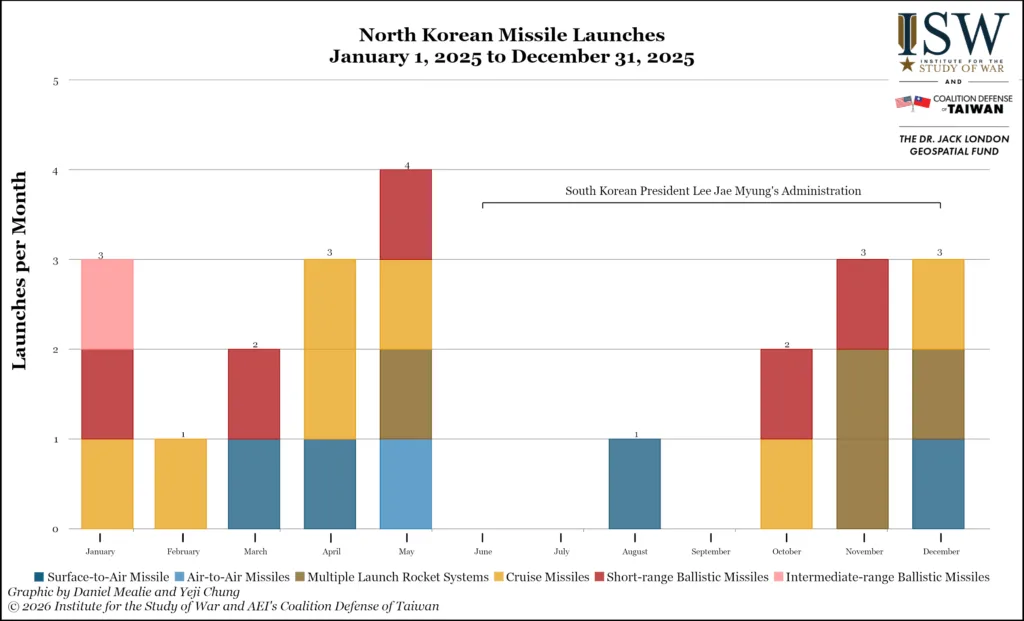
North Korea conducted two missile launches in late December 2025 and emphasized nuclear force modernization in official statements. North Korea is likely rejecting South Korean calls for dialogue through a show of force.[48] North Korea test-launched a new high-altitude long-range surface-to-air missile (SAM) on December 24.[49] North Korean state media reported on December 25 that the launch aimed to “evaluate the tactical and technical characteristics” of the system and it “successfully struck and destroyed“ aerial targets at the “200-kilometer range.”[50] North Korea subsequently tested a ”long-range strategic cruise missile” on December 29, calling it an “exercise of war deterrence” in response to “security threats.”[51] Seoul-based media outlet NK News assessed that the cruise missile may be part of the Hwasal series, which Pyongyang asserts can carry nuclear warheads.[52] Workers’ Party of Korea (WPK) General Secretary Kim Jong Un said North Korea will “continue to devote all efforts” to the development of its nuclear forces.[53] Kim also visited two missile factories on December 26 and directed continued modernization of the “munitions industry” to support missile and artillery operations.[54]
North Korea appears to be developing the new SAM system as a successor to its aging Pongae-5 system. A long-range SAM would expand North Korea’s aerial-denial coverage and strengthen its ability to defend against potential air and missile strikes. The long-range strategic cruise missile may allow North Korean missiles to evade ground-based radar detection and complicate US-South Korean detection and interception timelines.[55]
These tests occur amid intensifying North Korean military activity and rhetoric. South Korea has pursued confidence-building and deescalatory measures near the inter-Korean border since South Korean President Lee Jae Myung took office in June 2025. North Korea has not responded to South Korea’s calls for dialogue and instead appears to be reinforcing a no-dialogue posture through demonstrations of military strength while attributing regional instability to Seoul’s actions. South Korea is developing a nuclear-powered submarine to modernize its naval fleet. North Korea is likely using recent missile tests to both protest Seoul’s submarine acquisition program and to signal unwillingness to diplomatic engagement.
North Korea revealed an 8,700-ton nuclear-powered submarine in response to South Korea’s nuclear-powered submarines project.[56] North Korea will further intensify the development of modern military systems. North Korean State Media released the first full photograph of a nuclear-powered submarine during WPK General Secretary Kim Jong Un’s inspection of the facility on December 25.[57] South Korea’s Defense Security Forum reported that the submarine likely carries approximately 10 vertical launch cells for submarine-launched ballistic missiles (SLBM) and six 533-mm horizontal torpedo tubes.[58] North Korea unveiled its “five core defense tasks” at the 8th WPK Congress in 2021.[59] The tasks include the development of nuclear-powered submarines with underwater nuclear weapons, along with hypersonic missiles, larger-sized nuclear warheads, solid fuel intercontinental ballistic missiles, and military reconnaissance satellites.[60] North Korea claims that it has made steady progress toward these goals since 2023.[61]
South Korean lawmaker Yu Yong-weon said in September 2025 that Russia may have transferred two or three nuclear submarine modules to North Korea in early 2025.[62] Unnamed Spanish authorities confirmed on December 29 that a Russian vessel affiliated with the Russian Ministry of Defense, which sank in Spanish waters in December 2024, was carrying nuclear modules for submarines intended for North Korea.[63] North Korea’s development of the submarines suggests that Pyongyang may have received advanced military technology from Russia in exchange for troop deployments and arms sales.
Kim Jong Un may seek to show domestic and international audiences that he has fulfilled the 2021 military goals ahead of introducing the new objectives at the 9th WPK Party Congress.[64] Kim’s visit to the submarine facility was likely intended as a response to the United States-South Korea nuclear-powered submarine project and their recent military coordination. The North Korean Ministry of National Defense (MND) denounced the submarine project on December 25 as a “hostile activity.”[65] The MND also accused the USS George Washington’s visit to South Korea in November and the US nuclear submarine USS Greenville’s visit on December 23 of escalating tensions.[66] North Korea may intend to diversify its nuclear delivery systems beyond traditional missile to counter the US-South Korean alliance.