China Revives Economic Coercion to Punish Japan

Sino-Japanese relations are in freefall again after comments by new Japanese Prime Minister Sanae Takaichi on Nov. 7 suggesting that Chinese use of force against Taiwan could lead to Japan deploying its Self Defense Forces. Beijing quickly retaliated by sending Chinese coast guard vessels into waters around disputed islands and military drones near an outlying Japanese island.

Representational image. PREMIUM
Representational image.

The more consequential steps have been economic. China has unearthed its old playbook of informal coercive moves. Unlike clear-cut export controls, these disguised measures are harder to manage and pose escalatory risks. Governments and companies must grapple with how to respond.

Since Nov. 14, China has issued a series of escalating restrictions: cautioning tourists and students against travel to Japan; postponing the release of at least two Japanese films; and reinstating a blanket ban on Japanese seafood imports. That ban, introduced in August 2023, had been relaxed the day before Ms. Takaichi’s comments.

Unlike recent Chinese economic restrictions, such as rare earth export controls in October, Beijing denies imposing official sanctions. It instead attributes boycotts to popular sentiment while hiding behind technical bureaucratese—the seafood ban is ostensibly required to protect public health from nuclear contamination (again).

But the economic stakes for Japan are real. Tourism is roughly 7% of gross domestic product and Chinese visitors roughly one-fifth of all arrivals. Travel agencies have stopped offering group tour packages and multiple Chinese airlines have offered flight refunds, with one estimate that half a million tickets have been canceled. Over a third of Japan’s international student population is from China, and China is Japan’s largest export market for seafood.

These moves show how Beijing continues to coerce with Chinese characteristics, contrary to recent perceptions that China has shifted to more Western-style legalistic measures because it has now developed the underlying bureaucratic architecture. Certainly, the Chinese government has begun to use new sanctioning frameworks—including the Unreliable Entity List, the Anti-Foreign Sanctions Law, and an expanded export-control system—that mirror those used by the United States. The October rare-earth controls drew inspiration from the U.S. foreign direct product rule and semiconductor-export controls, requiring foreign firms to obtain Chinese government approval to export products that incorporate even minimal amounts of Chinese-origin rare earths or rely on Chinese technology.

But informality and ambiguity remain a feature, not a bug, of China’s approach to coercive economic bargaining. Some Chinese analysts openly called for restrictions on rare earth exports. Yet Beijing chose to activate mechanisms that mobilize public opinion—indirectly shaping the behavior of businesses and consumers—and afford the government plausible deniability. These are hallmarks of China’s playbook.

What advantages do informal sanctions provide for Beijing? First, ambiguous measures exact fewer reputational costs. China has long criticized unilateral sanctions by Western governments, so deniable pressure helps minimize charges of hypocrisy. Ambiguity also reduces the risk of legal or diplomatic complaints that might arise from clear violations of international trade rules.

These advantages are most appealing when China lacks a strong justification for claiming its actions are lawful countermeasures, as with its continuing campaign against Japan. Beijing has preferred to use informal measures, such as arbitrary customs inspections, technical regulatory enforcement and state-fomented consumer boycotts when pressuring countries to acquiesce to its territorial claims and other political demands. It did so against South Korea in 2016 and Australia in 2020.

It is hard for governments and companies to respond to such disguised measures effectively and cohesively. While Japan and its Group of Seven partners have built mechanisms to coordinate against formal coercion, there is no clear focal point for governments to target when Chinese pressure takes the form of patriotic consumer action rather than explicit state restrictions.

But mobilizing patriotic consumerism also carries risks that official sanctions don’t. Our research has found that public opinion—unlike precision-guided export controls—can be difficult to modulate once unleashed. The recent wave of airline refunds suggests that at least some travelers are responding to official cues. There have also been early signs of nationalistic Chinese sentiment bubbling to the surface, including an incident in Tokyo involving a person waving a Chinese flag at a busy intersection.

Past China-Japan crises have triggered protests that escalated into property damage and even physical violence, such as 2012 demonstrations over a territorial dispute. Amid heightened anti-Japanese sentiment, a Japanese schoolboy was tragically murdered in Shenzhen last year.

Beijing has demanded that Ms. Takaichi retract the statement that sparked the conflict, but backing down would be politically costly for her in Japan. Public pressure in both countries makes it harder for either side to de-escalate, increasing the risk of a public incident spreading into a broader confrontation.

Even as China hones its formal sanctions toolkit, it still turns to informal methods when legal and political justification is thin. These tools offer Beijing flexibility and deniability while adding volatility that can make crises worse. Governments need to figure out how to coordinate effective responses and bolster resilience against continued Chinese coercion on many fronts.

Mr. Ferguson is an assistant professor of international relations at Hitotsubashi University and a visiting researcher at the University of Tokyo. Ms. Wong is an assistant professor of political science and international relations at the University of Southern California and nonresident senior fellow at the American Enterprise Institute.


Source link

Visited 1 times, 1 visit(s) today

Related Article

Chinese Manufacturing Is Slumping Despite Boost From Trade Truce

(Bloomberg) — China’s manufacturing activity contracted in November, according to official and private surveys, as stronger demand overseas after a trade truce with the US failed to reverse a deepening slowdown in the economy. Despite a surge in new export orders, the RatingDog China manufacturing purchasing managers’ index unexpectedly slumped to 49.9, according to a

loadingImg

Dubai Courts China’s Next Tech Champions

When a little-known Chinese startup rented the cheapest-tier booth at a venture conference in Dubai last October, few took notice. Three months later, the company’s valuation had surged into the billions. That startup was DeepSeek, and its sudden rise has become an example of how Dubai is positioning itself as a launchpad for China’s next

YouTube video

China launches classified Shijian-28 spacecraft, reusable Zhuque-3 rocket faces delay

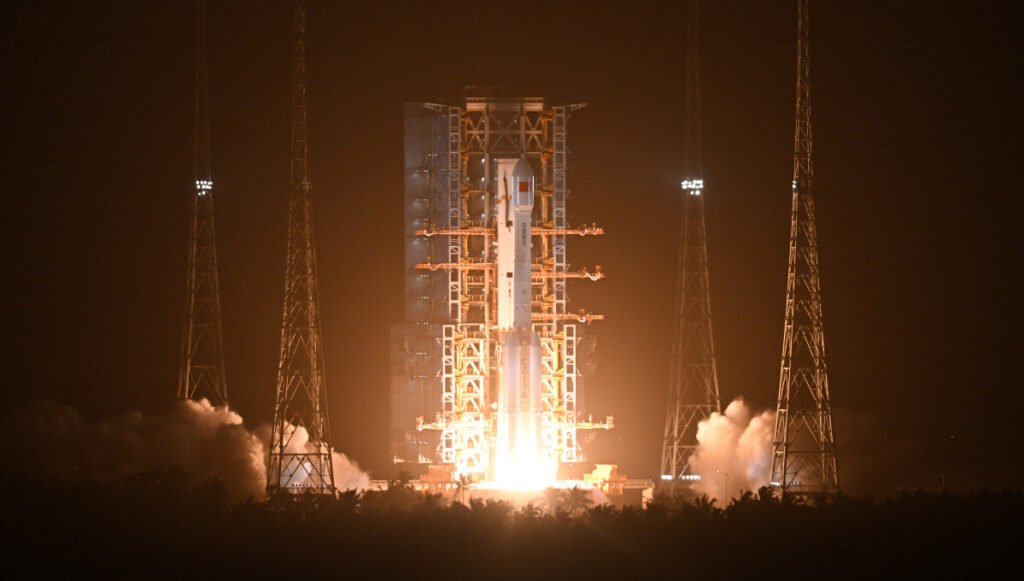
HELSINKI — China launched the latest in a series of experimental, often opaque satellites Sunday, while the debut flight of the commercial Zhuque-3 faces a delay. A Long March 7A rocket lifted off at 7:20 a.m. Eastern (1220 UTC)  Nov. 30 from Wenchang Satellite Launch Center on the southern island of Hainan. The China Aerospace

China’s Private Home-Sale Data Vanishes After Vanke Turmoil

(Bloomberg) — Two of China’s private data agencies skipped releasing data on monthly home sales by the country’s top developers, after state-backed China Vanke Co. stirred market concerns with its bond extension bid. China Real Estate Information Corp. and China Index Academy, which are among the country’s biggest private property data providers, didn’t disclose the

Zootopia 2 breaks records in China with $275 million opening — TradingView News

Zootopia 2 breaks records in China with $275 million opening — TradingView News

By Casey Hall and Nicoco Chan Disney’s DIS Zootopia 2 became the highest-grossing animated foreign film ever in China, despite generally muted interest in overseas movies in the country. As of Monday morning Beijing time, box office tracker Maoyan showed Zootopia 2’s local box office tally reaching 1.95 billion yuan ($275.6 million) in its first

China’s military firms struggle as corruption purge bites

China’s military firms struggle as corruption purge bites

Revenues of China’s top military firms fell 10% last year. (EPA Images pic) HONG KONG: Revenues at China’s giant military firms fell last year as corruption purges slowed arms contracts and procurement, according to a study released today by a leading conflict think tank. The Chinese declines contrast with strong revenue growth globally for big

Economic calendar in Asia Monday, December 1, 2025

Economic calendar in Asia Monday, December 1, 2025

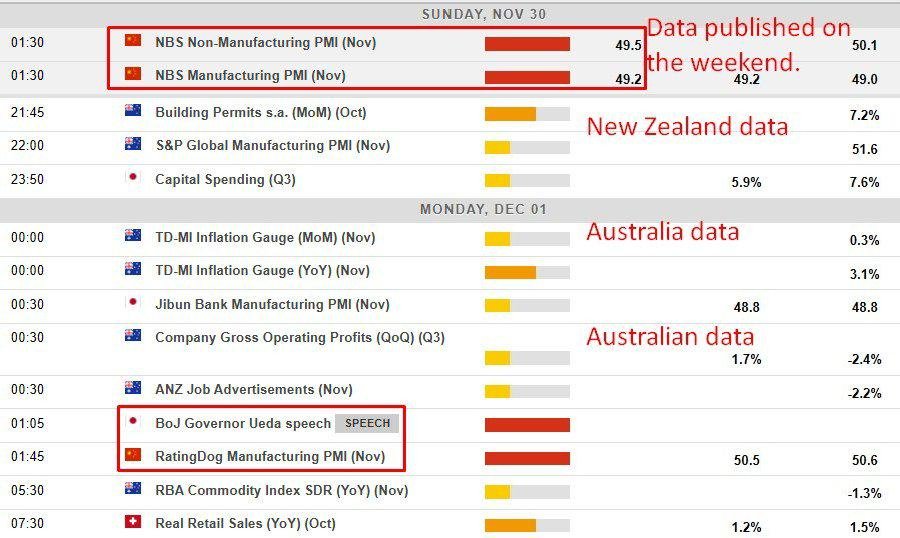
Two focal points today, Bank of Japan Governor Ueda speaking and another PMI from China. The December (18-19) Bank of Japan meeting is very much ‘live’, a rate hike potential is there: investingLive Asia-Pacific FX news wrap: Upbeat data from Japan, sticky inflation too Tokyo inflation stays hot as yen weakens, pushing BOJ closer to

ET logo

China’s November factory activity swings back to decline, private PMI shows

China‘s factory activity in November contracted slightly as production growth came to a halt and new orders slowed, a private-sector survey showed on Monday. The RatingDog China General Manufacturing Purchasing Managers’ Index (PMI), compiled by S&P Global, dropped to 49.9 in November from 50.6 in October, missing analysts’ expectations of 50.5 in a Reuters poll.

Zootopia 2 Sets Record, Best Hollywood Haul in Years

Zootopia 2 Sets Record, Best Hollywood Haul in Years

Disney’s smash-hit animated sequel Zootopia 2 got off to a stunning start in China over the holiday weekend, opening with an enormous $272 million five-day box office haul. It was the kind of powerful performance that once had Hollywood executives wildly bullish on the market potential of the world’s most populous nation, but which grew

Overseas Sales Surge as LANDKING Earns Strong Global Recognition

QINGDAO, China, Dec. 1, 2025 /PRNewswire/ — Amid the global commercial vehicle market’s rapid transformation, Weichai NECV’s overseas business thrives. As of October, overseas sales rose 71% year-on-year, underscoring solid international expansion. Recently, its LANDKING brand unveiled a new product portfolio, with 30 new models debuting to highlight its technological strength and industrial layout. A wholly

China successfully completes latest satellite launch

China successfully completes latest satellite launch

A modified Long March 7 carrier rocket carrying the Shijian 28 satellite blasts off from the Wenchang Spacecraft Launch Site in Hainan province, Nov 30, 2025. [Photo/Xinhua] China launched a Long March 7A carrier rocket on Sunday night to send a satellite into orbit, according to China Aerospace Science and Technology Corp. The State-owned space

Talent cultivation key to self-reliance in sci-tech

Talent cultivation key to self-reliance in sci-tech

SHI YU/CHINA DAILY Editor’s note: Recommendations of the Central Committee of the Communist Party of China for Formulating the 15th Five-Year Plan for National Economic and Social Development outline a series of measures for achieving self-reliance in science and technology over the next five years. President of the Chinese Academy of Sciences Hou Jianguo spoke

school of colorful jellyfish

China’s New Stealthy Military Drone Doesn’t Fly At All

China is no stranger to high-tech drone technology, including its use in aerial combat. During the Victory Day military parade in Beijing on September 3rd, the world caught a glimpse of China’s latest military innovations — this time an unmanned underwater drone system with advanced intelligence capabilities. The People’s Liberation Army Navy’s new technology could be

Moonshot and MiniMax step up as China’s new frontier AI labs

Chinese artificial intelligence start-ups Moonshot AI and MiniMax have emerged as China’s strongest contenders to rival US frontier labs in 2025 – even as DeepSeek has stolen the spotlight as the poster child for the country’s AI ambitions. Moonshot AI, founded by 33-year-old Yang Zhilin, has sharply raised its profile in China’s AI ecosystem with

Hong Kong fire: Citizens' anger over 146 deaths spills on to streets, demand fair probe; China slaps sedition law

Hong Kong fire: Citizens’ anger over 146 deaths spills on to streets, demand fair probe; China slaps sedition law

Public anger over Hong Kong’s deadliest residential fire in decades has spilled into the streets, even as a student activist who demanded accountability was reportedly detained under the city’s national security regime.Miles Kwan, 24, had been distributing flyers outside a city train station on Friday, urging commuters to support an independent investigation into the blaze

0
Would love your thoughts, please comment.x
()
x