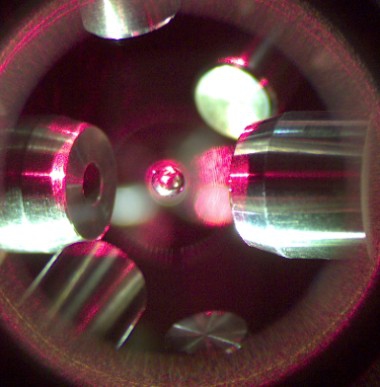
Laser heating experiment in the microgravity conditions Photo: Courtesy of Technology and Engineering Center for Space Utilization of the Chinese Academy of Sciences
China has achieved breakthrough in containerless laser heating technology reaching 3,100 C under microgravity conditions, Global Times learned from the Technology and Engineering Center for Space Utilization of the Chinese Academy of Sciences (CAS) on Thursday, the same day that China Manned Space Agency (CMSA) released the official report detailing progress made in scientific research and applications related to the China Space Station in 2025.
The Center for Space Application Engineering and Technology of the CAS serves as the lead unit for the space application system in China’s manned space program.
In 2025, smooth progress has been made in space science, application experiments and technology trials conducted on the China Space Station. Through continuous construction and optimization, the China Space Station has established scientific facilities covering multiple fields, ranging from space life sciences and human research, microgravity physical sciences, to new space technologies and applications, providing critical support for the implementation of core scientific tasks.
According to center, China added 31 new on-orbit scientific and application projects to the China Space Station in 2025. It uploaded approximately 867.5 kilograms of scientific payloads, including experiment modules, units and samples, and downlinked 83.92 kilograms of space science experiment samples. Over 150 TB of scientific data were acquired. Research teams conducted in-depth explorations in multiple directions, tackling a series of major scientific challenges and producing a range of original, cutting-edge and innovative advances and achievements, with more than 50 patents authorized.
Global Times