The number of patent applications for anti-drone (counter-UAV) technologies filed globally increased by 27% to 126 last year*, up from 99 the year before, according to new research from UK intellectual property (IP) law firm Mathys & Squire.
“The sharp rise in patents filed reflects growing global demand for systems capable of disabling or neutralising drones, whose use has expanded rapidly,” says the company in a statement. China dominated the global anti-drone patent landscape, filing 82 applications in the last year alone, far ahead of the US, which recorded just 22 new anti-drone patent submissions. China, the US and South Korea rank as the top three anti-drone patent filers globally.
European filers appear to be lagging in anti-drone patent filings.
Interference and jamming remain the most common area of innovation, recording 49 new patents last year. Signal interference technologies accounting for the largest share of new inventions. This reflects a growing focus on non-kinetic countermeasures designed to disrupt drone communications and navigation systems.
Following recent drone-related incidents – including the temporary suspension of operations in Copenhagen and Oslo airports – technologies that can rapidly disable or disrupt drones, such as signal interference, appear to be in increasing demand.
Chart: Number of patents by technology type
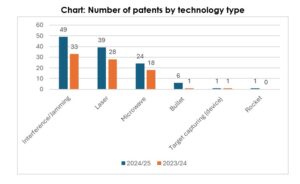
However, a notable shift is also underway toward next-generation counter-drone technologies. Laser-related inventions reached 39 in 2025, while microwave systems rose strongly to 24 patents, suggesting increasing interest in directed-energy approaches as part of future airspace security.
Andrew White, Partner at Mathys & Squire says: “Drones have shifted from being a niche concern to a mainstream security challenge and the rise in patent filings reflects that change. With drone disruptions affecting sensitive sites and infrastructure, organisations are racing to develop reliable countermeasures.”
He adds: “We’re also seeing innovation move beyond traditional approaches. Laser and microwave systems are gaining traction in the counter-drone market and this is likely just the beginning of a broader shift in how airspace threats are countered.”
Commercial and infrastructure protection use cases are also growing rapidly, with anti-drone technologies increasingly being developed for use in areas such as airports, prisons, energy infrastructure, ports and large public events.
*Research conducted with a year-end of March 31, 2025
For more information
https://www.mathys-squire.com/about-us/
The 2026 Unmanned Airspace Global Counter-UAS Systems Directory is now available. The Guide is the world’s only comprehensive, continually updated directory of global C-UAS companies and systems. It itemises over 1,000 C-UAS products and services with performance details, company sales and partnerships arrangements. It is updated every month and broken down into niche sub-sectors (net-capture, missiles, intercept drones, detectors etc) to give C-UAS procurement and industry personnel a unique perspective of global C-UAS technical capabilities and market positions. It is available in word, PDF and excel formats and Unmanned Airspace readers are eligible for a range of discounts. For more information about the Directory please contact the editor Philip Butterworth-Hayes at philip@unmannedairspace.info.