Beijing
—
China spent the last five years cultivating innovation and new technology at home. The next half decade will be dedicated to deploying the fruits of its labor to transform its economy – and its place in the world.
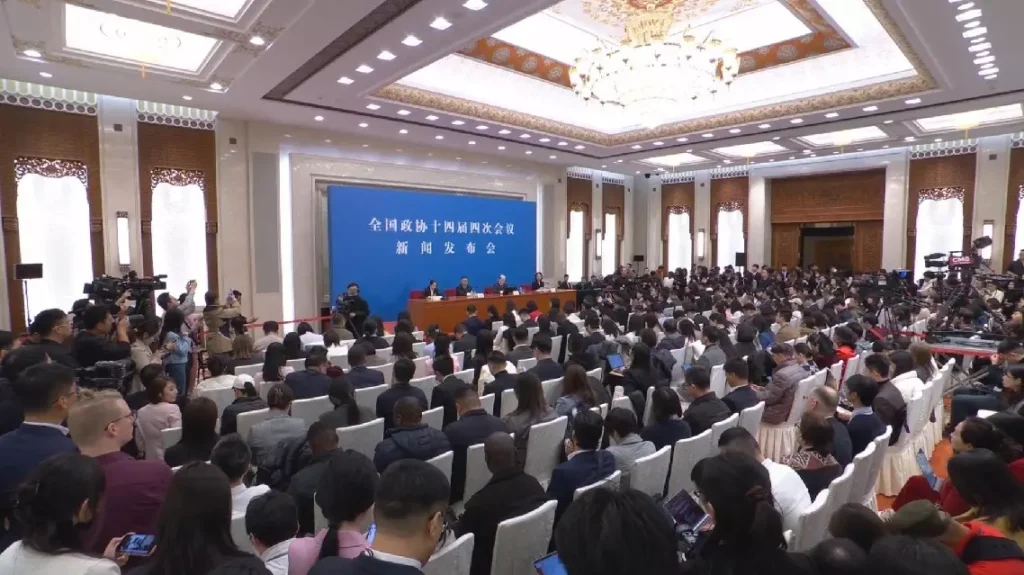
That’s set to be an overarching message as thousands of delegates from across China gather in the nation’s capital for the “Two Sessions” – a carefully choreographed annual meeting where the country’s leadership signals its priorities for the year ahead, and its rubber-stamp legislature approves them.
The pomp and ceremony of the gathering has long stood as a symbol of China’s tightly controlled political process, and Beijing’s authoritarian leaders are well aware of the juxtaposition that creates as the US, the world’s most powerful democracy, is riven with partisan infighting and engaged in another spiraling conflict in the Middle East.
At the top of the agenda this time around is approving the 15th “Five-Year Plan,” a blueprint for how Beijing aims to drive its economic growth into the next decade.
Details of the new plan have been hashed out behind closed doors by leader Xi Jinping’s inner circle over months. Now, the nearly 3,000 members of the National People’s Congress will green-light the document – likely with some tweaks based on the lawmakers’ feedback – with a ceremonial vote livestreamed across the country.

Buoyed by recent successes – as China’s AI upstarts go toe-to-toe with American rivals, its EV champions dominate global sales and its humanoid robots dazzle the world – Beijing is set to use the blueprint to further spur innovation and use it to build China’s economic strength and international clout.
Its leaders are also well aware they are setting up the country’s next economic plan at a moment of acute risks and opportunities.
The world order is in flux as the United States shakes up its policies and is increasingly seen as divided and unpredictable; rapidly evolving technologies are transforming work and war; and China’s economy faces slowing growth, dimmed consumer confidence and a shrinking population, while the risk of trade frictions and a tech rivalry with the US persist.
A rapidly expanding war in the Middle East – sparked by the US-Israel bombing of Iran and the killing of its China-friendly leader Ayatollah Ali Khamenei – has added a new layer of geopolitical uncertainty.
Whether China can use that shifting landscape to accelerate its rise as a global power will depend in part on how well Xi’s government steers the economy.
A mechanism borrowed from the Soviets decades ago, China’s five-year plans are crucial for the ruling Communist Party to keep the country’s sprawling bureaucracy and country of 1.4 billion in line with its vision.
Since the last five-year plan in 2021, China has dealt with major shocks. The country endured years of Beijing-mandated Covid controls, and its property sector crisis is continuing into its fifth year, dragging on families’ wealth and dampening a once-robust industry. China in 2025 weathered a second, blistering tariff war with the US and in recent years has faced mounting controls on access to American high tech.
But Beijing has also made tremendous strides in homegrown technologies, a key goal of its previous plan, which was all about making the country more self-sufficient, especially ending its reliance on American and other Western technologies.

China still lags US high tech in several areas, including semiconductors, but experts say it’s clear that Beijing is moving with confidence – and preparing to double down on and hone its current plan.
“If the (last) Five-Year Plan’s innovation policy was largely defensive, this one is much more proactive. The focus is on achieving breakthroughs in key technologies and accelerating the integration of technology and industry,” said Yue Su, principal economist for China at the Economist Intelligence Unit.
“Beijing appears to see the current wave of technological and industrial transformation as a historic opportunity to upgrade productivity.”
A lengthy list of “recommendations” for the plan released by a top Communist Party leadership body last fall called for “extraordinary measures” to achieve “decisive breakthroughs” in core technologies, like chips and industrial machine tools.
It was also clear about getting ahead early “in industries of the future,” which it names as quantum technology, biomanufacturing, hydrogen and nuclear fusion power, brain-computer interfaces, embodied artificial intelligence, and 6G mobile communications.

But Beijing is not just pushing for innovation in this plan, observers say, but for applying it at scale in China’s massive manufacturing sector and in its megacities.
There’s a shift away from “the zealous pursuit of technological breakthroughs for the sake of innovation, towards identifying and developing more sophisticated applications and diffusion architecture for technological innovation,” said Brian Wong, a fellow at the University of Hong Kong’s Center on Contemporary China and the World.
And signals so far indicate that China is also aware of the impact this vision will have on its workforce – and the need to invest in training and education.
Officials are clear that making a “domestically driven, high-tech manufacturing future” requires having a “skilled and adaptable workforce,” Wong added.
But even as China calibrates its high-tech vision for its future, observers will be parsing the upcoming plan to understand how exactly Beijing aims to address some of its most critical economic drags, like weak consumption at home and the longer-term risks of a rapidly declining birth rate.
Last year, the country’s reliance on exports to other countries drove China’s trade surplus to a record high, bringing frictions with nations that accuse China of flooding markets.
“China’s position of being dependent on external demand for quite a bit of its output and employment is not a very comfortable position to be in,” said Bert Hofman, a professor at the East Asian Institute at the National University Singapore and former World Bank country director for China.
Efforts to address issue will likely be “more prominent” in this plan, he added, and focus on strengthening China’s social security nets, he added.
China’s top-down planning has also played into its economic challenges.
As the central government dictates which areas it wants to focus on and subsidize, an influx of companies pour in to get a piece of the action, driving excessive supply and intense competition (dubbed “involution”) – contributing to China’s deflation and its export-reliance.

Apart from bolstering domestic demand, analysts say Beijing will look to elevate China’s economic role globally, not simply acting as the world’s factory floor but the source of technologies like AI chatbots, chips and robots used by countries to power their own economies.
Instead of a focus on exporting goods or building infrastructure overseas, “becoming a key supplier of technological know-how and expertise in its foreign investments” will likely be a goal spelled out in the upcoming plan, according to Wong in Hong Kong.
In its recommendations last fall, the party leadership nodded to this, saying the “new round of technological revolution and industrial transformation” has created “positive factors enabling China to make proactive moves in the international arena.”
Western officials and rights groups have raised a raft of concerns about the global adoption of Chinese technologies, including that an authoritarian China is aiding governments around the world to censor and monitor their populations.
But when transmitted from Beijing this week, the message from the halls of power will be another one – that China’s innovation and its development are a boon to the world.