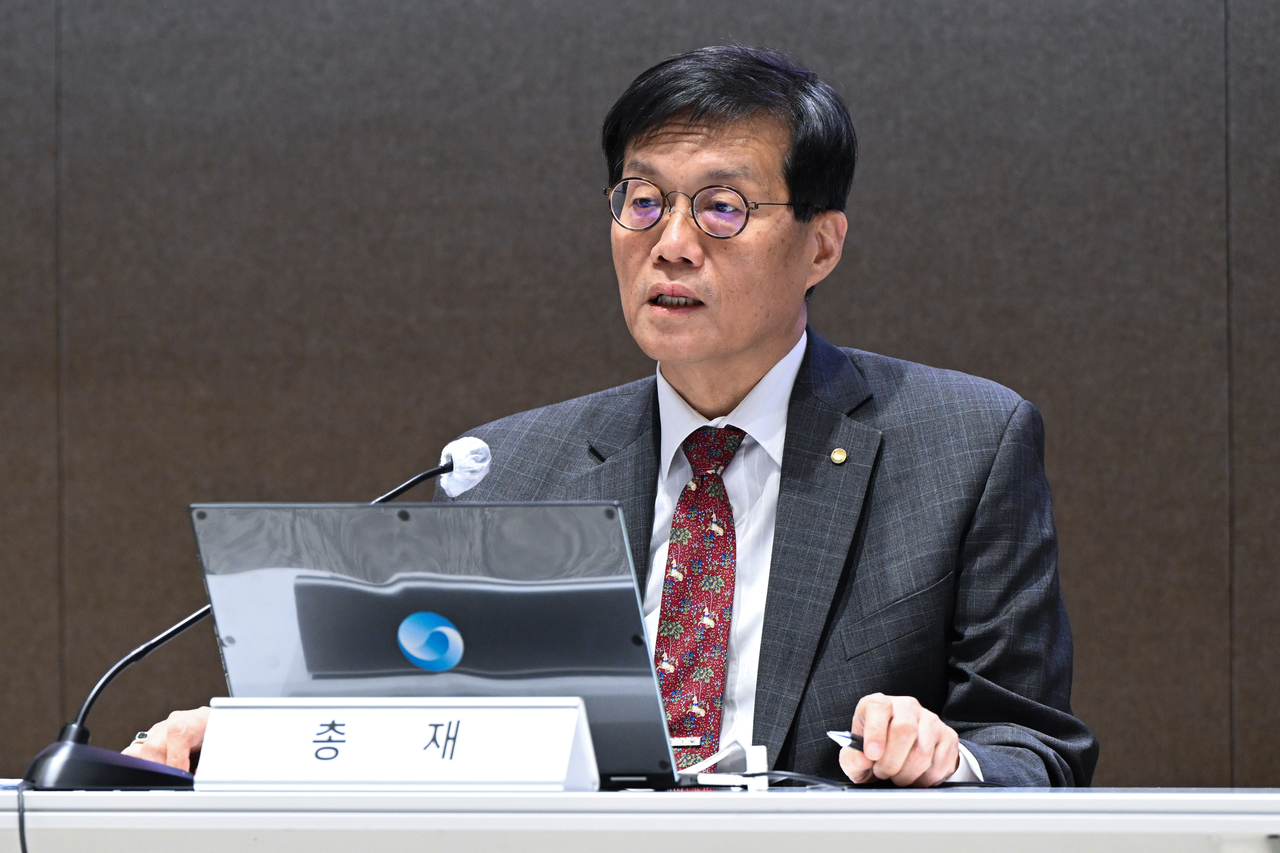
South Korea’s central bank chief pushed back Tuesday against claims that the country’s planned $200 billion investment in the US would weaken the won over the long term, calling such concerns an “overstatement.”
Under the Korea-US tariff deal, Seoul agreed to invest $200 billion in cash in the US, with the phased installments capped at $20 billion per year. The sum has been cited as one of the major factors weighing on the Korean won’s value against the dollar.
Bank of Korea Gov. Rhee Chang-yong, however, highlighted he does not see the US-bound investment as likely to cause a long-term depreciation of the Korean won.
“There are concerns that annual outflows of around $20 billion could weigh on the currency, but the memorandum of understanding makes clear that the $20 billion figure is a cap and that investments would be carried out only at a scale that would not affect the foreign exchange market,” Rhee said at a press briefing held explain the central bank’s inflation-targeting framework Tuesday.
Rhee explained the agreement stipulates that the BOK will finance the amount through interest and dividend income from its foreign exchange reserves, based on the premise that the execution does not overwhelm the forex market.
“(Korea) does not have an intention of making investments in the US at a scale that could potentially threaten the forex market,” he said. “Citing the investment as a factor driving long-term depreciation of the won is an overstatement.”
Despite the authorities’ latest efforts to ease downward pressure on the local currency, the won’s value per dollar tumbled Wednesday, weakening to 1,482.3 per dollar during daytime trading, its lowest value since April 9. It was quoted at 1,479.8 per dollar when the session wrapped up.
Rhee acknowledged the gravity of the situation, stating the won’s depreciation could be described as a “crisis,” considering its impact on the economy.
“Though the situation does not constitute a ‘traditional’ financial crisis and I have less concerns on such note, it still can be described as a crisis in other aspects, which are very concerning,” Rhee said, mentioning inflation and economic polarization as potential results of the won’s decline.
According to the BOK, the recent dip of the won could drive up inflation beyond the 2.1 percent forecast given for the next year.
The weakening of the won pressures the country’s inflation as Korea is heavily dependent on energy imports. A weaker won leads to higher prices of all goods, drives reduced domestic consumption, which in turn limits economic growth.
According to the BOK, a 10 percent depreciation of the won per dollar leads to a 0.3 percentage point surge for prices on the average.
Inflation, driven by the weak won, could impact the BOK’s rate decision. The central bank has been keeping the rate on hold at 2.5 percent since May.
“The primary concern is the level of prices,” Rhee said, when asked about how the inflation would influence the central bank’s monetary policy.
silverstar@heraldcorp.com



![Government officials pose for a photo before an inter-ministerial meeting on measures to strengthen foreign currency liquidity held at the government complex in Jongno District, central Seoul, on Dec. 18. From left, Financial Supervisory Service Gov. Lee Chan-jin, Deputy Prime Minister and Finance Minister Koo Yun-cheol, Financial Services Commission Chairman Lee Eog-weon and Bank of Korea Senior Deputy Gov. Ryoo Sang-dai. [YONHAP]](https://charm-retirement.com/wp-content/uploads/2025/12/ac07d7fc-9fd0-4527-8d58-14e318c230d8-1024x665.jpg)