Mark Zuckerberg believes smart glasses will be our primary computing devices in the future, and Meta currently dominates the market.
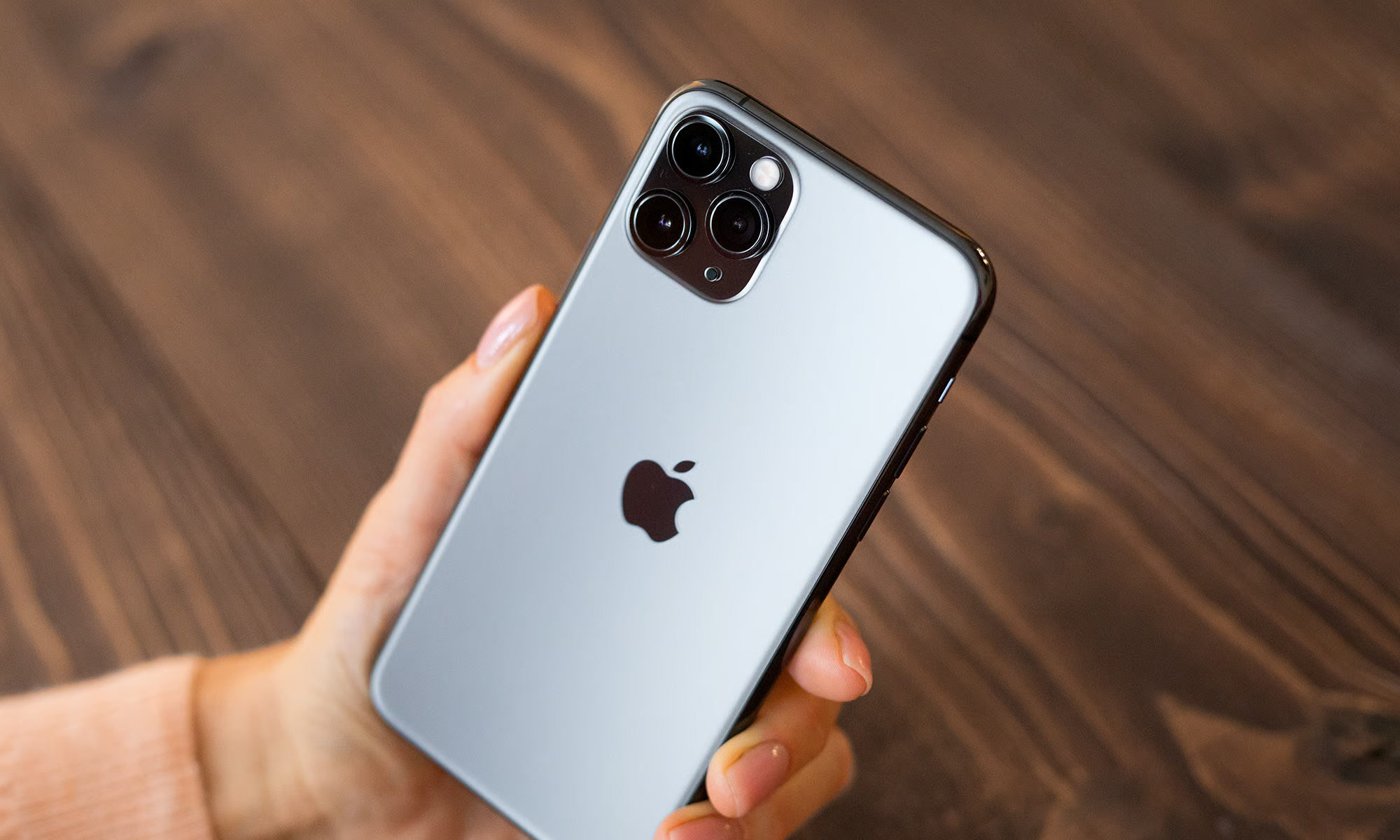
Apple (AAPL +0.59%) revolutionized mobile computing when it launched the first iPhone in 2007. Since then, smartphones have gradually become our primary computing devices, but it stands to reason that another technology could eventually fill that role.
Meta Platforms (META +0.47%) is betting on smart glasses. The company currently earns the vast majority of its money by selling targeted ads across its social media properties. But smart glasses developed by its Reality Labs business unit could eventually become a major source of revenue, especially with assistance from its Superintelligence Labs unit.
The following hedge fund billionaires, all of whom outperformed the S&P 500 over the past three years, bought shares of Meta Platforms in the third quarter.
- Israel Englander of Millennium Management added 793,500 shares. Meta Platforms is his eighth-largest holding, excluding options.
- Ken Griffin of Citadel Advisors added 1.4 million shares. Meta Platforms is his fourth-largest holding, excluding options.
- Philippe Laffont of Coatue Management added 355,900 shares. Meta Platforms is his largest holding.
Here’s what investors should know.

Image source: Getty Images.
Why Meta Platforms could be the Apple of the 2030s
In September, Meta Platforms launched its first augmented reality (AR) smart glasses, which feature a built-in display on the right lens. The glasses, called Meta Ray-Ban Display, also integrate the artificial intelligence assistant Meta AI. While analysts do not anticipate earthshaking sales, they do see the product as an important stepping stone toward the Orion glasses.
Meta first announced Orion in 2024 and is reportedly working toward a product launch in 2027. Orion smart glasses will have a built-in display on both lenses, creating a true holographic experience that blends the digital and physical worlds. Meta eventually plans to pair Orion with a superintelligence system, an AI assistant that surpasses human intelligence and can teach itself.
“Personal superintelligence that knows us deeply, understands our goals, and can help us achieve them will be by far the most useful,” CEO Mark Zuckerberg wrote earlier this year. “Personal devices like glasses that understand our context because they can see what we see, hear what we hear, and interact with us throughout the day will become our primary computing devices.”
Zuckerberg does not mean we will abandon smartphones in the future. Instead, he thinks AR smart glasses (paired with superintelligence) will be our go-to devices. For instance, personal computers are still very useful, but smartphones have replaced them for various tasks. Zuckerberg thinks smart glasses will displace smartphones in much the same way.
Importantly, Meta has been investing in smart glasses for years, and Zuckerberg says the company is “several years ahead” of its closest competitors. Indeed, Meta accounted for 73% of smart glasses shipments in the first half of 2025, up from 66% in the second half of 2024, according to Counterpoint Research.
If everything comes together as Zuckerberg expects — meaning AI smart glasses become our primary computing devices, and Meta maintains its leadership position in the market — Orion could be as successful as the iPhone, if not more so. In that scenario, Meta could become the Apple of the 2030s as it evolves into a consumer electronics giant.

Today’s Change
(0.47%) $3.10
Current Price
$668.04
Key Data Points
Market Cap
$1.7T
Day’s Range
$662.41 – $668.18
52wk Range
$479.80 – $796.25
Volume
283K
Avg Vol
18M
Gross Margin
82.00%
Dividend Yield
0.31%
Why Meta Platforms stock is worth buying today
In the near term, the investment thesis for Meta Platforms centers on its status as the second-largest ad tech company, a position derived from its dominance in social media. Facebook and Instagram generate consumer data on a large scale, creating a network effect that makes Meta’s content recommendation and ad targeting engines increasingly effective over time.
Meta Platforms has invested in artificial intelligence to reinforce that network effect. New AI-powered recommendation and ranking systems are deepening user engagement and improving ad conversion rates (i.e., more clicks) by showing people more relevant content across its social media properties. Morningstar analyst Malik Ahmed Khan writes, “Meta is a digital advertising juggernaut poised to increase its market share.”
Wall Street expects Meta’s earnings to increase at 17% annually over the next three years. That makes the current valuation of 29 times earnings look reasonable. Indeed, among 71 analysts, Meta has a median target price of $842.50 per share. That implies 26% upside from its current share price of $665.