The National Zoo’s first giant pandas, Ling-Ling and Hsing-Hsing, play in their yard in 1974 as onlookers watch.
File/AP
hide caption
toggle caption
File/AP
What’s black, white and back in the nation’s capital? Giant pandas, at last.
Bao Li and Qing Bao, both three years old, are making their public debut at the Smithsonian National Zoological Park (aka the National Zoo) on Friday after months of anticipation and fanfare — including panda-themed pop-up bars, hotel packages and special-edition transit cards.
The pair arrived in D.C. — aboard the fittingly nicknamed “Panda Express” — from China back in October. Since then, they could only be glimpsed occasionally on the zoo’s social media feed (including rolling around in the flurries during a snowstorm earlier this month).

Now, after a requisite quarantine and brief preview period for zoo members, the panda exhibit and its accompanying Giant Panda Cam are back on full display.
“Bao Li and Qing Bao have already won the hearts of our staff and volunteers, and we are excited to welcome panda fans back to the Zoo — the only place in the nation where you can see giant pandas for free — and celebrate the newest chapter of our giant panda breeding and conservation program,” said Brandie Smith, director of the Smithsonian’s National Zoo and Conservation Biology Institute.
🐼🎁🐼 Our gift to you: have yourself a merry little moment with giant pandas Bao Li and Qing Bao. Happy holidays from our wild family to yours!
. . .
🐾 Follow #DCPandas for updates, and meet our pandas when they make their giant debut Jan. 24, 2025. LEARN MORE:… pic.twitter.com/UprwrFyozs— National Zoo (@NationalZoo) December 25, 2024
Scientists estimate there are fewer than 2,000 giant pandas living in the wild, scattered throughout half a dozen mountainous regions in China. About 420 pandas live in captivity in zoos and reserves, mostly but not exclusively in China.
That’s because, over the last half a century, China has either gifted or loaned its beloved bears to zoos around the world, a practice that’s become known as “panda diplomacy.” In exchange, zoos pay a hefty fee to support panda conservation programs in China.
Under the National Zoo’s agreement, Bao Li and Qing Bao will stay in D.C. until 2034, and any cubs they birth will move to China by age four. The zoo is paying $1 million annually to contribute to projects including restoring giant panda habitat, monitoring wildlife diseases and assessing the impacts of climate change.
In addition to D.C., the San Diego Zoo welcomed two pandas in 2024, while the San Francisco Zoo is anticipating the arrival of a pair this year.
Panda diplomacy is seen as a way for China to not only conserve wildlife but promote goodwill and strengthen diplomatic ties with other countries — bringing a whole new meaning to soft power.

“Many people don’t realize it, but there are actually two Chinese ambassadors in Washington: me and the panda cub at the National Zoo,” Cui Tiankai, China’s then-ambassador to the U.S., wrote in a 2013 Washington Post op-ed.
Here’s a look at the current state of panda diplomacy — and how we got here.
The early years: Panda-monium starts to spread

Ruth Harkness holds Su Lin at her hotel room in New York City. Su Lin was never intended to be a pet, and ended up at a Chicago zoo.
Getty Images
hide caption
toggle caption
Getty Images
The first living giant panda exhibited in the U.S. was named Su Lin. The three-month-old cub was captured and brought over from China in 1936 by American fashion designer and socialite Ruth Harkness, who was inspired to carry out her late husband’s dream.
Su Lin, who was named after Harkness’ Chinese guide’s sister-in-law — he was believed to be female until after his death — ended up at Chicago’s Brookfield Zoo, where he became a star attraction, winning over celebrity admirers including Shirley Temple. He died of pneumonia in 1938, just weeks after Harkness brought back another panda from China — Mei Mei — to join him. Su Lin’s body is still on display at Chicago’s Field Museum.
Foreigners captured and took over a dozen pandas from China over the next decade, according to the World Wildlife Foundation (WWF), whose logo happens to be a panda. By the 1940s, China sought to end the exploitation of its pandas by foreigners, but recognized it had something special to offer its friends.

E. Elena Songster, a history professor at St. Mary’s College of California who authored Panda Nation: The Construction and Conservation of China’s Modern Icon, told WBUR in 2024 that the first time pandas were used “as diplomatic expression” was in 1941.
“Chiang Kai-shek’s wife, Soong Mei-ling, offered a pair of pandas to the United States as an expression of gratitude for our assistance with them in their war of resistance against Japan,” she explained.
The People’s Republic of China continued that practice in the years after it took over in 1949. The U.S. initially didn’t recognize and tried to weaken the communist government, forbade American citizens from visiting the country and encouraged its allies not to have diplomatic relations with China.
China began gifting pandas to its allies, including the Soviet Union and North Korea. It sent its first panda ambassadors, Ping Ping and Qi Qi, to the Soviet Union in 1957 to celebrate the 40th anniversary of the October Revolution, writes Yu Tao, a professor of Chinese Studies at the University of Western Australia.
Between 1957 and 1983, the country sent 24 pandas to foreign countries, including the U.S.
Mid-20th century: Panda diplomacy reaches the U.S.

First lady Patricia Nixon welcomes China’s giant pandas to Washington’s National Zoo on April 20, 1972. The tradition of China sending pandas to U.S. zoos has continued ever since.
File/AP
hide caption
toggle caption
File/AP
The U.S. and China began to warm to each other throughout the 1970s, with President Richard Nixon’s landmark 1972 visit signaling the beginning of a policy of engagement.
A pivotal moment came when China gave its first pair of pandas to the U.S., just months after Nixon’s trip.
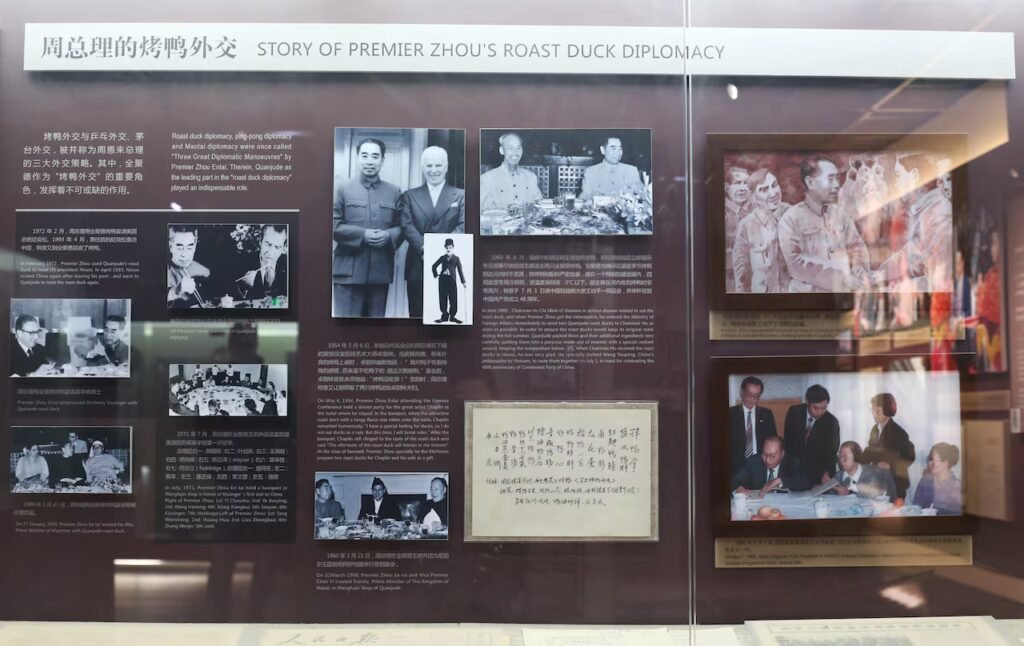
At a dinner in Beijing, while seated next to Chinese Premier Zhou Enlai, First Lady Patricia Nixon commented on a box of cigarettes decorated with pandas: “Aren’t they cute? I love them.”
“I’ll give you some,” he replied, according to the Richard Nixon Foundation.
Zhou gifted two giant pandas to the U.S., and the Nixons chose the National Zoo as their home.

Ling-Ling and Hsing-Hsing arrived in April 1972 and lived at the zoo for the next two decades. They drew millions of visitors until their deaths in 1992 and 1999, and set a new tradition in motion.
“[The gift] made a huge splash because the U.S. was a former enemy state, and so it was a giant gesture of diplomatic friendship,” Songster explains. “And from that moment, [China] saw how warmly welcomed the pandas were and how popular they were and how useful they were for putting a friendly face on China.”
By 1979, the U.S. and China had established full diplomatic relations.
As other countries — including West Germany and Japan — recognized Beijing in the early 1970s, they received pandas of their own. Soon, however, the practice began to look unsustainable.
Turn of the millennium: Gifts turn into loans

National Zoo visitors welcome Tian Tian and Mei Xiang to their new home in December 2000. They returned to China with their cub in late 2023.
Getty Images/Hulton Archive
hide caption
toggle caption
Getty Images/Hulton Archive
In the mid-1980s, China stopped giving pandas as gifts over concerns about its ability to maintain the wild population.
“And also at that time, there was a panda starvation scare, because there was a huge bamboo die-off in the pandas’ range,” Songster explained. “And so from that point forward, they started loaning them.”

That shift also embodied “China’s market-orientated economic reforms,” Tao wrote, with bears bringing in some $500,000 to $1 million per year.
While loan periods were initially relatively short, by the 1990s they had grown to at least 10 years, Songster said, proving less stressful for the animals and more conducive to reproduction.
In 1998, the U.S. shifted its acceptance policy to only allow a panda to reside stateside if China devoted more than half of its annual fee to conservation efforts, according to the History Channel.
Today: What pandas can tell us about politics

Wang Wang the panda chews on a box as South Australian Premier Peter Malinauskas and China’s Premier Li Qiang listen to a ranger at Adelaide Zoo in Australia in June 2024 — the first high-level diplomatic outreach by a Chinese leader to Australia since 2017.
Asanka Ratnayake/Getty Images AsiaPac
hide caption
toggle caption
Asanka Ratnayake/Getty Images AsiaPac
Scholars have noted that China’s panda strategy has evolved over the decades from strategic gift-giving to a financial transaction to, as of recent years, a symbol of trade relationships.
Indeed, many of China’s panda loans have coincided with trade deals. Shortly after the Edinburgh Zoo received two pandas in 2011, Scotland and China signed trade agreements involving salmon and renewable energy technology. The loan of two pandas to Germany in 2017 overlapped with Chinese leader Xi Jinping’s visit to Berlin.
The timing of panda loans has also seemed to reflect the level of tension between China and other nations.
The arrival of two pandas to Malaysia in 2014 — to mark the 40th anniversary of its diplomatic ties with Beijing — was delayed by several months because of disagreements over Malaysia’s handling of the disappearance of Flight MH370 (many of its passengers were Chinese).

In November 2023, the National Zoo sent its three pandas — Tian Tian and Mei Xiang, who had lived there since 2000, and their cub Xiao Qi Ji — back to China, in advance of the expiration of their loan agreement and amidst rising tensions between the two countries.
There was no agreement in place at the time for a new set of pandas to head to D.C., and Atlanta was left as the only zoo in the country housing any pandas.
A week later, however, Xi signaled openness to sending more pandas to the U.S., specifically California. And in May 2024, the official announcement came down: A pair of pandas — Bao Li and Qing Bao — would arrive in the States by the end of the year.