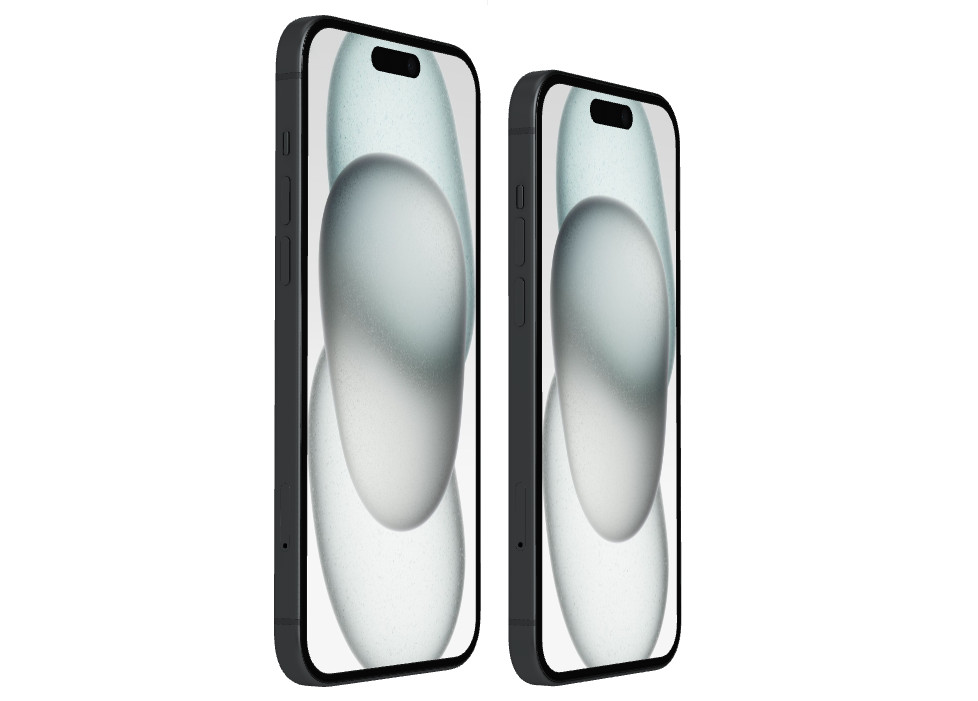
Wondering whether you should get this year’s budget iPhone 15 vanilla or the Plus? We’re here to help you out. They both have their quirks and strengths, but the good news, however, is that the iPhone 15 and 15 Plus offer a substantial upgrade over their predecessors, so whichever you decide to get, you will be greeted with a measurable improvement in performance, efficiency, display quality and, to some extent, camera performance.
But before we provide a more nuanced comparison, we suggest taking a quick look at the specs sheets.
Size comparison
If you are here reading this article, we would assume that you haven’t decided on size yet. But the difference is obvious. The 15 Plus will appeal to anyone looking for a big-screen experience and doesn’t mind the extra weight. The Plus tips the scale at 201 grams, which is quite hefty but still lighter than the Pro Max.
Naturally, the vanilla 15 is a much more compact and lightweight alternative. The 15 will definitely appeal to the old-school iOS users who are used to the smaller iPhones in the past.
It may not sound as much on paper, but the difference is glaring in person.
Aside from the size and weight difference, the two have no notable differences in design and build. After all, they both belong to the same family, so there’s no generational difference.
Display comparison
Both iPhones boast new, upgraded displays compared to their predecessors, but the difference between each other is limited to size and resolution. Naturally, the 15 Plus gets the bigger display with a higher resolution to match but retains the same 460 ppi as its smaller counterpart.
The duo’s displays are based on the same technology and support the same features – HDR10, Dolby Vision, 10-bit color depth and both are branded as Super Retina XDR OLED. The two also get the new Dynamic Island as well.
Even when it comes to real-world use, the two panels are nearly identical. In our testing, both had their max brightness peak in the mid-1,600 nits in auto mode and reached a little over 800 nits in manual mode. Color accuracy is superb in both cases.
So, as you can see, the size is the only thing that separates the two, and it’s obvious which one is suitable for which user.
Battery life
The winner in the battery endurance race wasn’t as clear-cut as we expected. Usually, bigger phones tend to have longer battery life because they can hold bigger batteries. And for the most part, this is still true here.
The iPhone 15 Plus scores 111 hours overall in our endurance tests, while the vanilla 15’s score is 98 hours. But that’s mainly due to the 15 Plus’ longer standby and call runtimes.
Looking closely at the results, the 15 and 15 Plus don’t seem to be much different, as the screen-on results are barely different. The 15 Plus runs longer when browsing, while the 15 Plus is more efficient in the video test, but by a small margin.
Perhaps the 15 Plus display draws disproportionally more energy as it’s bigger and has a higher resolution. Although historically, the latter rarely makes a big difference in real-world usage.
Either way, the conclusion you could draw from the results is that the 15 Plus may be suitable for people who tend to leave their device idling for longer, whereas power users who rack up screen time more easily won’t notice much of a difference.
Keep in mind that battery deterioration throughout the years is less felt on a bigger battery, so that may be one reason to opt for the Plus if you are looking to get a few years’ worth of use out of your new iPhone.
Charging speed
To our big surprise, the iPhone 15 Plus charges faster than the iPhone 15. However, to some extent, that makes sense because bigger batteries tend to charge faster as they can maintain higher voltage for longer.
On the grand scheme of things, however, you might feel little difference between the two. In the first 15 minutes, the 15 and 15 Plus charge equally fast, while at the 30-minute mark, the vanilla model was slightly faster even. Still, the 15 Plus completes a full cycle about 16 minutes faster.
Speaker test
Contrary to what most think, the speakers of both handsets are quite different. Sure, they use the same hybrid setup, and both are well balanced, but for some reason, the smaller iPhone has slightly louder speakers.
Either way, the difference is rather negligible, but the sound tuning can’t be overlooked. There’s a noticeable difference in bass and treble. The bigger iPhone seems to have more bass and offers fuller sound, while the vanilla iPhone 15 gets the vocals across better but at the cost of a slight ring at a higher volume. We kind of like the 15 Plus better, though.
You can compare how the two iPhones sound in controlled acoustic conditions with the samples below. Just make sure you have your headphones on and the volume at max level.
Performance
Since both handsets run on the same A16 Bionic chip, based on the same 4nm node, there’s little to no difference in short benchmark tasks. The 15 Plus consistently edges out the vanilla 15 in all benchmarks, but the difference is statistically insignificant. It’s probably because the 15 Plus has a slightly larger body and can maintain higher clock speeds for longer.
But since benchmarks work in short bursts, the results don’t show a huge deviation.
Camera comparison
The camera comparison is pretty easy. Both devices sport a brand new 48MP main camera, which offers a significant upgrade over last year’s standard iPhone 14 lineup, but there’s absolutely no difference between the two handset’s ability to perform in daylight or low-light scenarios.
The new 48MP sensor outputs excellent photos in pretty much every scenario, even at night, without having to resort to the dedicated Night mode. On the other hand, the Night mode does seem to improve overall image quality, but it’s rarely triggered by the software.



iPhone 15 Plus: 0.5x • 1x • 2x



iPhone 15: 0.5x • 1x • 2x
Even the cropped 2x zoom samples are excellent, but the ultrawide camera leaves more to be desired, especially after dusk.



iPhone 15 Plus low-light: 0.5x • 1x • 2x



iPhone 15 low-light: 0.5x • 1x • 2x
The bottom line is you shouldn’t make a decision based on camera performance as both handsets offer the same quality overall.
That applies to video recording as well.
Here’s a glimpse of how the iPhone 15 Plus’ main camera compares in image quality to the iPhone 15 in our Image compare tool.
And here’s how the iPhone 15 Plus’ main camera compares in video quality to the iPhone 15 in our Video compare tool.
Verdict
As you can see, it’s not just about size. Sure, getting the bigger 15 Plus has some benefits and drawbacks due to its bigger size, but there are other things to consider here. For instance, price. The 15 Plus’ MSRP is €1,100/$899 (in Europe/USA), while the 15 asks sensibly less – €950/$800. That’s about 150 bucks worth of a difference, which some users may not justify. Especially if you don’t mind having a more compact device in your pocket. After all, the iPhone 15 is the cheapest possible entry into Apple’s 2023 ecosystem, and it’s also the closest you will get to your years-old compact iPhone.
On the other hand, the iPhone 15 Plus makes a compelling case for itself as it’s slightly better in some regards. It’s capable of maintaining higher clock speeds for longer, it’s slightly faster when it comes to charging, it offers a bit longer battery life, and, of course, it has a bigger display.
No matter how we put it, though, the deciding factor would still be the display size, because for the most part, you will get a near-identical user experience. It depends on whether you want a big-screen iOS experience or you are into something more compact.

- The bigger display.
- The slightly faster charging.
- The slightly longer battery life
Get the iPhone 15 Plus for:

- The smaller dimensions and lower weight.
- The lower price.
Get the iPhone 15 for: