All sides in the Gulf war are at risk of overplaying their hands
IN WAR, WHAT at first seems logical can, in hindsight, prove to have been foolhardy. Having repelled its Iraqi invaders in 1982, Iran spurned a ceasefire and pushed ahead with a counter-invasion. America overthrew Saddam Hussein within weeks in 2003, only to bog itself down in nearly a decade of counter-insurgency. Both had their reasons: Iran wanted to topple the Iraqi government; America wanted to install a friendly regime. Both overplayed their hands and wound up in long, inconclusive wars of attrition.
Iran has effectively kept the Strait of Hormuz closed, amid the US-Israeli conflict with Iran, (REUTERS/ Representative)
Now in its fifth week, the third Gulf war has already gone on longer than Donald Trump predicted at the start. America and Iran have exchanged proposals for a ceasefire, but their positions are far apart. Almost no one in the region is optimistic that their indirect talks will lead to a deal. Some are now talking of America deploying thousands of troops on the ground to seize Iranian territory; the Pentagon is reported to be preparing for weeks of ground operations. Further weeks of fighting seem likely—which would suit Israel, the third party to this war.
Once again, each side has its reasons for continuing. The risk is that they will overreach in turn. Iran may miss its best opportunity to end the war on favourable terms. Mr Trump may embroil himself in the sort of prolonged conflict he once railed against. And even as they fight alongside each other, Israel may cause deep damage to its most important relationship: the one with America.
In Iran, the regime now reckons it has the upper hand. It has endured a month of war and kept up a steady (if diminished) pace of missile-and-drone attacks on Israel and the Arab Gulf states. It has already inflicted enormous damage on the global economy. More pain is coming: Mr Trump may have talked down oil prices last week by exaggerating his progress towards a deal, but reality—a shortfall of some 10m barrels per day—is creeping back in. A barrel of Brent crude now fetches more than $112.
Meanwhile the damage to Iran, though extensive, is still mostly limited to military and nuclear targets. The regime even continues to export oil (and in some cases, it charges a premium over Brent).
This should be Iran’s moment of maximal leverage to try and end the conflict. It could offer to relinquish its control of the Strait of Hormuz in exchange for sanctions relief, throw in a few other modest concessions and promise to discuss the rest of America’s demands in the future, knowing that Mr Trump’s attention span is limited and such talks may never happen. That would be an imperfect deal for Iran—but it would be far better for the regime than for Mr Trump.
Yet the Islamic Republic seems unwilling to make such a deal. Iran has been attacked twice over the past year while negotiating with America, which puts its surviving leaders in a mood both vengeful and suspicious. They want not only to end this war but to deter another one, and they reckon further economic chaos might help to achieve the latter goal. Some officials hope to levy tolls on those using Hormuz, charging fees to vessels that pass through the strait. They also insist on terms that Mr Trump cannot agree to, such as closing American bases in the region and paying reparations for the war.
Should the war continue, though, two developments are likely. First, it will get harder for Mr Trump to declare victory. The closure of Hormuz is already a political embarrassment at home, and it is hardening the positions of key allies in the Gulf, particularly Saudi Arabia and the United Arab Emirates (UAE). If it continues for a few more weeks, selling a half-baked deal as a success may prove beyond even Mr Trump’s powers of persuasion.
Second, the damage to Iran will mount. On Friday Israel bombed large steel plants in the country, at least one of which subsequently halted production. The impact of a prolonged shutdown would be profound. Iron and steel are among Iran’s main non-oil exports, with revenue of almost $7bn a year—a vital source of hard currency, since oil exports have been hobbled by American sanctions. The plants also supply a range of domestic industries, from cars to construction.
For now, America is holding Israel back from additional such attacks, but it will not impose restraint forever. Iran’s control of Hormuz may thus be a wasting asset: if the regime does not trade it for a ceasefire, it will end up inviting further, more destructive conflict—which is likely to include a ground invasion.
The Pentagon has already dispatched around 7,000 marines and paratroopers to the region and may deploy another 10,000 troops. They may attempt to capture islands at the mouth of the strait, such as Abu Musa and the Tunbs, which are disputed between Iran and the UAE. A few officials in the Gulf are also urging America to impose its own blockade on the strait to curtail Iran’s oil exports (though that would probably have the effect of pushing up global oil prices further).
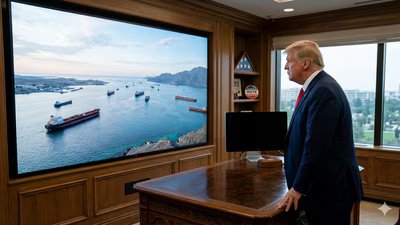
Such steps may not be enough for a president fond of theatrics (Mr Trump is said to watch a daily highlight reel of things going boom in Iran as part of his intelligence briefing). He might be tempted towards something more spectacular: seizing Kharg Island, the site of Iran’s main oil-export terminal, or dispatching commandos to secure Iran’s stash of highly enriched uranium. Both would be risky and operationally complex.
Whichever option Mr Trump chooses, his administration hopes it will be a knockout blow: either it will force Iran to reopen the strait, or it will give the president a chance to declare victory. It may do neither. If America seizes islands only for Iran to remain unbowed, its armed forces will have to hold them. Should American troops suffer heavy casualties, Mr Trump may feel compelled to send more. Far from ending the war, a ground invasion may suck America further in.
That in turn will present risks for Binyamin Netanyahu, the Israeli prime minister, and for Israel as a whole. The politician hopes the war will help him win a legislative election later this year. A long conflict may hurt him. Much of the country is still under restrictions that prevent businesses and schools from operating normally which the finance ministry estimates are costing more than $1bn (0.2% of GDP) a week. Public support for the war, though high, is already softening. Half of Jewish Israelis say they strongly support it, down from 74% at the beginning of March, according to the Israel Democracy Institute, a think-tank (Arab Israelis are overwhelmingly opposed).
A bigger worry for Israel is what will happen to its standing in America, which has already plummeted after two years of scorched-earth conflict in Gaza. A Gallup poll released just before the attack on Iran found that, for the first time, more Americans were sympathetic to the Palestinians (41%) than to Israel (36%). Though Republicans are still staunchly pro-Israel, a vocal minority within the party argues that the Jewish state has too much influence over American foreign policy. In the latest Economist/YouGov survey, 55% of Americans said Israel would benefit from the war in Iran; just 30% thought America would do so.
Imagine, then, that the war drags on for months. Scores of American troops are killed in combat. Inflation soars. A wounded Trump administration accuses Mr Netanyahu of leading it into a quagmire. The midterms in November become a referendum on America’s relationship with Israel. None of this is entirely far-fetched (indeed, the blame game has already begun). Each side thinks it has something to gain from continuing the war. In the end, though, the question may be which has the most to lose.
When you buy through links on our articles, Future and its syndication partners may earn a commission. Credit: Android Central What you need to know Netflix is raising prices again across all tiers in the US and Canada — its second hike in roughly 14 months. The ad-supported plan jumps to $8.99 (+$1), while ad-free
Oil advanced as Iran-backed Houthi militants in Yemen entered the Middle East war and more US troops arrived in the region, raising fears the widening conflict will cause further chaos for energy markets. The conflict has put global oil and gas supplies at risk, led to shortages of fertilisers, and affected air travel. (Agencies) Brent
President Donald Trump on Sunday night said he has “no problem” with a Russian oil tanker off the coast of Cuba delivering relief to the island, which has been brought to its knees by a US oil blockade. President Donald Trump speaks to reporters aboard Air Force One en route from West Palm Beach, Fla.,
US President Donald Trump said Sunday that the US-Israel war had achieved regime change in Iran, even as he assured that he would “make a deal” with the Iranians. US President Donald Trump waves to the media as he walks on the South Lawn upon his arrival at the White House. (AP) “I think we’ll
Israeli security forces are looking for ways to enable worship at the Church of the Holy Sepulchre during Holy Week after police prevented the Latin Patriarch from holding Mass there on Palm Sunday, citing security concerns. “Freedom of worship in Jerusalem must be fully guaranteed, without exception, for all faiths,” the EU’s Kallas said. (Reuters)
Donald Trump has claimed that Iran allowed additional oil tankers to pass through the Strait of Hormuz as a ‘present’ to Washington, even as the conflict in the Middle East deepens and high-stakes negotiations continue behind the scenes. Trump claimed that Iran had allowed 20 oil tankers to cross Strait of Hormuz as a gift
Paris: Ministers from the G7 will hold talks on Monday to unpack the economic consequences of the war in the Middle East, the French government said, as oil and gas prices continue to soar. The United States and Israel launched strikes on Iran in late February and Tehran has hit back by targeting crude-exporting countries
US President Donald Trump has revealed his “favourite thing to do” in the Iran war, and not surprisingly, it is taking Tehran’s oil. President Donald Trump waves to the media as he walks on the South Lawn upon his arrival at the White House, Sunday in Washington. (AP) The US has been accused in the
A garage can be a tough environment, collecting dirt, moisture, insects, and rodents. It can be difficult to use power tools and work in such conditions, especially if your garage’s design is one that doesn’t have enough outlets in the right places, forcing people to use extension cords or power strips. If your garage floor is
A two-property industrial outdoor storage site in Bergen County has been sold as part of a major new investment push targeting the Meadowlands and other key markets. JLL Capital Markets said this week it completed the sale of the Premier Meadowlands industrial outdoor storage site in Moonachie, a location totaling approximately 1.44 acres. Sagard Real
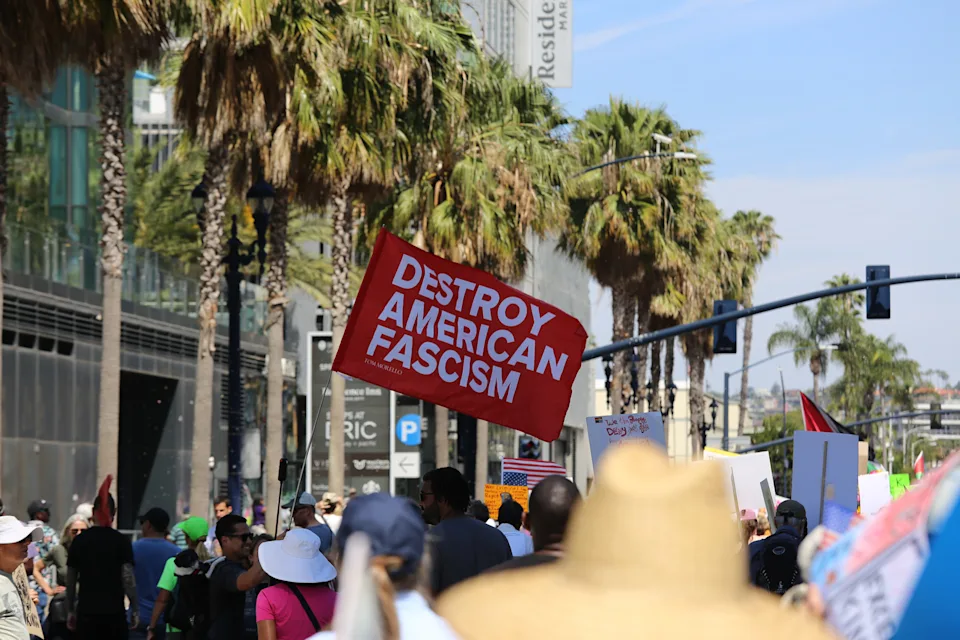
SAN DIEGO (FOX 5/KUSI) — A record nearly 100,000 people took part in “No Kings” events across San Diego County on Saturday, according to Take Action San Diego. The progressive activist group said on Sunday that an estimated 93,000 to 98,000 demonstrators gathered across 22 countywide events as part of a nationwide day of protest
An Iranian strike on a power station in Kuwait killed one Indian worker and damaged a building at the site, the Gulf state’s electricity ministry said on Monday. On February 28, Israel and the United States launched strikes on Iran, killing its supreme leader and triggering a war that spread across the Middle East unleashing
Britain’s Prime Minister Keir Starmer speaks to the media at the port in Helsinki, Finland, Thursday, March 26, 2026 via Associated Press Keir Starmer is expected to make Labour’s decision not to go to war with Donald Trump against Iran central to the party’s local election campaign on Monday. Speaking from the West Midlands, the
Every so often, the auto industry produces a car that never reaches production but still leaves a lasting impression on people who know what they are looking at. The Guanci SJJ was one of those cars. It arrived during one of the hardest periods in modern American automotive history, yet it had the shape, engineering
LONDON, March 29 (Reuters) – Britain’s finance minister will urge her G7 counterparts on Monday not to pursue unilateral measures such as new trade barriers while the Iran war continues, saying such steps could further threaten energy security. During a meeting with G7 finance ministers, energy ministers and central bank governors, Rachel Reeves will say
The report noted that the damage to the tower was caused by shrapnel striking the facility, and that the authorities were working to restore power in the affected areas. Power outages were reported on Sunday in Tehran and Karaj after an attack targeted a high-voltage tower in Alborz province, according to Nournews. The report noted
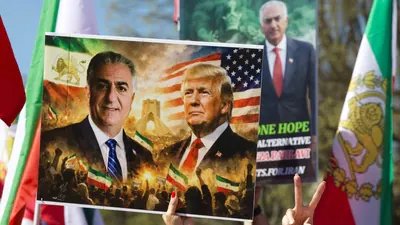
Thousands of people have been killed across the Middle East in the Iran war, which began when the U.S. and Israel struck Iran on February 28. Those strikes triggered Iranian attacks on Israel, US bases and the Gulf states, while opening a new front in Lebanon. Demonstrators hold up an image of Reza Pahlavi, son
Sir Keir Starmer will pledge to “fight for our values” in a volatile world as he kicks off Labour’s local election campaign on Monday. Labour approaches the May 7 elections struggling in the polls and facing challenges from both Reform UK to the right and a resurgent Green Party to the left. But despite predictions
AeroVironment, Inc. (NASDAQ:AVAV) is one of the best defense contractor stocks to buy right now. On March 23, analysts at BTIG reiterated a Buy rating on AeroVironment, Inc. (NASDAQ:AVAV) and a $330 price target. AeroVironment Inc. (AVAV) Secures $117M US Army UAV Contract following $97M Contract Michael Fitzsimmons/Shutterstock.com The positive stance is in response to
One man is in custody after a mother and her 12-year-old son were killed in a shooting on Saturday night. [DOWNLOAD: Free WHIO-TV News app for alerts as news breaks] Around 8:10 p.m., Akron Police officers responded to a shooting near 30 West Wilbeth Road, CBS affiliate WOIO-19 reported. TRENDING STORIES: Dispatchers received multiple 911