[The content of this article has been produced by our advertising partner.]
Hong Kong’s first Research Grants Council (RGC) Research Summit, held at Hong Kong Science Park on December 11, arrived at a watershed moment when technological breakthroughs such as AI are no longer simply scientific discoveries within ivory towers but are directly impacting our daily lives.
Presenting their work at the Summit, Hong Kong researchers often in partnerships with scholars and experts in the Greater Bay Area (GBA) and internationally, put AI to use across a wide range of applications in health care, transport systems, manufacturing settings and environmental protection.
The Summit, which coincided with the RGC’s 35th anniversary, highlighted the maturing of Hong Kong’s globally connected academic research community with continuous government investment and public funding over the last three and half decades.
It is against this backdrop that the Summit sought to set a direction for the years ahead, when universities are challenged by disruptive technological transformation and geopolitical tensions, particularly in areas where cutting-edge technologies are becoming more critical for Hong Kong’s future development.
Strategic direction from the UGC and RGC
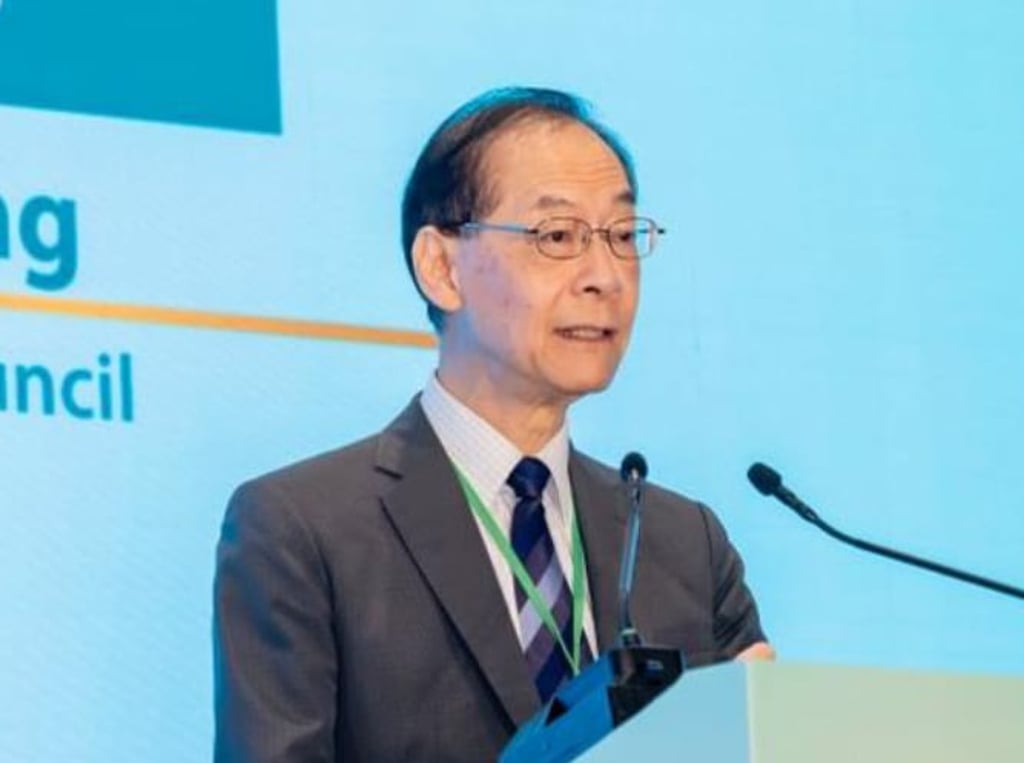
More than 20 competitive funding schemes are now in operation and more than 1,500 new projects receive support every year, he said, adding that collaboration has become far more common, with overseas partnerships rising from a few thousand a decade ago to more than 7,000 today.
Hong Kong’s research ecosystem, Professor Tong pointed out, has developed the expertise, talent and momentum for the next phase of scientific discovery, which he expects will bring more impactful work that would benefit society and the economy.
Plenary discussions on Research Future and Hong Kong’s role
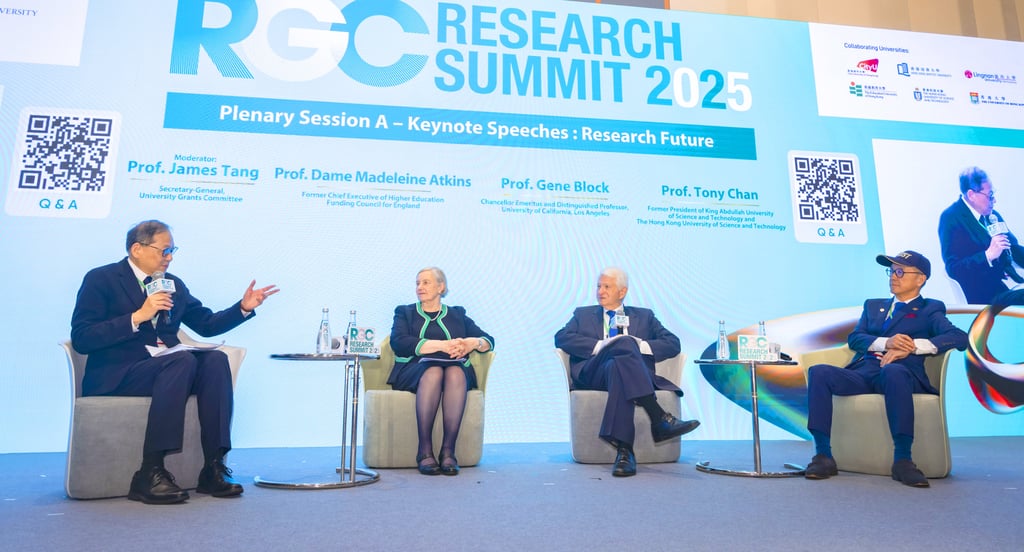
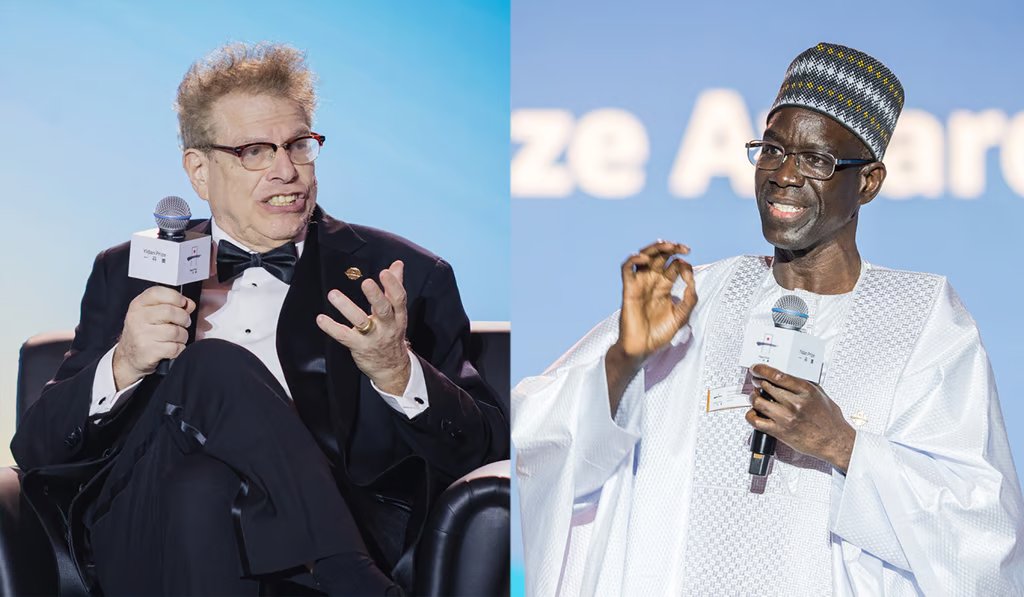
The panelists addressed the problems that may arise when decisions are made by opaque models, while the need for openness, human supervision, fairness, privacy and secure handling of information was acknowledged.
While they viewed AI as a useful research tool, the consensus was that the scientific community, especially our younger generation would need to maintain scepticism and judgement that are key to academic work. Discussion also shifted towards the way funding bodies around the world are trying to support work that can be put to the test in real-world settings more quickly than before, especially with rising competition from big tech corporations and other players beyond the existing academic boundaries.
Moderating this session, Professor James Tang, Secretary-General of the University Grants Committee (UGC), called for research with purpose and collaboratively with partners outside of academia and globally. He noted that Hong Kong has reached a point where knowledge can be used in ways that were not possible even five years ago.
He said that the Summit was organised to encourage research in new areas of enquiry and to work across institutions in different fields such as data science, sustainable technologies and biomedicine which increasingly require collaborations across disciplines and institutions around the world.
On Hong Kong’s privileged position as an interface and super-connector, he said that the city’s links with the Chinese Mainland and the wider world internationally give it an unusual combination of access to Chinese scientific communities and those elsewhere with unparalleled opportunity for scientific collaborations globally.
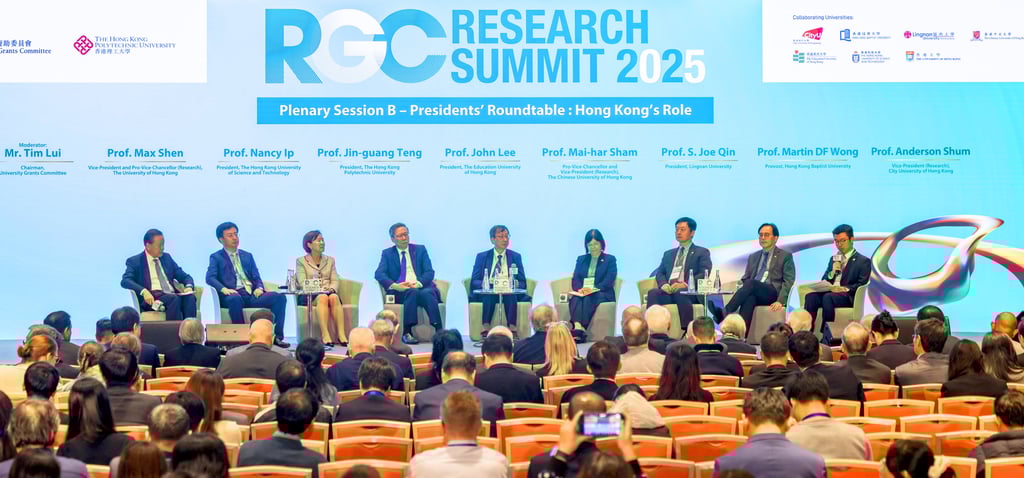
They spoke about working with partners in the GBA and abroad, noting a steady pipeline of joint projects across Hong Kong’s research community and the value of channelling talent, knowledge and technology through the city.
The need for more space for labs and research centres was raised, alongside calls for recruitment policies that attract more young researchers to develop their careers in Hong Kong. Much of the discussion focused on keeping university research open to partners in the Chinese Mainland and overseas, while finding ways for knowledge transfer to benefit society as whole.
Research projects show AI entering everyday use
The Summit highlighted some exciting application of pioneering research work put into practical use by showcasing a number of projects supported by the Collaborative Research Fund (CRF) and the Research Impact Fund (RIF).
AI-empowered robots in the operating theatre
One exemplary case in point was a project on intelligent surgical robotic assistants, developing robotic systems that combines visual analysis, sound recognition and robotic control to support surgeons during complex procedures. Image datasets from stomach operations and speech recordings are being used to train models that can recognise instruments, organs, and language, enabling robots to follow procedural flow and respond to spoken commands. The objective is to reduce human errors and ease the strain on clinical teams, with tests carried out on endoscope robots and automated scrub nurse robots in cadaveric procedures.
Digital twins for autonomous driving
Another project on digital twin networking for autonomous driving demonstrated how AI-empowered digital twin services can facilitate the transition of autonomous driving to public roads, making an important impact on improving our daily lives. The team is building a network that links virtual models of roads, vehicles and user behaviour with real-time traffic data. This approach may prepare autonomous driving systems for varied conditions, utilizing digital twin services provided by multiple service providers, and could support real-time simulations for future traffic management.
Sensing through future 6G networks
On the telecommunications side, research into sensing within future 6G networks showed how mobile infrastructure may be put to work in two ways at once. The team is examining how base stations, which already transmit data, may also sense their surroundings. If workable, factories could monitor equipment without extra sensors and vehicles could read their environment with network support. Trials with single and multi-station sensing are under way.
Edge computing for faster AI tasks
Edge computing was the focus of another CRF project. The group is studying ways to bring together devices with different processing strength so that they can run AI tasks quickly as a shared system. The work covers hardware abstraction, resource scheduling and methods for producing optimised code, with autonomous driving used as an example setting.
Studying bridge performance in harsher conditions
One project used decades of data from the Tsing Ma Bridge to study how long-span sea-crossing structures may hold up under more frequent extreme weather. The team is drawing on climate projections, temperature records and wind patterns to suggest updates to design codes and maintenance regimes.
Engineering support for urban greenery
Work on tree root systems in compact cities offered a different example of applied research. The group aims to find ways for trees to grow in road systems without causing disruption or failing in storms. Their methods include using breathable materials within road structures, shaping root paths, improving drainage and reducing pavement heave. The project may help to bring more greenery into dense urban areas while reducing hazards.
Health resilience in a changing climate
This RIF project builds on an earlier study of Hong Kong’s extreme heat, now focusing on the often-overlooked risks of winter cold. It examines how future weather patterns, particularly sudden temperature drops, may affect the physical and mental health of older adults. By combining epidemiological records, climate projections, and social factors, the study identifies vulnerable groups. Co-creating knowledge with NGOs and care providers, the project translates findings into actionable strategies, enhancing public health planning and community support for aging societies.
Policy signals for the next phase of research
In her remarks, Secretary for Education, Dr Choi Yuk-lin said Hong Kong’s universities have raised their profile internationally and that government support for postgraduate and postdoctoral research has been expanded.
Initiatives to bring in more students from abroad, relax admission routes and set up new pathways in medicine and related fields were cited as steps to grow the city’s pool of young researchers, supported by RGC schemes and closer links with international institutions.
The fast spread of AI across transport, health, culture and business will also call for graduates with a mix of technical and practical knowledge, alongside a sound understanding of digital tools, she added.