Concerns over an artificial intelligence (AI) bubble, the weakening won and potential changes in U.S. interest rate policy loom as major variables — so-called “gray rhinos” — that could shake the Korean stock market in 2026, analysts said Thursday.
A gray rhino is an economic term referring to a danger that is plainly visible and widely recognized, yet frequently underestimated or inadequately prepared for. It contrasts with a “black swan,” which denotes a shock that emerges without warning.
Questions surrounding a possible AI bubble are expected to remain a decisive factor for global technology stocks.
Should major tech firms continue their aggressive cloud infrastructure spending as planned, investor anxiety could subside, allowing semiconductor shares to gain additional upward momentum. Experts caution, however, that investment fueled by heavy borrowing could undermine market confidence.
Goldman Sachs estimates that capital spending by the five largest cloud computing and storage service providers — Amazon, Google (Alphabet), Meta, Microsoft and Oracle — will total $471 billion this year, representing a 23.6 percent increase from 2025.
If their returns fall short of expectations, the resulting pressure could trigger a sharper pullback in share prices.
“Aggressive strategies relying on large-scale debt could quickly translate into heightened financial risk if they fail,” said Kim Byung-youn, a senior analyst at NH Investment & Securities. “In such a scenario, companies with stronger balance sheets, such as Samsung Electronics or SK hynix, may become more attractive to investors as concerns over leverage mount.”
The won-dollar exchange rate also stands out as a factor capable of altering the trajectory of Korean equities.
After climbing to around 1,480 won per dollar last month, the exchange rate retreated as authorities intensified verbal warnings and introduced measures to stabilize supply and demand. Despite the recent pullback, analysts expect structural pressure on the domestic currency to persist over the medium to long term. They attribute this largely to the prolonged reversal in interest rate differentials, with Korea’s policy rate remaining below that of the United States since 2022, spurring greater capital outflows.
“As the recent surge in overseas investment by domestic institutions and individuals has become a structural trend, a meaningful decline in the exchange rate would likely require a recovery in Korea’s manufacturing sector, which serves as a key indicator of the economy’s underlying strength,” KB Securities analyst Oh Jae-young said.
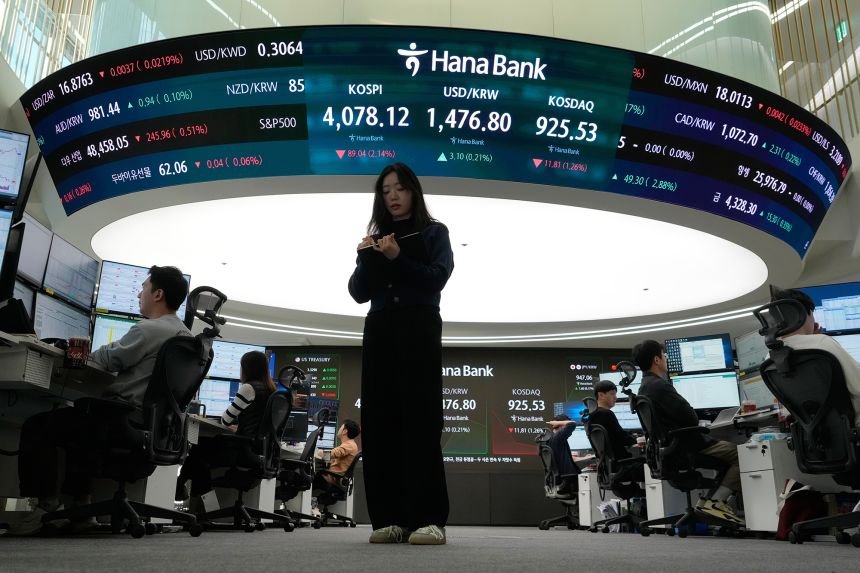
The closing prices of the KOSPI and Kosdaq, along with the won-dollar exchange rate, are displayed on monitors in the dealing room of Hana Bank in Seoul, Tuesday, the final trading day of 2025. Yonhap
Meanwhile, changes in U.S. monetary policy are emerging as a major gray rhino for global equity markets.
The Donald Trump administration is reportedly considering Kevin Hassett, a long-time conservative economist and key Trump economic adviser, as a top contender to replace Federal Reserve Chair Jerome Powell when his term expires in May. With Hassett widely regarded as leaning toward monetary easing, speculation is building that the dollar could enter a long-term weakening trend once new leadership takes the helm at the Fed.
Although these factors pose risks that could increase market volatility, they could also trigger relief rallies once uncertainty eases, analysts noted. A prime example was Trump’s tariff provocations in early 2025, initially regarded as the year’s biggest market threat but later turning into a catalyst for a stock rebound as negotiations progressed.
Building on this optimism, some brokerages forecast that the KOSPI, which surpassed 4,000 for the first time last year, could climb higher, potentially reaching 5,000.
NH Investment & Securities and Hyundai Motor Securities have offered the most optimistic outlooks, setting the index target at 5,500.
“With the onset of an interest rate-cut cycle in the U.S. and other major economies, market liquidity is set to expand, while the global AI investment surge will continue to drive strong gains in the semiconductor sector and sustain AI-themed stocks as market leaders,” Hyundai Motor Securities said in its report. “The KOSPI is expected to track foreign net buying and the strong performance of U.S. AI equities, with the semiconductor industry likely driving further upward momentum.”
On Tuesday, the final trading day of 2025, the KOSPI slipped 6.39 points, or 0.15 percent, to close at 4,214.17. For the full year, the index gained approximately 76 percent, ranking first in returns among G20 and OECD nations.