A Roth IRA offers significant benefits for retirees. As an after-tax account, distributions from Roth IRAs are typically tax-free. This can save you a lot of money in retirement, but at the cost of up-front tax payments while you’re saving. You will spend more to build your portfolio today, but will save money later.
A financial advisor can help you plan and save for retirement. Find a fiduciary advisor today.
For example, say that you’re married and in your late 50s. You and your spouse have a 401(k) with $1.6 million and are building toward a strong retirement. Would you benefit by switching to Roth contributions?
In this case, most households may benefit by sticking with their pre-tax contributions, but the answer will depend on a number of factors. Here’s how to think about it.
Pros and Cons of a Roth IRA
As an after-tax account, a Roth IRA doesn’t offer any tax deduction or credit for your contributions up front. The benefit comes in retirement when you can withdraw your money tax-free.
This is the inverse of a tax-deferred retirement account, like a traditional IRA or 401(k). Such accounts provide an income tax deduction on all contributions – up to the annual contribution limits – for the year in which they’re made. Then, in retirement, you pay income taxes on all withdrawals (both returns and principal).
Up-front taxes are the main disadvantage to a Roth IRA. The money you spend on taxes is capital that you could have otherwise invested for long-term, tax-deferred growth. For example, say that you pay an effective tax rate of 20%. With a Roth IRA, you’d have to earn $1.20 for every $1 you save to account for taxes on your contribution. With a 401(k), on the other hand, you can save and invest the full $1.20 in pre-tax earnings.
But there are significant advantages to Roth IRAs. First, and most notably, you can keep all the money you withdraw from this account (provided that you adhere to a few rules). By contrast, all withdrawals from a 401(k) are effectively reduced by your income tax rate.
Second, a Roth IRA is excellent for maximizing growth. The longer this portfolio grows, the more value its tax-free withdrawals will have. Third, Roth withdrawals can help keep your Social Security benefit taxes low since they do not increase your taxable income.
Fourth, and finally, Roth IRAs are not subject to required minimum distributions (RMDs), so you can keep the money invested for as long as you want.
If you’re unsure whether a Roth IRA is a good option for your financial circumstances, consider speaking with a financial advisor.
Roth Contributions vs. Conversions

There are two main ways to build a Roth IRA if you already have a retirement account: contributions and conversions.
With a Roth conversion, you move the money from your existing pre-tax portfolio into a Roth IRA. There are no limits on how much money you can convert. For example, someone could convert their entire $1.6 million 401(k) in a single year.
With contributions, you begin putting newly earned income into a Roth IRA each year. These savings are subject to standard IRA contribution limits. In 2024, you can save up to $7,000 in IRAs or $8,000 if you are 50 or older. Since IRA contribution limits are different from 401(k) limits, you can contribute up to the limits of both a Roth IRA and a 401(k) in the same year if you have the capital.
Weighing Your Options
In both cases, the money that flows into a Roth account counts toward your taxable income for the year. With contributions, this means you do not get to deduct the money you save in your Roth IRA. With a conversion, you include the amount that’s rolled over in your taxable income for the year. For example, if you converted the full $1.6 million, you would pay taxes on the lump sum.
If you convert a pre-tax portfolio, make sure you have the cash on hand to pay the resulting taxes. This is particularly true for investors over the age of 59 ½, as above this age you can use the money from your portfolio to pay income taxes.
Finally, Roth contributions are subject to the five-year rule. Any earnings that your contributions generate must remain in the account for five years, regardless of your age or retirement status. For example, say you contribute $8,000 in 2024 and $8,000 in 2025. Any interest that the first $8,000 generates must remain invested until 2029. Earnings from the second $8,000 must remain there until 2030. Violating this rule can result in income taxes and a 10% penalty.
Roth conversions are subject to a separate five-year rule that requires the converted amount to remain in the account for five years before it can be withdrawn penalty-free. A five-year waiting window applies to each individual Roth conversion, however.
Luckily, the five-year waiting periods start retroactively, so doing a Roth conversion or making a Roth contribution in December 2024 will mean your five-year period started in January 2024.
If you want to add a Roth account to your mix of assets but don’t know whether contributions or conversions make the most sense, consider matching with a financial advisor and talking it through.
Should You Switch To Roth Contributions?
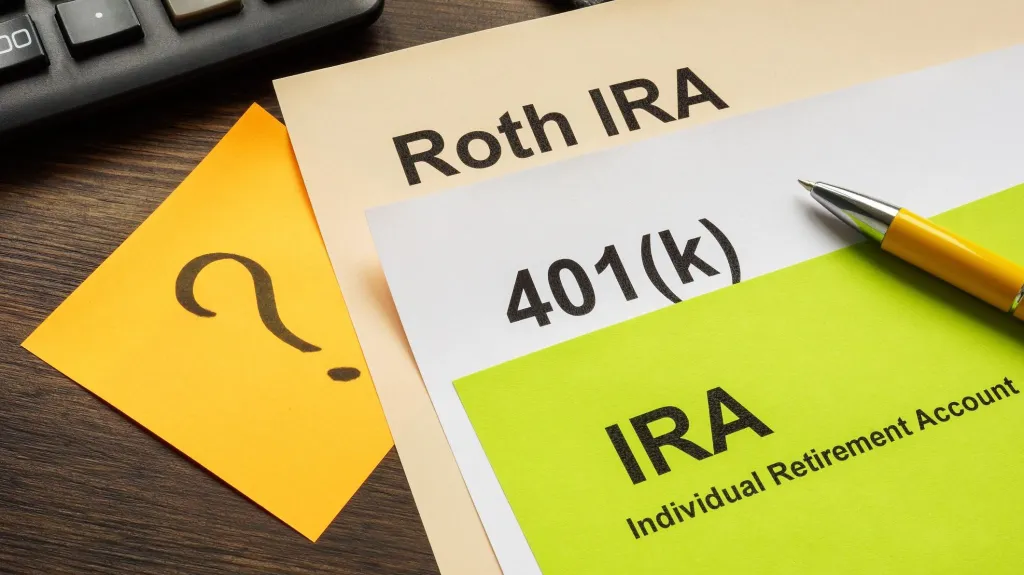
So, should you switch to Roth contributions? For example, say that you’re 57 with $1.6 million in your 401(k). Is now a good time to prioritize Roth contributions over ongoing 401(k) investments?
While it depends on your individual situation, there’s a decent chance the answer may be no.
The rule of thumb is that a Roth IRA works best for people who expect to be in a higher tax bracket in retirement. As a result, Roth IRA contributions usually have the most value earlier in life, when most households make less money and have more time for their money to grow tax-free.
By contrast, a 401(k) and other pre-tax accounts typically work best when you currently pay a higher tax rate than you will in retirement. This lets you maximize the value of the present tax deduction, effectively letting you defer the income taxes on your current income until later in life when you’re in a lower tax bracket.
For example, say that you pay an effective tax rate of 25% and expect that rate to be 15% in retirement. You have $5,000 of pre-tax income to contribute and it will double by the time you retire. With a Roth IRA, you would contribute $3,750 ($5,000 – 25%). In retirement, you would withdraw and keep $7,500 ($3,750*2 – 0%). With a pre-tax 401(k), you would contribute the full $5,000. In retirement, you would withdraw and keep $8,500 ($5,000*2 – 15%) since your marginal tax rate would be just 15%.
Here, the lower rates in retirement would make the tax-deferred account a better option.
For a couple in their late 50s, there are a couple of things to keep in mind.
First, if you have the capacity to make both 401(k) and Roth IRA contributions, this can be a good way to build up your savings and preserve some tax flexibility in retirement.
If you do have to choose between a Roth IRA and 401(k), the 401(k) may actually be a better option. Households in their late 50s are typically at the peak of their earnings and, as result, their marginal tax rate. If your income and taxes decrease in retirement, a Roth IRA may lose its overall value.
Now, households with a particularly strong 401(k) can still get real value from the long-term untaxed gains of a Roth IRA. For example, say you switch to maximized Roth contributions today. With 10 years of contributions and 30 years of growth, your account could grow considerably. While you still likely get more value from the relatively higher deductions from a 401(k), it’s worth considering the long-term tax-free gains.
Overall, talk to a financial advisor to decide what your specific financial situation could look like. However, if you are like most households in the home stretch of their retirement preparations, continuing to save in a 401(k) very well might be the better choice.
Bottom Line
For households approaching retirement, a Roth IRA can provide some strong growth opportunities and tax flexibility, but you may end up paying more in taxes to build this portfolio. If you expect your tax rate to be lower in retirement, the benefits of a pre-tax 401(k) may outweigh the advantages associated with switching to Roth contributions. Then again, Roth accounts offer more income flexibility in retirement since RMDs aren’t mandated and distributions are tax-free.
Roth IRA Management Tips
- One of the key issues with an IRA of any kind is self-management. You need to open this account on your own and, in most cases, you need to manage its investments as well. That can be pretty intimidating, although fortunately it doesn’t have to be.
- A financial advisor can help you build a comprehensive retirement plan. Finding a financial advisor doesn’t have to be hard. SmartAsset’s free tool matches you with up to three vetted financial advisors who serve your area, and you can have a free introductory call with your advisor matches to decide which one you feel is right for you. If you’re ready to find an advisor who can help you achieve your financial goals, get started now.
Photo credit: ©iStock.com/courtneyk, ©iStock.com/Wavebreakmedia, ©iStock.com/designer491
The post We’re in Our Late 50s With $1.6 Million in Our 401(k)s. Should We Switch to Roth Contributions? appeared first on SmartReads by SmartAsset.
The views and opinions expressed herein are the views and opinions of the author and do not necessarily reflect those of Nasdaq, Inc.