jayk7/Moment via Getty Images
In this piece I discuss a valuable lesson about the stock market.
If I had to pick only one lesson-learned from my 45-years of studying the stock market, it would be to stay with the primary trend and don’t engage in high-frequency trading. Day-trading is fine if one thinks of it as entertainment, like going to a casino, but it usually ends in disaster if one thinks of it as “investing.”
The more frequent the trading (like day trading), the higher the chances of loss overall. This is something I learned both from experience and from observation. Wealth is accumulated by identifying the primary trend and staying with it, not by high-frequency trading.
There’s a fundamental principle at work in high-frequency trading which results in a concentration of success in a minority number of players. Two models describe this tendency: Price’s Law and Pareto’s Principle.
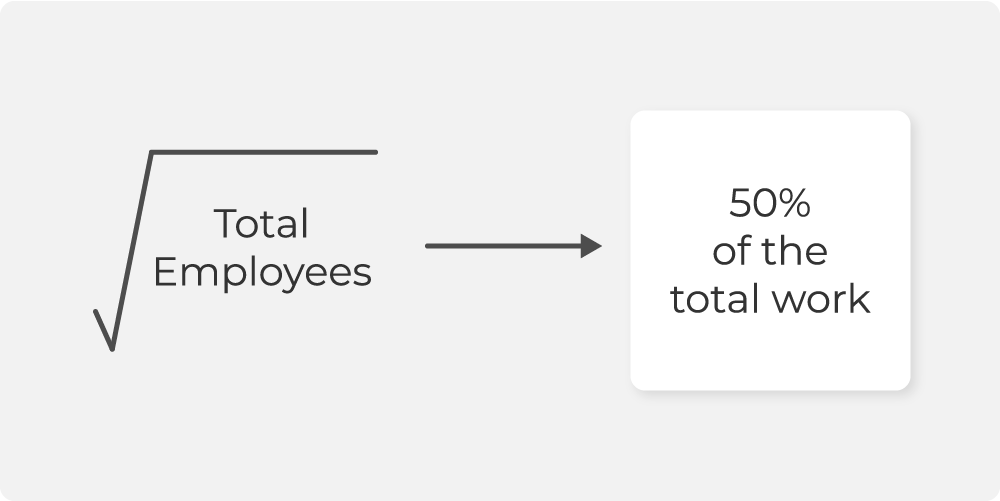
Price’s Law says that 50% of the work is accomplished by the square root of the total number of employees.
learnrepeatacademy.com/
This applies to every round of stock trading, and leads to a smaller number of traders getting the majority of the money after each iteration.
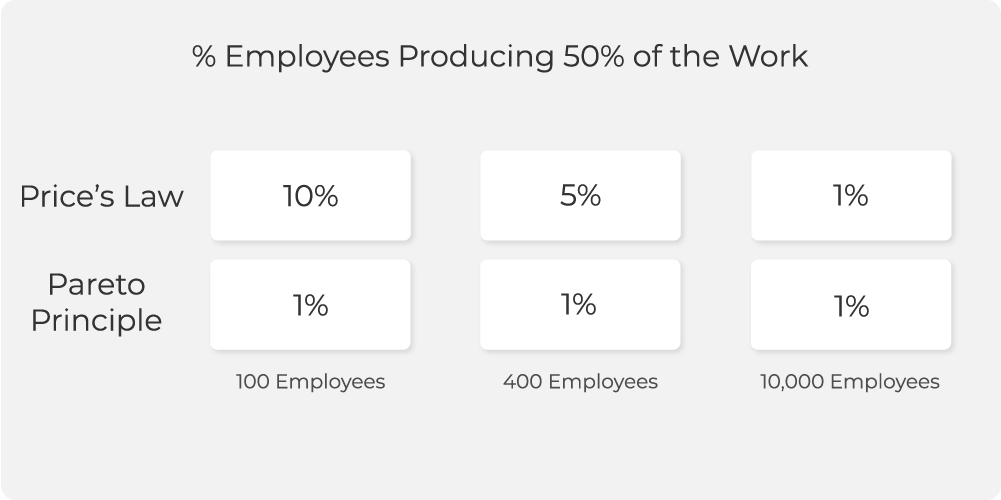
Imagine starting with 100 traders. Ten of them (the square root) will receive 50% of the profits, while 90 of the traders end up sharing the other 50% (with some of them losing everything and having to leave the game). The concentration of wealth will continue with each successive iteration until, theoretically, all the money will go to just one individual player as the rest go to zero. This is what happens when you play the game of Monopoly to its conclusion.
In day trading, it’s not so simple because there are always new players coming into the game, but the tendency to concentrate wealth is the same. In a casino, the dealers and the house never lose. In day trading, the market-makers, high-frequency algorithms, and the trading platform always win.
The Pareto Principle says that 80% of the work is done by 20% of the total number of people doing the work. At first glance, this seems different than Price’s Law, but that is only because Price’s Law is scale dependent; as the number of players increases, the difference disappears and the two principles converge. In a game with a very large number of players, like the stock market, both principles predict the same thing… 1% of the traders will take 50% of the money (table below).
learnrepeatacademy.com
This is why we only allocate a tiny amount of our funds to “trading.” Most of our positions stay lined up with what we have determined to be the primary trend in the market. The trick is knowing enough to determine the primary trend above all the daily noise and MSM fear mongering.
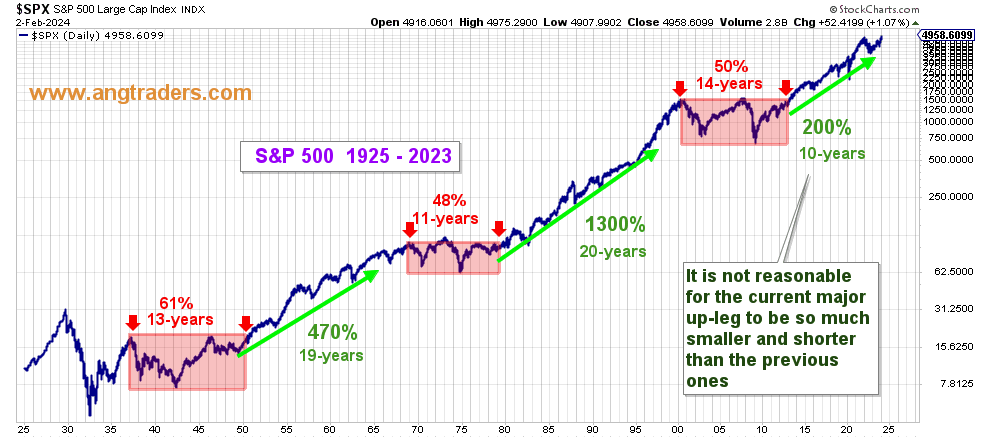
The stock market over the last 100 years has had three massive bull phases (we are currently in the third of these) and three trading-range periods that were populated with bear markets (red highlights). We’re only a little more than half-way through the current bull trend.
ANG Traders, stockcharts
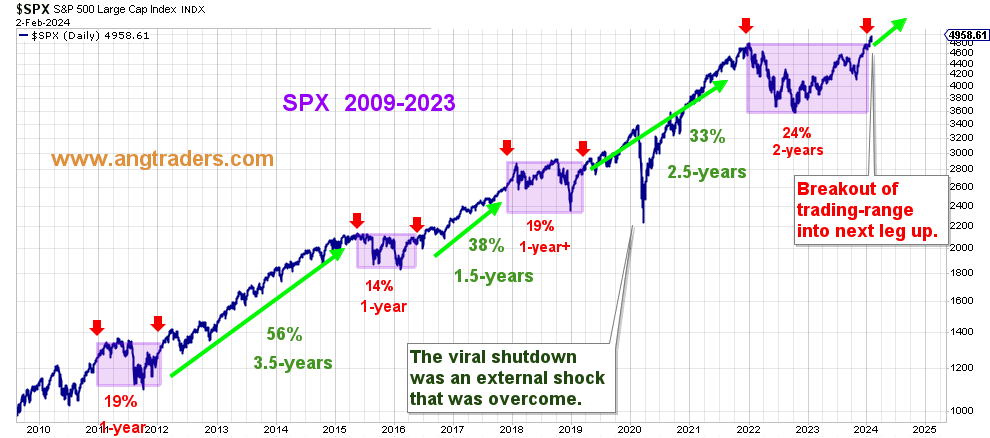
Within the major bull trends, there’s a fractal pattern of trading-ranges and rallies. The SPX has just broken out of the trading-range we have been in since 2022 (purple area and red-pointer below). The trading-range we just exited, lasted twice as long as the others, but now the next up-leg is confirmed and should last 1.5-3.5 years. (See our entry for the 2024 Seeking Alpha market prediction competition here and results here.)
ANG Traders, stockcharts
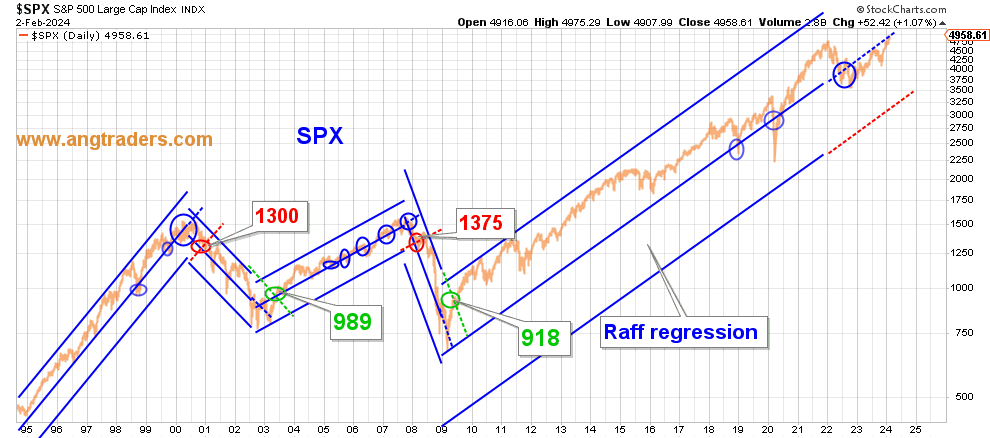
The Raff regression helps us to identify the primary trend; it has been bullish since 2009.
ANG Traders, stockcharts
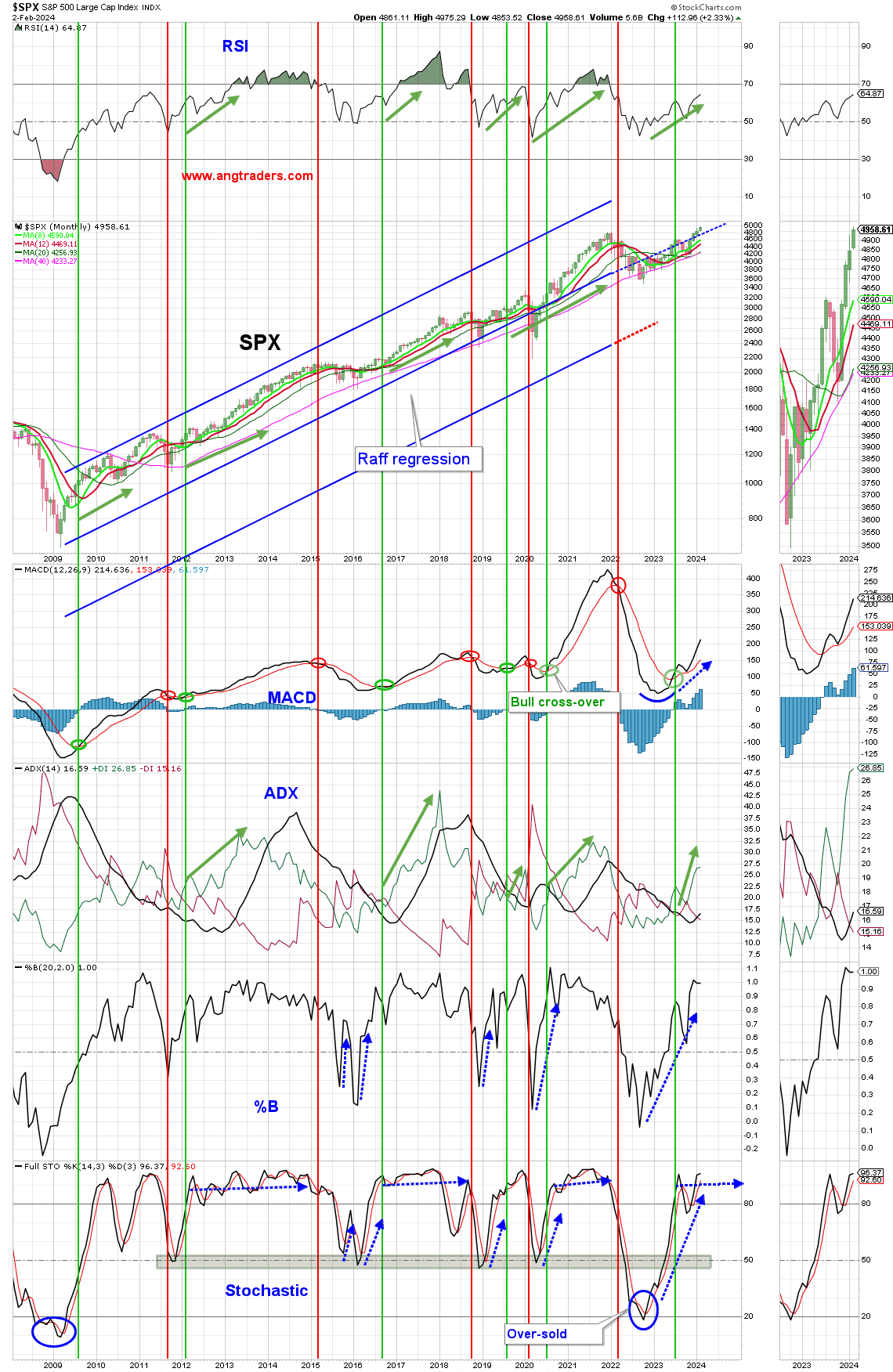
A closer look at the bull market since 2009 shows that technically the SPX has room to rally before getting overbought, and the index is riding the Raff regression mid-line higher. The SPX is just starting to recover from a “dip” within the primary bull trend.
ANG Traders, stockcharts
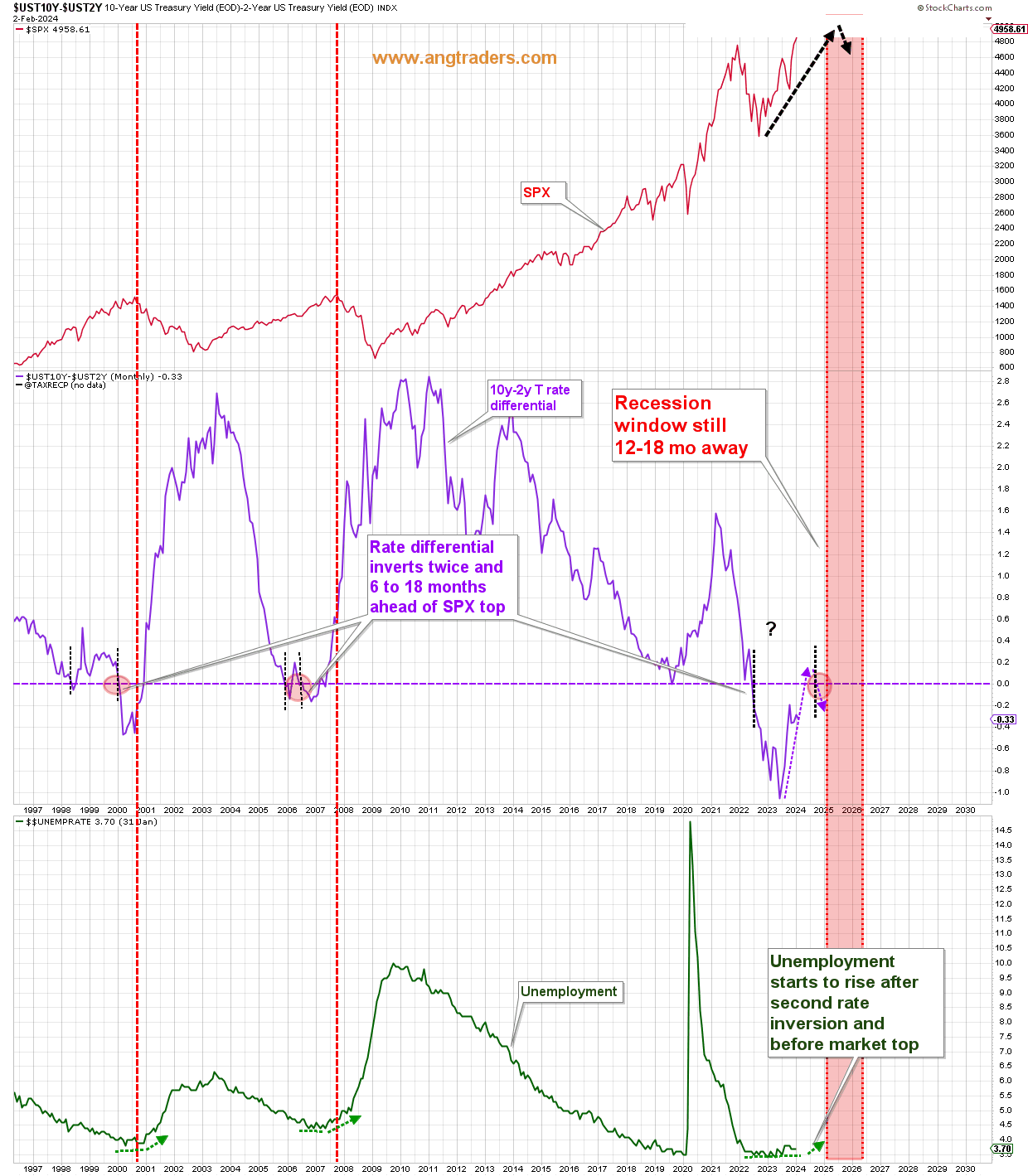
Despite all the doom and gloom about inflation and recession that has been fed to the herd by the mainstream media, none of it has materialized (we wrote about it here here).
The 10-2 inversion that gets trotted out as a reason to expect a recession is misinterpreted; there are two inversions (at the monthly-scale) ahead of recessions. We have yet to recover from the first inversion. We have a couple of years before we need to think about recession.
ANG Traders, stockcharts
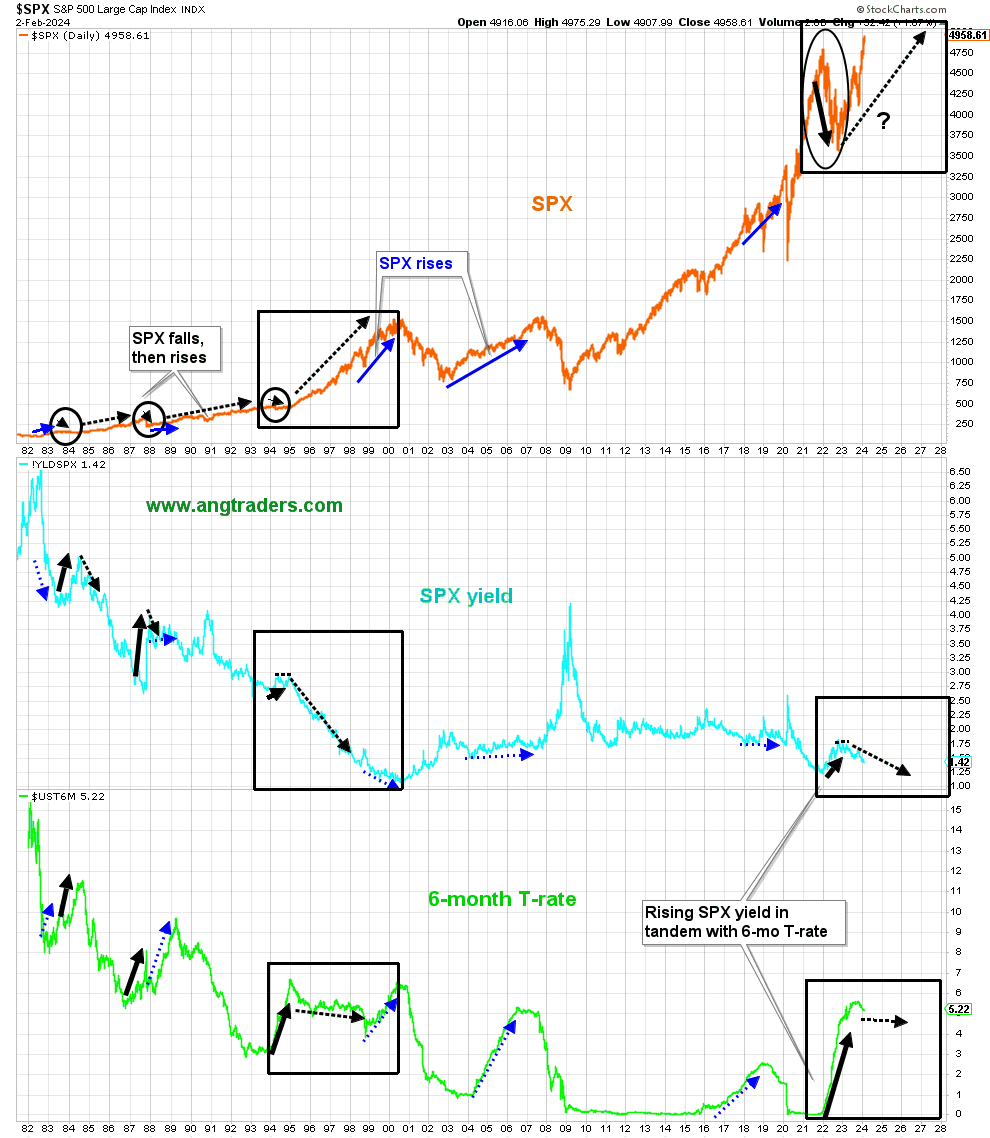
And when it comes to the effect of interest rates, the chart below shows that, after an initial shock, interest rates tend to drive the economy and stock market higher. The situation is very similar to the start of the dotcom bull market (black rectangles below).
ANG Traders, stockcharts
The most fundamental driver of the stock market is the Federal Government spending deficit; an increasing deficit (green-arrows below) correlates with SPX rallies, and decreasing deficits (red-arrow below) correlate with SPX weakness. At this point in 2024, the deficit is set to increase slightly from last year which means the primary bull trend should continue its charge higher.
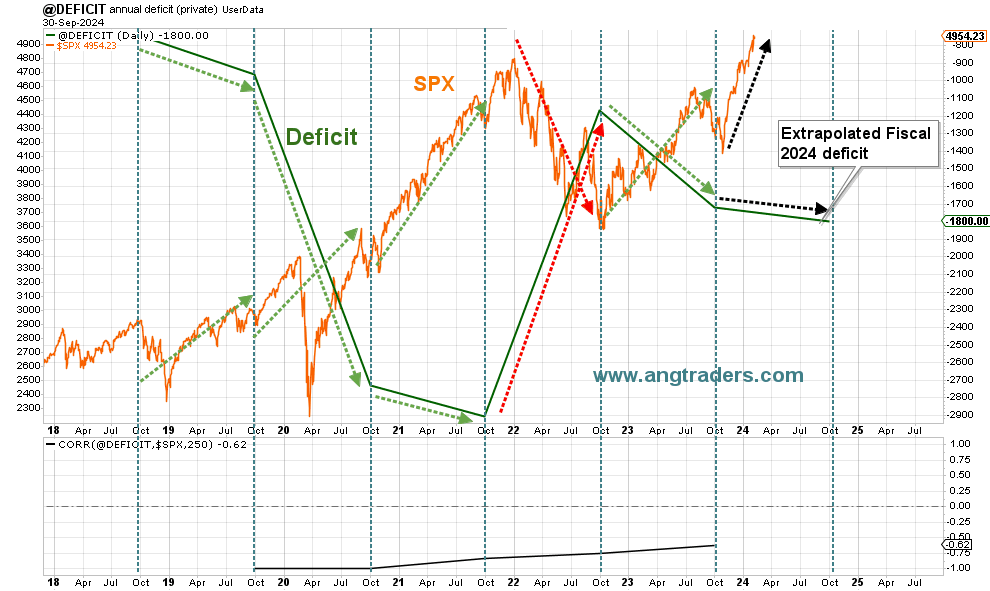
ANG Traders, stockcharts
Identifying the primary trend and staying on the right side of it is how wealth is accumulated.