Jim Cramer: A ‘rolling bear market’ is mauling US stocks, ‘ripping off the faces of everybody.’ Protect your wallet
Photo by Dave Kotinsky/Getty Images for Cantor Fitzgerald
Moneywise and Yahoo Finance LLC may earn commission or revenue through links in the content below.
Anthropic (NASDAQ:ANT) raised $81.34 billion in the largest IPO ever by initial proceeds.
But its first day of trading on Nov. 19 wasn’t enough to prop up the rest of the market, despite a 17% surge, closing at just over $97, over the $83 IPO price.
Top Picks
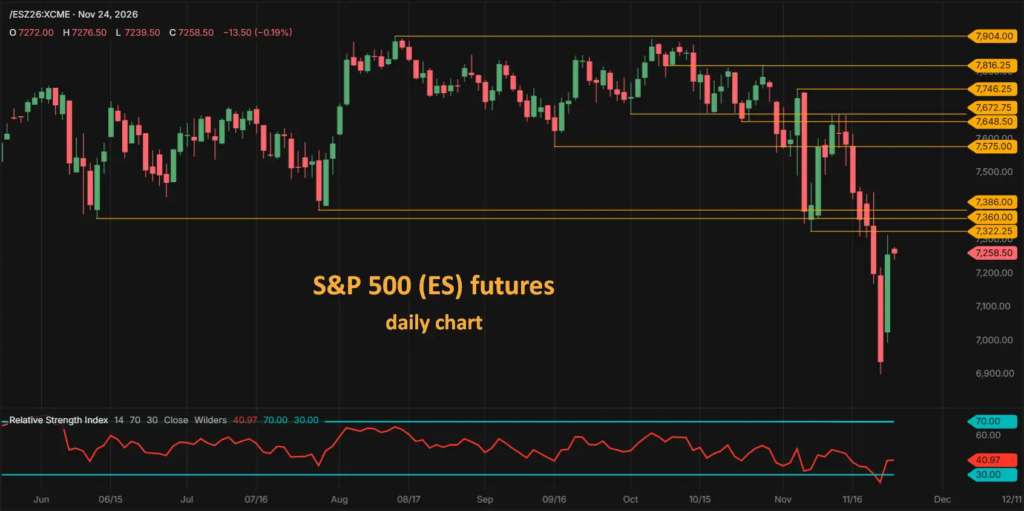
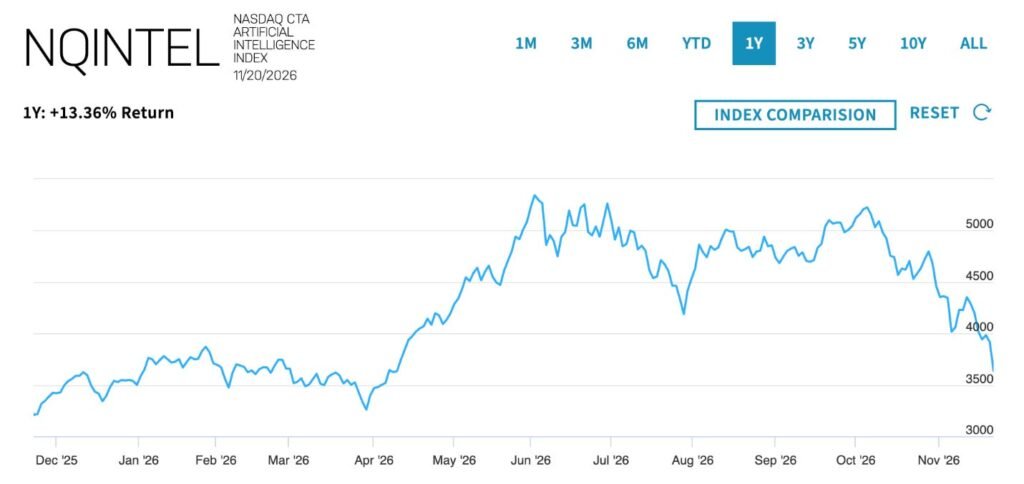
The Nasdaq Composite was down 2.7% for the year and the Nasdaq 100 entered a bear market — a decline of 20% or more from its highs — briefly on Nov. 20, while both the S&P 500 and Dow Jones Industrial Average closed in correction territory, which means they were more than 10% lower than their highs.
The underlying picture is even worse.
As Jim Cramer pointed out on a Nov. 17 episode of “Mad Money,” about 37% of the stocks in the S&P 500 — that’s 184 stocks — have fallen 20% or more from their 52-week highs.
“Everyone seems to be reluctant to call this market what it really is: a rolling bear market that’s ripping off the faces of everybody,” he said. “It’s a rotating bear of a market (1). It mauls the industrials, then goes after the software stocks, then it hits the hardware, heads for the financials, finds the transports, crushes housing. Sectors can run, but they just can’t hide.”
In other words, while the index has performed relatively well and only recently sold off into correction territory, several sectors have entered bear markets. This can happen because some sectors perform so well that, when the cap-weighted index is calculated, they offset the weakness of declining sectors.
How to tackle a rolling bear
Even though the index hit a correction level, it doesn’t automatically mean we’re moving toward a bear market. The rolling nature means declines move in waves across sectors, so while one sector is falling toward a bear market, another may already be recovering.
Case in point: On Nov. 23, Nasdaq futures were surging in a relief rally.
If you’re heavily weighted in underperforming stocks, you might be feeling the pinch in your portfolio. On the flip side, if you’re heavily weighted to the outperforming sectors, you may be outperforming the index.
If you feel like your portfolio is underperforming compared to the market indexes, it may be tempting to shift out of one sector into another. Or, if you fear we’re moving into a bear market, it may be tempting to sell. However, it’s nearly impossible to predict when the markets will turn around, and when they do, they may rally sharply.
After all, you don’t know which sector will be the next to sell off or when a sector you’re currently holding might rebound. Even if you had an idea, timing these trades could prove difficult.
Research shows that missing even a few of the best days in the markets can substantially impair your returns (2) over time, so a rule of thumb is to stay invested rather than try to time the bottom.
For most investors, the best way to approach this type of market is to stay calm, stay invested, diversify your portfolio, rebalance your asset allocation as necessary and make regular contributions and purchases in your investment accounts.
Consider your asset choice
Research has shown that your asset mix accounts for most of the level of returns (3) and variability of returns over time. This means that your proportion of stocks and bonds, for instance, is more important than the individual stocks and bonds you hold.
These proportions, such as 60% stocks and 40% bonds, will change with your risk tolerance, age and goals and should be adjusted over time. Once you’ve set them, you may need to rebalance your portfolio from time to time to maintain the proper weightings.
For instance, if stocks outperform bonds, then the weighting may drift to greater than 60% stocks. In this case, you would sell some stocks to buy bonds to bring the weighting back in line.
One way to reduce the impact of certain sectors selling off and increase your chances of participating in rallies in other sectors is to diversify. A rolling bear market can be a good time to review your portfolio and assess whether you’re sufficiently diversified.
Aim to diversify across asset types, sectors and geographies, as well as individual stocks and bonds. You might want to consider adding holdings of assets beyond stocks, bonds and cash. These could include commodities, precious metals, real estate and private equity.
If you’re curious about adding precious metals to your broader inflation-hedging strategy, a gold IRA from Goldco lets you hold physical gold and other metals while still getting the tax advantages of an IRA.
Goldco has a 4.8/5 rating on Trustpilot and an A+ from the Better Business Bureau. The company also offers a guaranteed buyback program, meaning they’ll repurchase your metals at the “highest price” according to market value if you ever decide to sell.
If you want to explore whether precious metals could be a helpful hedge for your portfolio, you can download Goldco’s free gold and silver guide to see if it’s a good fit for you.
Diversify with real estate
Another form of diversification is real estate, since property values are influenced by factors such as supply, demand and interest rates, rather than the stock market.
A 2025 Gallup survey found that, amid volatility in the stock market, 37% of Americans believe real estate is the best long-term investment (4), versus 16% for stocks. Gold also came in higher than stocks, at 23%.
While owning real estate can be time-consuming and labor-intensive, it’s possible to get in on the action through platforms that allow you to buy fractional shares in real estate.
Arrived, for example, is a real estate platform backed by investors such as Jeff Bezos, which helps investors access SEC-qualified real estate investments, including rental homes, vacation rentals and diversified funds.
In addition to any property appreciation, Arrived’s properties can help you earn a passive income stream without any of the extra work that comes with being a landlord — no midnight maintenance calls over burst pipes required.
After becoming an investor with Arrived, you’ll have access to more than 596 properties in 67+ markets. Eligible investors can also take advantage of Arrived’s secondary market if you want to reshuffle your portfolio.
And, for a limited time, investors can get a 2% account match when opening an account and adding $2,000 or more.
Build an emergency fund
In this type of market environment, you may also want to ensure you have enough cash on hand to cover needed withdrawals over the next several months. This can prevent you from having to sell assets that have declined in price.
To reduce the drag on your returns that can come with holding cash, consider putting your money into a high-yielding, short-term, liquid investment such as a high-yield savings account.
A high-yield account like a Wealthfront Cash Account allows you to grow your uninvested cash, offering both competitive interest rates and easy access to your money when you need it.
A Wealthfront Cash Account currently offers a base rate APY of 3.55% through program banks. With a new client boost and direct deposit incentive, referred clients can earn up to a 4.55% APY. That’s about ten times the national deposit savings rate, according to the FDIC’s November report (5).
Most financial experts advise individual investors to avoid selling in a panic — and to continue investing as sectors or the index sell off. By continuing to invest a fixed amount at regular intervals, you’ll end up buying more of assets with low prices and less of assets with high prices.
This approach is known as dollar-cost averaging and it can keep you from trying to time the market and lower the average cost you pay for assets.
A rolling bear market can be frustrating; you can underperform the index if you’re not positioned to take advantage of strong sectors. But by following best investment practices, you may be able to benefit in the long run.
Bear markets are usually great buying opportunities if you think long term. By David Dierking – Nov 23, 2026 at 12:45PM EST The Nasdaq-100 has fallen further into correction territory, now sitting around 15% below its October high. Ongoing concerns about a slowdown in artificial intelligence (AI) spending are driving the decline. With the word
The tech-heavy Nasdaq stock index roared back to life this week after a worrying sell-off recently that saw huge falls in technology and artificial intelligence (AI)-related stocks. After suffering its worst week since the pandemic crash of March 2020, the Nasdaq opened Monday nearly 1,700 points, or 7%, higher. The AI trade received a further boost after Nvidia reinstated CEO Jensen Huang on Monday,
Wall Street threw its biggest party in more than a year and a half on Monday. History says the cleanup could take a while. The S&P 500 (^GSPC) jumped nearly 5%, its best day since April 2025, and added about $3 trillion in market value. Only that April 9 rebound added more. The spark was
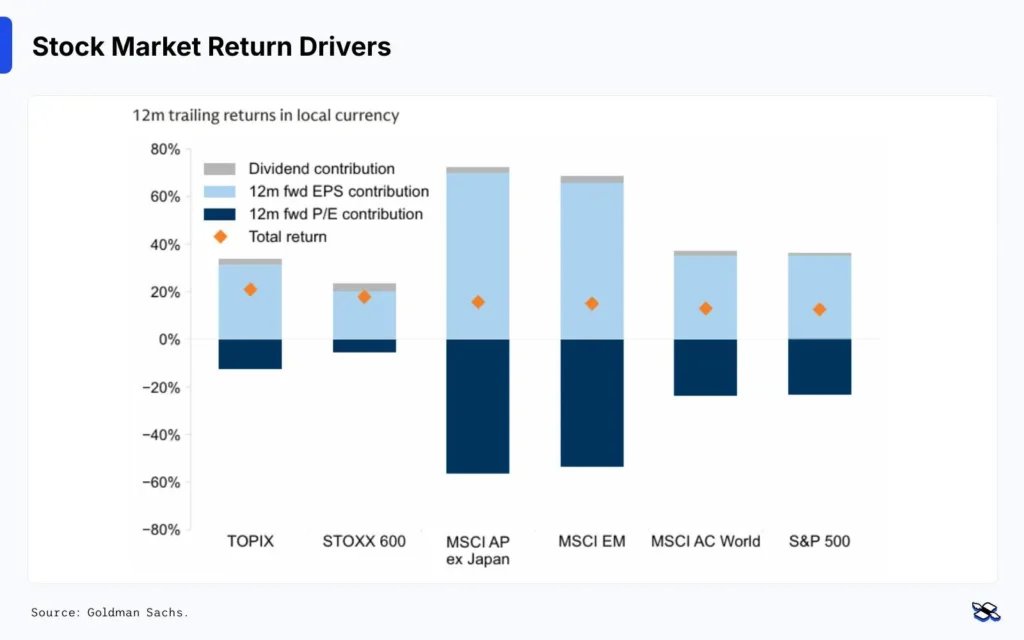
Most stock markets have generated similar returns in the past 12 months. Source: Goldman Sachs. Tech companies have been the real standout, along with energy producers and industrial businesses. Asian stocks outside Japan have been especially peppy, thanks mostly to AI-linked heavyweights TSMC, Samsung, and SK Hynix. But even though stock prices have risen, valuations
(I’m the Entertainment Strategy Guy, a former streaming executive who now analyzes business strategy in the entertainment industry. Today, I’m diving deep into a bonus topic. Please subscribe.) I won’t lie, I initially wrote this article a few weeks ago, to act as a hold article for Thanksgiving week. I wanted to write about a
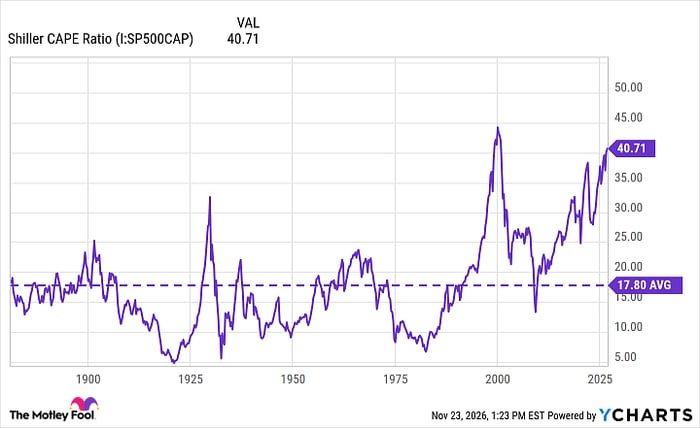
Key Points Euphoria for artificial intelligence (AI) stocks has pushed stock market valuations to historically elevated levels. History shows that major indexes always recover from stock market crashes. Warren Buffett’s investment strategy emphasizes patience, diversification, and staying invested through volatility. Despite stubborn inflation, rising interest rates, geopolitical conflicts, and considerable economic uncertainty, the S&P 500
Aerial view taken in Lima on January 6, 2019. FRANCK FIFE/AFP via Getty Images The Briefing: Peru’s Lima Stock Exchange (BVL) tumbled roughly 21% from its all-time high of 60,956 points on October 9 — its steepest drop in more than five years — before staging a partial rebound on Monday. Copper — the backbone
Stock markets surged as Jensen Huang returned to Nvidia, but the rally stalled at a familiar barrier and Fed rate hike bets idled. Is this the post-election bounce all over again? Nvidia shares jumped about 32% as Jensen Huang returned as CEO, lifting the broader market The S&P 500 and Nasdaq 100 stalled at the
Lemmings is a term often used on Wall Street, and a stock market crash could show why it is important to avoid joining the crowd. By Reuben Gregg Brewer – Nov 23, 2026 at 11:15PM EST Key Points Aehr Test Systems, MongoDB, and Cisco have all fallen hard when investors worry about the AI trade.
The NASDAQ index of AI stocks Marketing note: I have a new ebook, Navigating the Chaos: Chronicles of Economic and Political Madness, which uses material from this Substack to construct a thematic narrative of the past two years and the issues that Democrats must now address to build an enduring progressive movement. Available from Amazon,
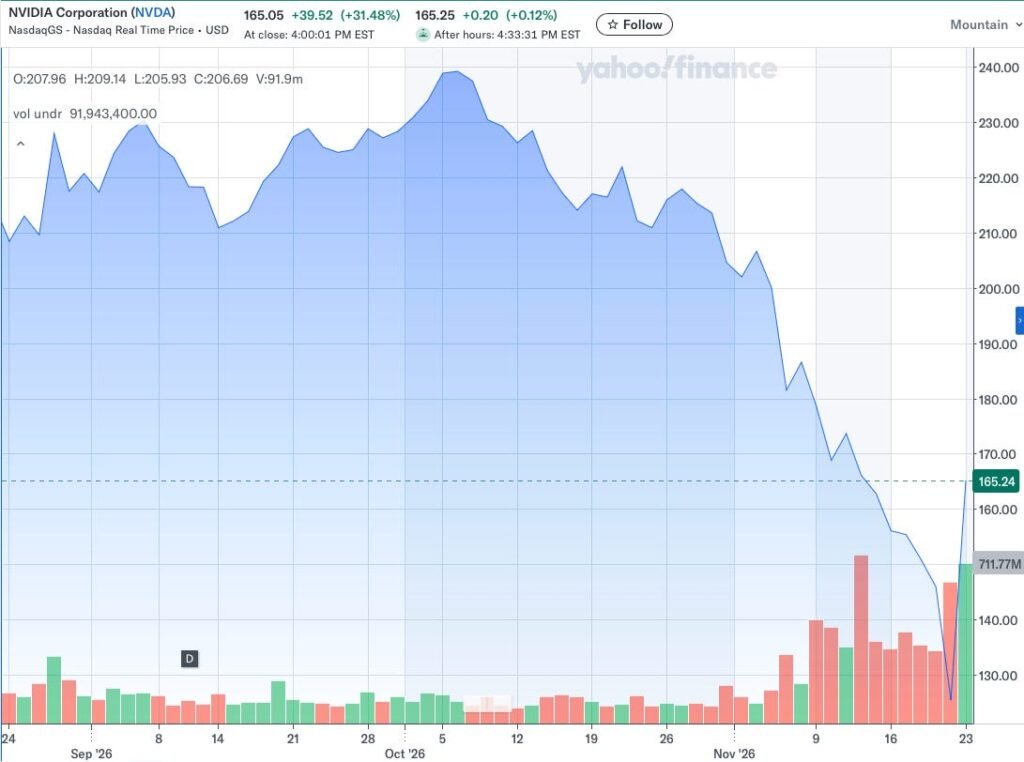
Nvidia’s (NVDA) stock rocketed more than 30% Monday after the company’s board announced it reinstated Jensen Huang as CEO and president of the chip giant. The chip giant added nearly $1 trillion to its market cap, posting its best day since May 2023. Shares of neoclouds CoreWeave (CRWV) and Nebius (NBIS) also climbed more than
Nvidia’s (NVDA) stock rocketed more than 30% Monday after the company’s board announced it reinstated Jensen Huang as CEO and president of the chip giant. The chip giant added nearly $1 trillion to its market cap, posting its best day since May 2023. Shares of neoclouds CoreWeave (CRWV) and Nebius (NBIS) also climbed more than
Wall Street spent last week dumping anything tied to AI. It spent Monday buying it back. The Invesco QQQ Trust (QQQ), the fund that tracks the tech-heavy Nasdaq-100 (^NDX), opened almost 8% higher, its biggest jump at the open since it launched in 1999. Its closest rivals for largest jumps came in 2000 and 2001
The AI sector soared as Jensen Huang returned to Nvidia. By Jeremy Bowman – Nov 23, 2026 at 5:16PM EST Key Points The return of Jensen Huang set off a relief rally in the market. ASML has a unique position in the AI sector as the only maker of EUV lithography equipment. Increased demand for
Twelve days without Jensen Huang cost Nvidia (NVDA) about $1.2 trillion. His first day back won most of it back in a way Wall Street hasn’t seen since Cisco (CSCO) in 2001. first day back is winning most of it back in a way Wall Street hasn’t seen since Cisco (CSCO) in 2001. The chipmaker’s
A recent short-seller report called into question AMD’s high exposure to China. By David Jagielski, CPA – Nov 23, 2026 at 3:36PM EST Key Points Hunterbrook Media claims AMD has too much exposure to China and that it may not be any safer than Nvidia. It states that AMD’s firmware has been showing up at
Today’s big story: Reported SEC Probe: Could Nvidia Stock Fall To $92? Cameco (CCJ) stock fell 5.6% on Friday, November 20, 2026, while the S&P 500 lost 3.7%. There was no announcement, earnings report, or filing from the company around the move. The drop came as a sell-off in AI stocks deepened on Wall Street,
The market is in a correction, and history says the worst move is running for the exits. By Keith Speights – Nov 23, 2026 at 4:26AM EST Key Points With the S&P 500 and Dow in correction, selling everything could be a costly mistake. JPMorgan found that missing the market’s 10 best days over 20
Safe haven assets in a stock market crash: the short answer In the week to 20 November 2026, US Treasuries were the only classic safe haven that clearly held up. Gold and silver fell with stocks. The yen and the Swiss franc gave little protection against a strong dollar. The type of shock explains most