FRANCK FIFE/AFP via Getty Images
The Briefing:
- Peru’s Lima Stock Exchange (BVL) tumbled roughly 21% from its all-time high of 60,956 points on October 9 — its steepest drop in more than five years — before staging a partial rebound on Monday.
- Copper — the backbone of Peru’s equity market — has dropped roughly 17% from its September record of $6.85 per pound, dragging down the mining companies that dominate the index.
- Three interlocking shocks drove the decline: late-October tech earnings that cast doubt on AI spending, the November 5 Wall Street selloff, and the November 12 resignation of Nvidia CEO Jensen Huang — who was reinstated by Nvidia’s board on Monday, November 23.
Peru’s Bolsa de Valores de Lima (BVL) has not been able to find its footing since October 9, when its benchmark General Index hit an all-time high of 60,956 points. What followed has been a relentless slide driven by falling copper prices, a broad Wall Street selloff rooted in AI uncertainty, and a leadership crisis at the world’s most influential semiconductor company. Lima now stands as the region’s most bruised equity market over this period.
It Started With Doubt About AI’s Payoff
Much of the BVL’s strong 2026 run was underwritten by a single narrative: copper is indispensable to artificial intelligence infrastructure — data center cables, transformers, cooling systems. When that story began to wobble, Lima felt it immediately.
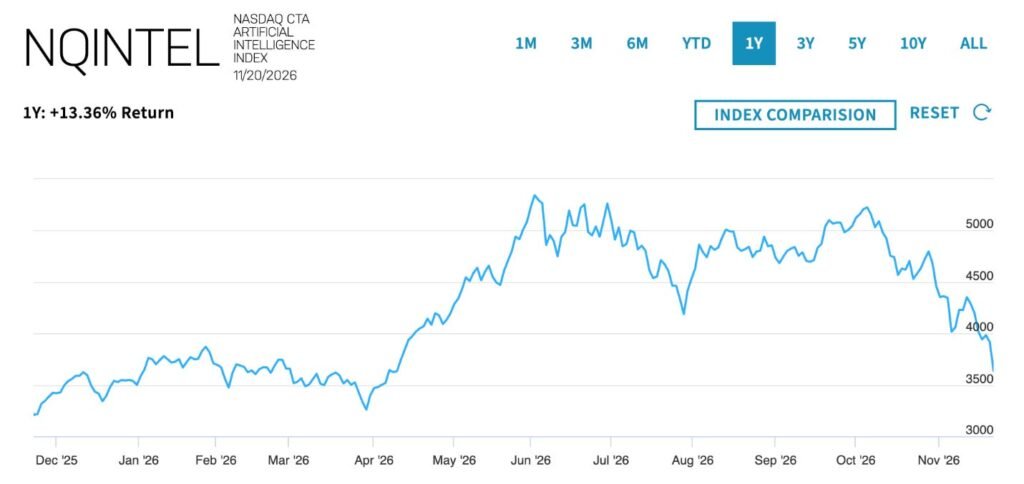
The cracks appeared in late October, when quarterly earnings from several major tech companies disappointed. Google reported negative free cash flow, and Amazon unveiled a $220 billion capital expenditure plan, prompting investors to question whether the AI buildout could ever generate adequate returns. The Nasdaq Composite fell 3.37% on October 30 alone, and the index shed roughly $3.3 trillion in market value across the month.
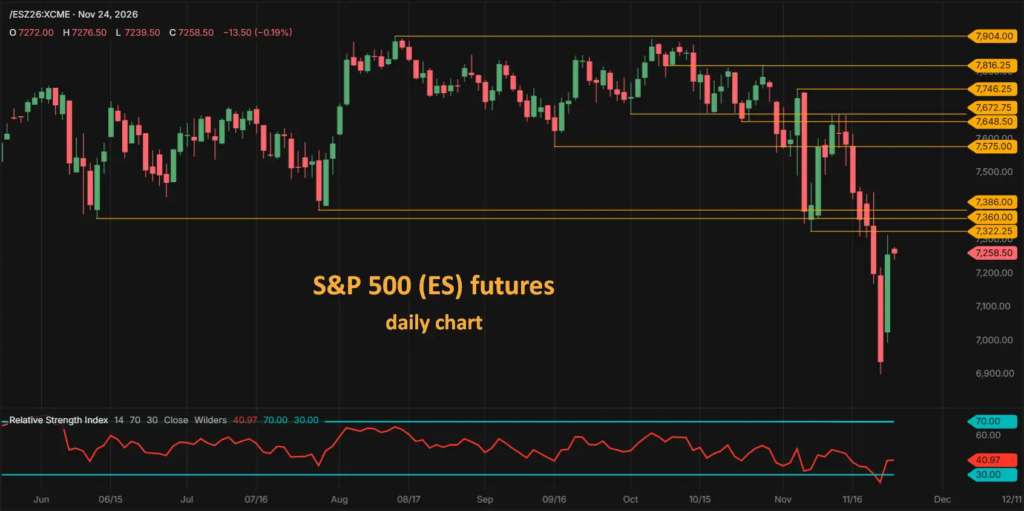
The worst single session came on November 5, when the S&P 500 tumbled 4.4% — its worst day since April 2025’s Liberation Day tariff shock — while the Nasdaq Composite lost 5.5% and the Dow Jones dropped more than 1,800 points. Concerns that Democratic midterm victories could lead to tighter restrictions on data center development amplified the selloff.
Huang’s Resignation Added a Second Shock
One week later, on November 12, a second blow landed. Jensen Huang resigned as Nvidia’s president, CEO, and board member after 33 years at the company he co-founded, amid a personal scandal and national security controversy, with CFO Colette Kress stepping in as interim chief. Nvidia’s shares fell nearly 12% the following day, wiping hundreds of billions in market value and deepening the negative sentiment around everything tied to AI hardware — until Nvidia’s board reversed course on Monday, November 23, and unanimously reinstated Huang, triggering a sharp relief rally across Wall Street, copper, and Lima’s exchange.
For copper, which had been trading at a premium precisely because of its role in AI infrastructure, the LME benchmark fell to a four-month low on November 17, touching $13,210 per tonne (roughly $5.99 per pound). That places copper about 17% below its September record of $6.85 per pound.
Lima Is, at Its Core, a Mining Exchange
Understanding why Lima underperforms the region requires just one figure: more than 60% of listed companies on the BVL belong to the mining sector, with Southern Copper and Cerro Verde as the index’s anchors. When copper falls on the LME, Lima doesn’t just absorb the blow — it amplifies it.
The macro backdrop compounds the pressure. The Federal Reserve raised its benchmark rate in September — the first hike in three years, pushing the federal funds rate to a range of 3.75%–4.00% — as inflation remains well above target, partly fueled by energy price spikes linked to Middle East tensions. Fed Chair Kevin Warsh has also eliminated the Fed’s quarterly forward guidance, leaving markets without a compass on the pace of further tightening. At least one additional rate hike is widely anticipated before year-end.
Analysts: No Floor in Sight Yet
The honest answer, for now, is that no one can call a bottom with confidence. Rolando Luna, strategist at Faro Capital, puts it plainly: “It could keep falling for three or four months, transitionally, but we don’t see a floor right now.” Luna acknowledges that copper’s long-term fundamentals remain intact — global electrification, the energy transition, Asian urbanization — but warns that the near-term mood is dominated by AI pessimism.
Jorge Espada of Valoro Capital takes a slightly more constructive view, arguing that a return to 2025’s copper lows is unlikely given continued global growth. But he agrees that skepticism about AI’s real returns has reopened a question markets thought was settled: will the data center boom actually produce the copper demand everyone projected?
What Would Stabilize the Market
The most likely path to stabilization, analysts say, requires copper to hold above $5.00 per pound and the Federal Reserve to refrain from an unexpectedly aggressive move. If either condition deteriorates, the BVL General Index could test levels not seen since 2022.
For now, Lima is paying the price for having risen too far, too fast — in a market structurally dependent on a single metal and on a global technology narrative — and for having both props pulled at once.
© {{Year}} Latin Times. All rights reserved. Do not reproduce without permission.