The NASDAQ index of AI stocks
Marketing note: I have a new ebook, Navigating the Chaos: Chronicles of Economic and Political Madness, which uses material from this Substack to construct a thematic narrative of the past two years and the issues that Democrats must now address to build an enduring progressive movement. Available from Amazon, Kobo,Bookshop, and Nook.
Uh-oh. Wile E. Coyote just looked down and realized that he was suspended in mid-air, with nothing to support him. And so, obeying the laws of cartoon physics, he plunged.
I’m talking, of course, about the prices of AI-related stocks. Many observers have long argued that AI valuations weren’t justified by the fundamentals, that we were looking at a massive financial bubble. Over the past few weeks, the market has started taking these warnings much more seriously.
Let me be honest and admit that even now I’m not quite as confident in my bubble verdict as I was in diagnosing the housing bubble 20 years ago. AI is, after all, a radically new technology, and we can’t be 100 percent sure that historical patterns will apply. But they probably will.
There are a variety of metrics analysts use to assess whether we’re in a bubble. Most analyses involve projecting future spending on AI and future revenue of the companies supplying AI, and asking whether theseprojections justify current valuations. Such exercises are useful and necessary, but are riddled with huge uncertainty. And I don’t believe that I understand either the technology or the markets well enough to do such an analysis myself.
But there are other ways to assess the situation. Lately I’ve been looking at a metric that doesn’t depend on assumptions about future demand for AI, let alone earnings projections. The so-called Buffett indicator — yes, that Buffett — is simply the ratio of the total market value of U.S. stocks to GDP. Here it is, estimated up to Sept. 30, that is, just before the recent meltdown:
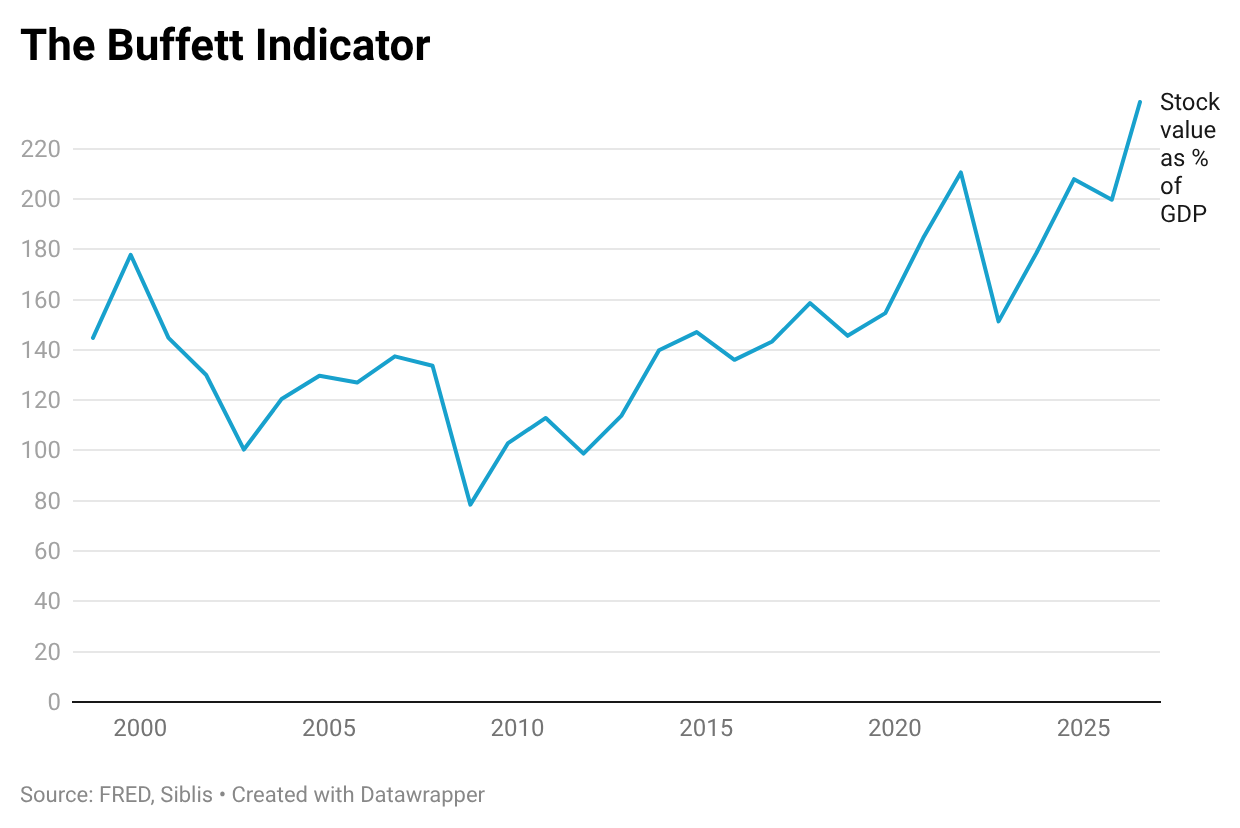
Until a few weeks ago, the Buffett indicator was very far above historically normal levels, and in fact well above its level at the peak of the dotcom bubble.
Now, the Buffett indicator is a metric for the valuation of all stocks, not just AI stocks. But on the eve of the plunge, AI-related companies accounted for almost half the S&P 500, and were responsible for most of the rise in the Buffett indicator over the past few years. So in practice there isn’t that much difference between looking at AI stocks and the valuation of the market as a whole. And the Buffett indicator is looking strongly bubblicious.
OK, what would plausibly justify such a high valuation on stocks?
One answer, which is what you hear from AI boosters, is that this technology will lead to explosive growth in productivity and hence future economic growth. Based on this scenario, a Buffett indicator based on future GDP – that is, the ratio of today’s total stock market value to future GDP – would look much less out of line.
Now the truth is that while AI is a remarkable technology, we still can’t see a large payoff in productivity growth, which is running only slightly above its 20-year average:
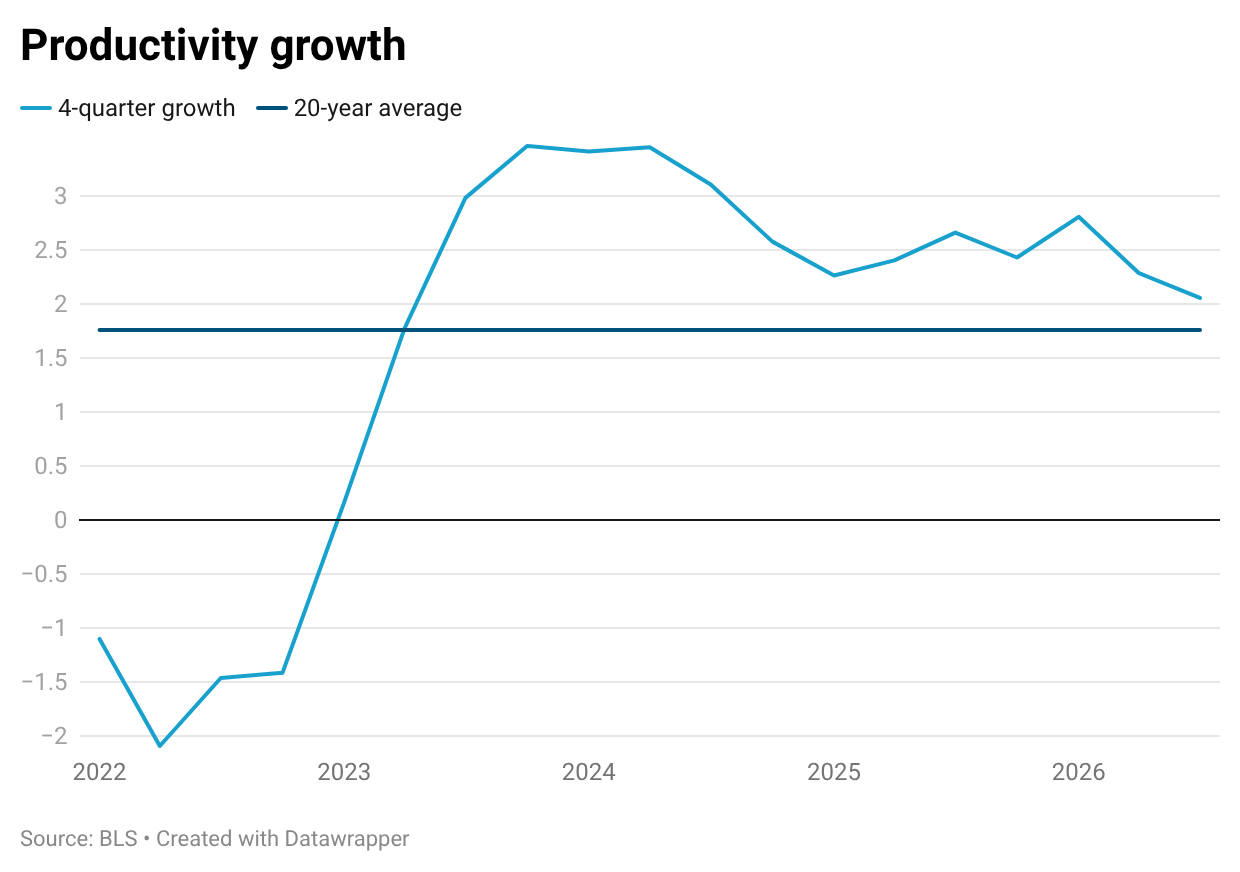
But maybe the big payoff is still to come.
Another possible justification for a sky-high Buffett indicator might be a large redistribution of income away from labor to capital, which would hurt the great majority of Americans but would raise profits. We’ve already seen a substantial reduction in the share of national income going to workers:
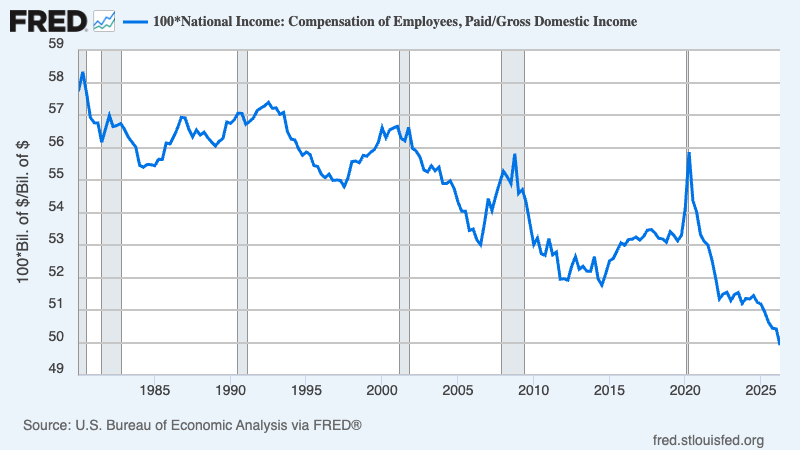
And AI is a highly capital-intensive technology that will, other things equal, lead to an even larger decline in the labor share and rise in the profit share.
So let’s grant for the sake of argument the proposition that a combination of accelerated economic growth and redistribution from labor to capital will mean rapidly rising profits. Even so, this wouldn’t necessarily justify the extremely high valuations the market has been placing on leading AI companies unless we believe that those companies will capture those future profits. And that’s a very dubious proposition.
As many of us have pointed out — with special clarity by Dean Baker — there’s growing evidence that today’s leading AI companies are not establishing durable monopoly positions like those held in the past by Microsoft, Google, Facebook etc. They are instead facing rapidly growing competition, for example from open-weight Chinese models that deliver most of the performance of frontier models at a fraction of the cost.
The market has been valuing the hyperscalers as if they’re all future Microsofts, companies that generated huge profits for decades on end. But they may instead be future WorldComs, companies that raised investor hopes only to go bankrupt when it turned out that they didn’t have a viable profit model.
So how bad will this get? Many observers have been making comparisons with the dotcom bust a quarter-century ago. Indeed, some have been making Nvidious comparisons — sorry, I’ve been waiting months to make that joke. In any case, so far the fall in AI stocks has been smaller than the dotcom bust, when the Nasdaq fell 70 percent:
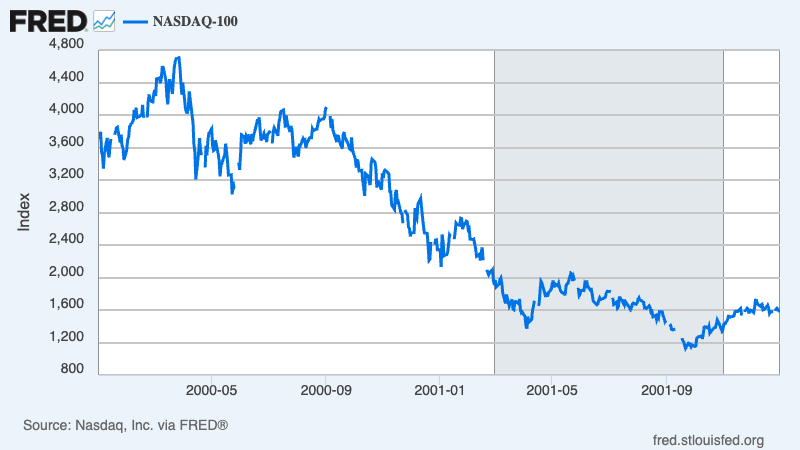
But notice that the dotcom bust didn’t happen all at once. There was an initial downward leg roughly comparable to what we’ve already experienced with AI. Then there was a temporary period of stabilization, followed by a second, even bigger plunge.
And we’re talking about a lot of money here. If the Buffett indicator falls back to what it was in, say, 2019, that would wipe out wealth equal to around 80 percent of GDP: $25 trillion.
What would that do to the wider economy? I’ll talk about that in a future post.
MUSICAL CODA