Today’s big story: Reported SEC Probe: Could Nvidia Stock Fall To $92?
In an earlier piece, we looked at the phone companies that cut their spending in 2002. Around those cuts, the stocks of the companies that sold them equipment fell 89% to 99% (Cisco Fell 89%. Is Nvidia Stock Next?).
The next question is about today. Could the big buyers of Nvidia‘s chips cut back the same way? The table compares the buyers of 2000 with five of today’s.
The buyers then and now: Verizon spent $1.11 for every $1 of cash its business brought in. Oracle spends $1.61.
| Buyer | Spent per $1 of cash | Debt, years of cash | Sales growth |
|---|---|---|---|
| Verizon, 2000 | $1.11 | 3.6 | +4% |
| SBC, 2000 | $0.92 | 1.8 | +4% |
| Oracle | $1.61 | 2.7 | +22% |
| Amazon | $1.28 | 1.1 | +15% |
| Alphabet | $0.89 | 0.7 | +22% |
| Meta | $0.78 | 0.6 | +28% |
| Microsoft | $0.69 | 0.2 | +18% |
Source: Trefis. Spending is capital spending, money put into long-lived assets such as networks and data centers. Cash is operating cash flow, the cash a company’s business brings in. Debt is borrowed debt, leases excluded. Today’s buyers: 12 months to September 2026 (Oracle to August). Sales growth is for 2001 at Verizon, because its 2000 sales doubled in the GTE merger, and for 2000 at SBC.
One of today’s five looks most like Verizon in 2000. Oracle owes 2.7 years of its cash flow. Verizon owed 3.6.
In dollars, Oracle‘s business brought in $46.9 billion of cash in the 12 months to August. Its capital spending was $75.7 billion. The $28.7 billion gap came mostly from borrowing. Its borrowed debt is $125.3 billion. Repaying it would take 2.7 years of all that cash, with nothing spent on anything else. Microsoft‘s debt would take about two months.
Nvidia sells to these buyers, as Cisco sold to Verizon. If much of your wealth sits in Nvidia, their spending plans matter to you. Our partner advisory firm offers a free 30-minute strategy review. It covers a floor under losses and a lower-tax way out. Book the free review.
Why Could Verizon Cut Back?
It had to.
Verizon’s sales grew 3.8% in 2001 and 0.6% in 2002. Its debt reached $64.3 billion at the end of 2001. With sales barely growing, every extra dollar spent on building added to debt it had to repay. Cutting back was the cure. In 2002, Verizon cut its spending 31% and SBC cut 39%. Verizon’s cash from its business rose from $15.8 billion in 2000 to $22.1 billion in 2002. Its debt fell to $45.4 billion by 2003.
For the buyer, the cut worked. For the seller, it meant lost sales. Cisco‘s sales fell 15% in fiscal 2002, to $18.9 billion.
Can Today’s Buyers Stop?
Three can afford not to. Two would have to.
Microsoft, Meta and Alphabet pay for their building out of cash, with money left over. Their sales are growing 18% to 28%. Their operating margins, the share of sales left after running costs, are 33% to 47%. Verizon and SBC were at about 20% in 2000. Amazon and Oracle borrow to build. Together, the five owed $551 billion of borrowed debt in September, up $306 billion in a year.
So the choice is different this time. Verizon could cut because its sales had nearly stopped growing. Today’s three cash payers would be pausing while their sales grow 18% to 28%. They would also be handing their customers to a rival that didn’t pause.
The pressure to pause falls on the two borrowers. Say Amazon and Oracle spent only the cash their businesses bring in. The five’s $691 billion of yearly spending would then fall by $76 billion, or 11%. That’s about a third of Verizon’s 31% cut.
Why Are Nike And P&G Still Spending?
In our view, because AI can replace payroll.
In 2000, companies bought the internet to add a sales channel, which added cost. When sales slowed in 2001, technology spending was cut. Business spending on information-processing equipment and software fell 14% in two years.
In our view, this time companies are buying AI to save on people. So it gets paid for by cutting payroll. Business spending on software is up 9% in a year, and spending on computers is up 70%. Meanwhile, the information industry has 119,000 fewer jobs, down 4.2%. Data-processing and hosting jobs are down 5.4%, even as data centers boom.
Look at Nike. Its sales are down 1% over the past year. Its operating margin is 8.2%, against 15.6% in fiscal 2021. Still, it raised its capital spending 31%, to $676 million. It also announced job cuts in October. At P&G, sales are up 3.5% and the operating margin is down from 24.1% to 22.6%. Its spending is up 15%.
In our view, when business customers squeeze costs, they cut people first and AI last. That is the reverse of 2001. In our view, it is why AI spending can keep going in a slowdown, and also why it lands on jobs.
What Does That Do To Jobs And Inflation?
Slower layoffs, less help from the Fed.
The job market isn’t breaking. Unemployment is 4.1%. Weekly jobless claims run near 200,000, and there are 7.5 million open jobs. In 2001, claims went from 290,000 to 476,000 in 16 months. Openings fell from 5.2 million to 3.4 million by 2002.
But 2001 had a cushion that 2026 lacks. Inflation fell from 3.4% to 1.6%. So the Fed could cut its rate from an average of 6.2% in 2000 to 1.7% in 2002. Today inflation is 3.7%, and the Fed raised rates in September.
As we argued in October, four forces drive inflation. They are war, immigration, taxes and AI (Inflation Is Back. Is A Stock Market Crash Next?). AI is the one that keeps going. Data centers bid up the price of power and chips. At the same time, some companies may be using AI to cut staff. That’s how a pause in hiring and a hot economy can show up at the same time.
What Would A Pause Look Like, Step By Step?
A timeline, then and now.
- The spending peak. Then: in 2000, Verizon spends $1.11 per $1 of cash. Now: Oracle spends $1.61 and Amazon $1.28 in the latest 12 months.
- The first buyer cuts back. Then: in 2001, SBC cuts spending 15%. Now: watch Oracle’s report, expected in mid-December. Also watch the big four’s spending plans in late January and early February.
- The seller’s sales fall. Then: Cisco’s sales fall 15% in fiscal 2002. Now: Nvidia’s next report is expected in late February.
- Jobs follow. Then: unemployment goes from 4.0% in 2000 to 6.3% by June 2003. Now: it is 4.1%, but information jobs are already down 4.2%.
- The Fed responds. Then: it cuts its rate from 6.2% to 1.7%, as inflation falls. Now: the rate is 4.00% after a September hike. The next decision is December 9, and inflation is 3.7%.
- The bottom. Then: in October 2002, the S&P 500 is down 49% and Cisco 89%. Now: no step past the first has happened.
Today’s version differs at the second step. Three of the five buyers don’t need to cut back. The two that might would cut 11% of the total, not a third. The risk that is different this time sits at step five. If a pause comes, the Fed may not be free to cushion it.
So What Do You Do?
Watch the borrowers.
The data points to Oracle and Amazon as the buyers whose spending can change fastest. It points to the Fed as the cushion that may not come.
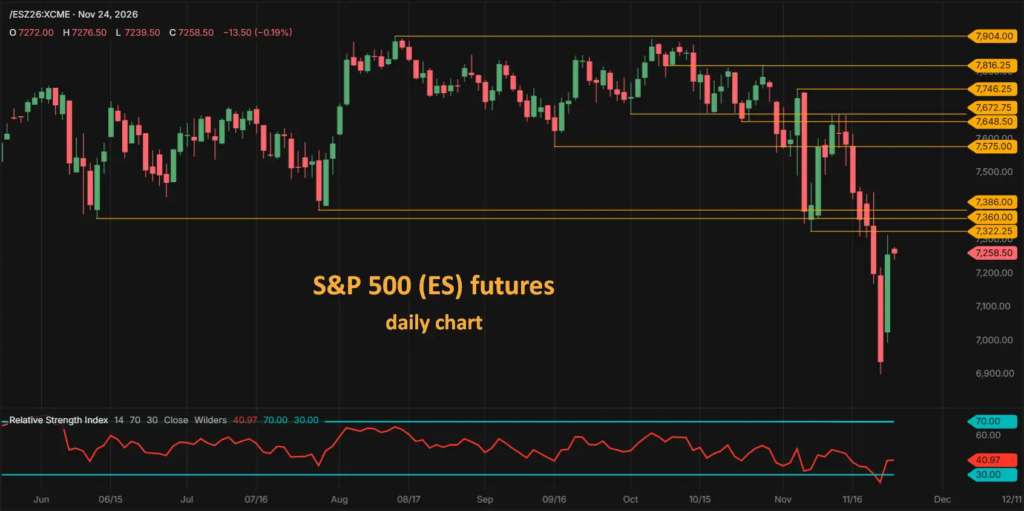
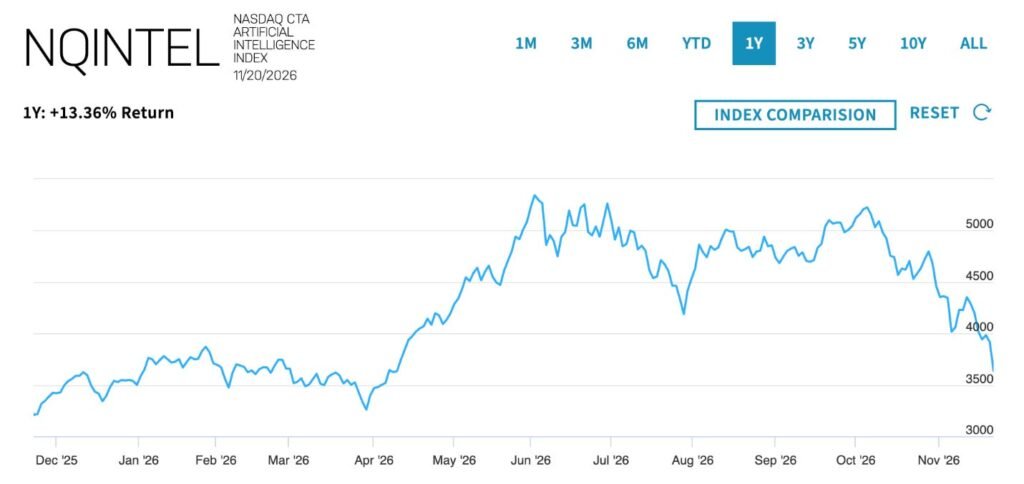
Nvidia fell 14.0% on Friday, Nov 20, a hard day for AI stocks. That day Reuters reported, citing two people briefed on the matter, that SEC enforcement staff are examining potential accounting issues at Nvidia. It is a report, not a charge.
Say you own Nvidia directly and through index funds. The question is whether your plan survives the step that 2002 shows was the worst. That is when sellers’ sales fall while the Fed may not be able to help.
The line to remember: in 2002 the buyers cut back because they had to. Today most of them can afford not to. The ones to watch are the two that borrow, and a Fed that may not be free to cut.
By the October 2002 bottom, the S&P 500 was down 49%. If a pause comes, it is easier to stay invested when what you own falls less than the market.
Could You Hold On Through The Next Fall?
Holding on is easier when your portfolio falls less than the market. For every dollar its benchmark lost, the Trefis High Quality (HQ) Portfolio lost about 81 cents on average, holding 30 quality stocks in equal weight.
For education, not a recommendation to buy or sell.
For questions about this article or underlying research, email help@trefis.com.