After a series of anti-government protests and movements across Europe, the latest one has been reported from the Czech Republic. Thousands of people gathered on Sunday, in what is being called the largest demonstration since 1989, to protest against the government’s switch in funding for public media, which many fear would severely impact press freedom in the Central European nation.
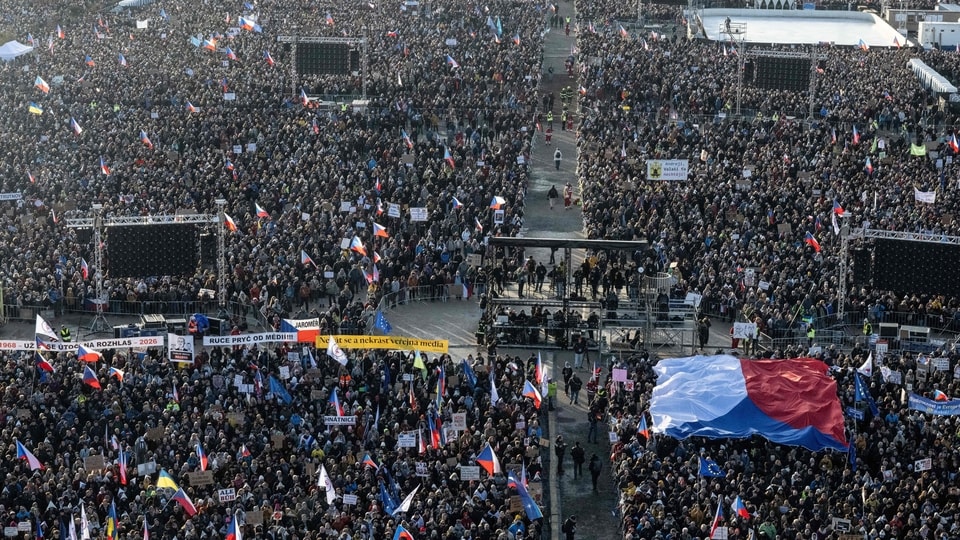
On Sunday, around 350,000 to 400,000 people gathered in Prague’s Letná Plain to protest against the Prime Minister Andrej Babiš-led coalition’s move.
Tensions surged further after the government rushed to pass the bill, with the lower house of parliament giving its preliminary approval at 4:36am on October 24.
The protest in Prague marks the latest challenge to PM Babiš and his coalition of populist, hard-right nationalist and Eurosceptic parties, after weeks of demonstrations in towns and cities and a strike by staff at Czech TV and Czech Radio.
What is the Czech government’s media plan?
Under Babiš’ plan, the Czech Republic’s public radio and television broadcasters would be financed from the state budget. This model replaces state media’s existing system of regular fees paid by individuals, households and businesses.
Once implemented, the state budget plan would also result in broadcasters receiving about 15% less money than they do now, which could lead to layoffs, limited production and cancellations of programmes.
The move comes after the Babis coalition frequently criticised public and private media coverage of its policies and accused some outlets of bias. The switch in funding also comes after the PM vowed to scrap the broadcasting fee before taking office in December 2025.
Why the protests?
While the changes were introduced in October 2026, the protests date back to June, with public media employees striking, saying the plan would make broadcasters vulnerable to government pressure.
However, the prime minister has defended the new funding model, stating that it would be fairer to poorer households and encourage outlets to become more efficient.
“There is no war for independent media. There is no fight for democracy and no nationalisation of media is being prepared,” Babis wrote in a Facebook post in October.
Opposition has also criticised the bill, comparing it to the policies of neighbouring countries such as Slovakia under prime minister Robert Fico and Hungary’s former premier Viktor Orbán, stating that public media getting funds from the state’s budget would lead to censorship and severely impact press freedom in the country.
Sunday’s demonstration was organised by the Million Moments for Democracy group, which has stated that the bill poses a grave threat to democracy.
“Babiš and his government obviously think they will get away with anything … that they can ignore experts, silence critics and treat democratic institutions like their property,” the group said in a statement on social media.
Despite trust in state media being low, as per a Reuters Institute Digital News Report, public service journalism in the Czech Republic is still among the most trusted news sources, with Czech Television still being the most-watched broadcaster across age groups in the country.
“We need to keep media independent. The government is taking steps to control them, cut their funding and affect what they broadcast,” computer programmer Jan Snasel told AFP during Sunday’s rally.
Along with the Opposition in the Czech Republic, organisations such as the European Broadcasting Union, the European Federation of Journalists, Reporters Without Borders and the International Press Institute have also criticsed the plan.
In a statement in October, the EU broadcasting union slammed the late-night and fast-tracked debate, stating that the plan was not in accordance with the EU’s rules.
“Funding models are a national decision. But any reform must respect these binding European rules. A change this significant deserves thorough assessment, open parliamentary debate and genuine consultation with ČT, ČRo and other stakeholders,” the statement said, adding that funding for public media “must be adequate, sustainable and predictable, and must protect editorial independence.”
Ahead of Sunday’s rally, Czech TV and Czech Radio staff went on another one-day strike on November 3, as thousands, including university students, rallied across the country against the proposed bill.
Babis defended the bill again last week, stating that “nobody wants to control public media, let alone nationalise them” and that “none of what the people are protesting against… is true”.
Rally draws comparison to 1989 Velvet Revolution
The rally, which saw around 350,000 to 400,000 people gather in Prague, is one of the largest anti-government protests the Czech Republic has seen since the Velvet Revolution in 1989.
The Velvet Revolution was a series of protests and demonstrations which ultimately led to the downfall of the communist regime in the country and paved the way for the first multi-party vote in 1990.
The revolution started on November 17, 1989 after riot police suppressed a peaceful student demonstration. The crackdown on student protestors sparked national outrage and led to gatherings until December 29, 1989, with around 750,000 people taking part in the demonstrations.
During this time, a nationwide two-hour general strike was also carried out, bringing erstwhile Czechoslovakia to a halt.
The movement, along with economic and social difference between the Czechs and Slovaks in the nation, also paved the way for the country to split into the two nations we know today – Czech Republic and Slovakia.