If a Stock Market Crash Is Coming, History Says SCHD’s Dividend Grew Through the Last Two Bear Markets. But Here’s the Catch I’m Watching.

With the market on edge these days, especially heading into Friday’s jobs report, a question keeps nagging income investors: What will happen to my dividends if stocks crash?

The Schwab U.S. Dividend Equity ETF (SCHD -0.97%) has already endured two bear markets since its inception in 2011. The S&P 500 fell about 34% in early 2020 and again by over 24% in 2022. Yet SCHD’s annual dividends per share rose about 49% from 2019 to 2022, from a split-adjusted $0.57 to $0.85 per share.

I own the ETF and added to my position last week, so I wanted to know what that record can — and can’t — tell us. Here’s a recent catch in its dividend record that I’m watching very closely.

Image source: Getty Images.

What SCHD’s dividend did in 2020 and 2022

Adjusted for the ETF’s 2024 3-for-1 share split, the Schwab U.S. Dividend Equity ETF paid roughly $0.57 per share in 2019, $0.68 in 2020, $0.75 in 2021, and $0.85 in 2022, according to the distribution history on its website. That’s an increase of 17.6% in the year of the COVID crash and 13.9% in the year of the bear market.

However, while the dividend went up both times, SCHD’s share price didn’t escape the downdraft. Its worst three-month return was -21.6% in early 2020. It also declined during the 2022 bear market.

One caution when you look at the payout history is that SCHD’s quarterly payments swing wildly:
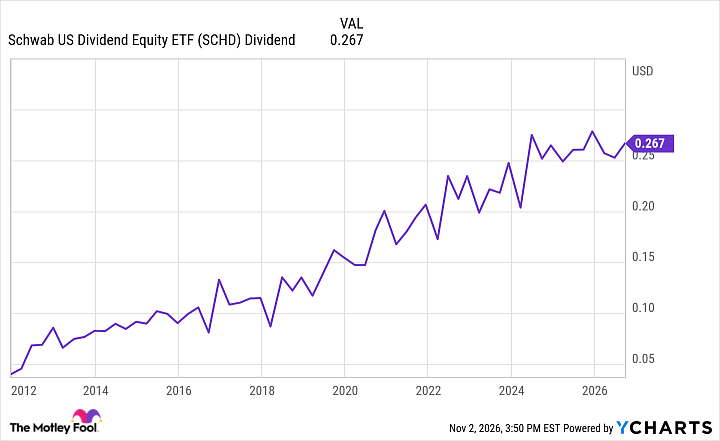
SCHD Dividend Chart

SCHD Dividend data by YCharts

So, while the payout grew in both 2020 and 2022, it wasn’t a straight line.

Here’s the catch

SCHD’s dividend didn’t just grow through those downturns. It grew fast. Overall, dividends per share have grown at a 9% compound annual rate from 2020 through 2025. However, over the past 12 months, the payout has only increased by about 2% compared to the prior year.

That’s a sharp slowdown, and it matters because the case for a dividend growth ETF rests on that growth. I don’t know yet whether it’s a blip or a trend. If the pace stays near 2%, the resilience we saw in 2020 and 2022 is worth less than it looks.

SCHD Schwab U.S. Dividend Equity ETF

$35.55-$0.35 (-0.97%)

NYSEMKT · As of 4:00 PM ET 11/03/26

It’s also worth noting that no two crashes are the same. For example, the 2020 crash was brutal but brief, and the 2022 decline was driven by rising inflation and interest rates. So, a deeper, longer earnings recession would be a tougher test for the dividend.

Why the payout held up during bear markets

The slowdown doesn’t erase why SCHD’s payout held up in the past. The ETF tracks the Dow Jones U.S. Dividend 100 Index, which screens for yield, five-year dividend growth, and financial strength. The index also revamps its holdings once a year, swapping out companies that no longer measure up.

The ETF holds many large companies with long histories of dividend growth. Its top holdings include Procter & Gamble and Coca-Cola. Big, established businesses like these tend to have the cash flow and financial strength to keep paying through a downturn. Procter & Gamble has raised its dividend for 70 straight years, while Coca-Cola is up to 64 straight years. They’re both Dividend Kings, companies with 50 or more years of annual dividend increases.

What could happen to SCHD if there’s another crash?

If the last two crashes are any indication, SCHD’s dividend will likely keep rising while its share price would probably decline during a market slump. Depending on the catalyst, it might decline less than the S&P 500, due to the more defensive nature of its holdings, its strong dividend income, and its current valuation (at 18.2 times earnings, it’s cheaper than the S&P 500 at 23.6 times earnings).

That’s not a bad combination if you’re collecting dividends. SCHD currently has a trailing 12-month yield of more than 3%. If its share price declines while its payout continues to rise, investors could lock in an even higher yield on newly purchased shares, enabling them to generate even more dividend income in the future.

What I’m watching

I’m not selling SCHD because a stock market crash could be coming, as the ETF’s history gives me some comfort. It has historically continued paying a higher dividend, even though its share price has taken a hit. However, the catch is that dividend growth has significantly slowed more recently despite a solid economic environment. That’s why I’ll be watching its next payout announcement in December to see if the slowdown is just a temporary blip or something more concerning.

Source link

Visited 2 times, 1 visit(s) today

Related Article

If a Stock Market Crash Is Coming, Warren Buffett Says This Is the Best Move Investors Should Make

Key Points Euphoria for artificial intelligence (AI) stocks has pushed stock market valuations to historically elevated levels. History shows that major indexes always recover from stock market crashes. Warren Buffett’s investment strategy emphasizes patience, diversification, and staying invested through volatility. Despite stubborn inflation, rising interest rates, geopolitical conflicts, and considerable economic uncertainty, the S&P 500

Jensen Huang Is Back and Nvidia Soared. Is the Problem Really Solved?

Stock markets surged as Jensen Huang returned to Nvidia, but the rally stalled at a familiar barrier and Fed rate hike bets idled. Is this the post-election bounce all over again? Nvidia shares jumped about 32% as Jensen Huang returned as CEO, lifting the broader market The S&P 500 and Nasdaq 100 stalled at the

Pop! Goes the Bubble – Paul Krugman

The NASDAQ index of AI stocks Marketing note: I have a new ebook, Navigating the Chaos: Chronicles of Economic and Political Madness, which uses material from this Substack to construct a thematic narrative of the past two years and the issues that Democrats must now address to build an enduring progressive movement. Available from Amazon,

Why stocks had their best Monday since 2020

Wall Street spent last week dumping anything tied to AI. It spent Monday buying it back. The Invesco QQQ Trust (QQQ), the fund that tracks the tech-heavy Nasdaq-100 (^NDX), opened almost 8% higher, its biggest jump at the open since it launched in 1999. Its closest rivals for largest jumps came in 2000 and 2001

Why ASML Stock Popped Today

The AI sector soared as Jensen Huang returned to Nvidia. By Jeremy Bowman – Nov 23, 2026 at 5:16PM EST Key Points The return of Jensen Huang set off a relief rally in the market. ASML has a unique position in the AI sector as the only maker of EUV lithography equipment. Increased demand for

Daily Market Price Updates and Commentary 23rd November 2026

  ICE Futures U.S. Sugar No.11 Contract Settlement (cUS$/lb) Open High Low Last Volume O/I Life High Life Low Mar27 17.61 0.58 ▲ 17.16 17.76 17.05 17.58 86,142 505,778 21.29 14.42 May27 16.99 0.62 ▲ 16.48 17.14 16.40 16.95 48,219 212,687 20.40 14.29 Jul27 16.62 0.58 ▲ 16.13 16.75 16.07 16.56 28,205 144,896 19.81 14.27

Is AMD’s Stock in Trouble After a Concerning Short-Seller Report?

A recent short-seller report called into question AMD’s high exposure to China. By David Jagielski, CPA – Nov 23, 2026 at 3:36PM EST Key Points Hunterbrook Media claims AMD has too much exposure to China and that it may not be any safer than Nvidia. It states that AMD’s firmware has been showing up at

What Sent Cameco Stock Lower Again?

Today’s big story: Reported SEC Probe: Could Nvidia Stock Fall To $92? Cameco (CCJ) stock fell 5.6% on Friday, November 20, 2026, while the S&P 500 lost 3.7%. There was no announcement, earnings report, or filing from the company around the move. The drop came as a sell-off in AI stocks deepened on Wall Street,

Safe Haven Assets in a Crash: Gold, Bonds, Franc (Nov 2026)

Safe haven assets in a stock market crash: the short answer In the week to 20 November 2026, US Treasuries were the only classic safe haven that clearly held up. Gold and silver fell with stocks. The yen and the Swiss franc gave little protection against a strong dollar. The type of shock explains most

General Electric Co Stock (GE) Moved Up by 3.93% on Nov 23: What Signal Does It Send?

GE Aerospace advanced firmly during the session, driven by robust institutional accumulation following reinforcing signals across commercial aviation aftermarket demand and elevated capital return visibility. As commercial airlines continue to extend the service lives of existing fleets amid broader airframer delivery delays, utilization rates for legacy engine platforms remain exceptionally high. This dynamic directly benefits

Why stocks are having their wildest Monday morning since 2008

Wall Street spent last week dumping anything tied to AI. It’s spending Monday buying it back. The Invesco QQQ Trust (QQQ), the fund that tracks the tech-heavy Nasdaq-100 (^NDX), opened almost 8% higher, its biggest jump at the open since it launched in 1999. Its closest rivals for largest jumps came in 2000 and 2001

How to protect your retirement savings if the AI boom fizzles

After stock markets, including the tech-heavy NASDAQ, got pummeled on Nov. 20, 2026, many Americans are asking themselves whether the huge bet on artificial intelligence is heading south. This question has profound implications for retirement savings, given how much these investment accounts are tied to stocks. The NASDAQ has plunged about 18% since early October

0
Would love your thoughts, please comment.x
()
x