The day after a missile hit the airport where Riyadh Air’s offices are based, the British boss of Saudi Arabia’s new airline wanted to soothe staff fears.
“We would never operate a flight or have people work in a building if we were not confident in its safety,” Chief Executive Tony Douglas wrote in a companywide note earlier this month. The airline’s headquarters remained “open for business as usual,” he said, despite an attack just a couple of miles away that destroyed an aircraft and killed three people, including a pilot at its sister airline.
Within 24 hours, the Houthi militia in neighboring Yemen behind that strike launched a fresh missile barrage on the capital, killing over a dozen people at the same airport, collapsing part of the terminal building and leaving hundreds more injured.
The CEO’s next message to staff told most to stay home the following day, according to emails reviewed by The Wall Street Journal.
The escalating conflict with the Houthis, who have declared commercial aviation a target, has upended Saudi Arabia’s airline industry and the operations of global carriers that increasingly rely on its airspace for transit.
The violence has particularly dampened the fortunes of Riyadh Air—which started commercial flights this summer, aiming to be a key part of the kingdom’s long-term economic ambitions. The airline has repeatedly diverted flights and canceled others at the last minute. Some have been placed in holding patterns for as long as two hours while waiting out active threats, tracking data shows.
Just months after getting off the ground, the airline has evacuated all aircraft from its home base and has halted almost all flying over the past two weeks. The handful of special flights the airline operated in recent days landed either in Jeddah, Saudi Arabia, or at a small airport 200 miles from Riyadh, with passengers ferried on an hourslong ground journey to the capital.
A spokesman for Riyadh Air didn’t respond to requests for comment.
This year was meant to see the launch of a key pillar in Saudi Crown Prince Mohammed bin Salman’s ambition for his economy: a high-end airline to transport wealthy tourists. It was also designed to help the country catch up with rivals in the United Arab Emirates and Qatar, whose airlines have become dominating forces in global air travel over the past three decades, thanks in part to their convenient location between Europe and Asia.
It is a strategy Riyadh Air’s sister carrier, Saudia, hasn’t pursued, instead focusing its operations on the massive demand from workers in the kingdom’s oil industry and from those traveling there for pilgrimage. Its operations have likewise been upended by Houthi attacks, which on Oct. 8 killed one of its pilots and destroyed an Airbus A320 aircraft.
The violence isn’t only rattling Saudi Arabia’s aviation dream, but also putting the likes of Emirates, the world’s biggest long-haul carrier, under pressure as Gulf airlines battle to overcome flight restrictions and anxieties about their flights’ proximity to the war in Iran.
This summer, Riyadh Air’s CEO struck an optimistic tone, despite having delayed a soft launch set for March as missiles crisscrossed the region. Douglas, in an interview in London in June, said getting new seats for his aircraft in time had been more of a headache than the conflict playing out across the Middle East.
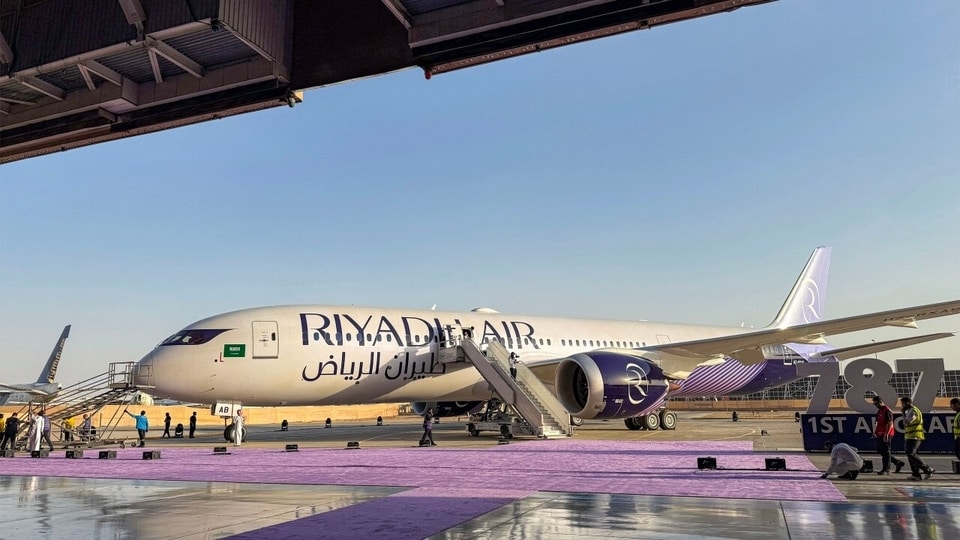
Four months later, with the airline’s primary airport facing a prolonged closure, Riyadh Air staff have instead been volunteering at hospitals where victims of the airport strikes were treated. Its newest aircraft, delivered by Boeing last week, had to be redirected to Jeddah. That came days after the airline withdrew from the capital the last of its Boeing 787 Dreamliners—each valued at more than $130 million—after it was grounded following light damage from a missile strike.
Prospects for the rest of the year are looking grim, too, as Iranian officials have told mediators Tehran would respond to any renewed U.S.-Israel attacks with strikes aimed at civilian targets, including airports. The airline is also facing a renewal of its war-risk insurance policy next month, the Journal has reported.
The carrier is set to restart in force on Sunday, with only four flights listed on its website as canceled—compared with over 30 scrapped each day since the airport closure on Oct. 10.
The return to semiregular flying would come with a major caveat: Riyadh Air won’t be flying to Riyadh. Instead, the airline is using a route it tested earlier in the week, sending aircraft from places such as London, Islamabad and Cairo to an airport in Al Qassim province, according to the carrier’s website. From there it is a free 4½-hour bus journey to the Saudi capital.
Complimentary water, juice and snacks are provided.
Write to Benjamin Katz at ben.katz@wsj.com and Stephen Kalin at stephen.kalin@wsj.com