$4,000 in These 4 Non-Nvidia Chip Stocks Could Be Worth This Much by 2030
Nvidia (NASDAQ: NVDA) is now the largest company on the planet; its market cap represents around 7.5% of the value of the S&P 500. As such, if you own any mutual funds or exchange-traded funds (ETFs) — particularly index funds — you probably already have a lot of exposure to the giant chipmaker.
However, if you want to build a small portfolio of other chip stocks, you could do so by buying a basket that includes Broadcom (NASDAQ: AVGO), Marvell (NASDAQ: MRVL), Advanced Micro Devices (NASDAQ: AMD), and Arm Holdings (NASDAQ: ARM). Splitting an initial investment of around $4,000 fairly evenly, you could buy three shares of Broadcom, four shares of Marvell, two shares of AMD, and four shares of Arm. And if the AI infrastructure boom continues, by 2030, that semiconductor portfolio could be worth over $10,000. That’s about a 150% return. Here’s how.
Missed Nvidia in 2009? This Rare Signal Is Flashing Again. In 2009, a “Double Down” signal flashed for a little-known chipmaker called Nvidia. For the first time in years, that same “Total Conviction” signal is flashing for a company 1/100th the size of Nvidia. Continue »
Broadcom and Marvell
One of the biggest trends in AI infrastructure now is that hyperscalers (owners of large data centers) are choosing to designing custom parallel processors that are narrowly suited to their own computing needs. These application-specific integrated circuits (ASICs) — hardwired chips built for specific tasks — can lower costs and improve cloud computing and data center economics.
However, hyperscalers generally need the intellectual property and know-how of companies that specialize in this tech niche to turn their concepts into complete designs, and as such, they are increasingly turning to Broadcom and Marvell. Broadcom counts Alphabet, Anthropic, Meta Platforms, and OpenAI among its customers, while Amazon and Microsoft are Marvell’s custom chip customers. This is a huge and growing business for both companies.
Image source: Getty Images.
Analysts are forecasting that Broadcom’s adjusted earnings per share (EPS) will grow to $52.15 in its fiscal 2031 (which ends in October 2031). The S&P 500 currently has a forward P/E of around 19 times; if you apply that multiple to Broadcom’s fiscal 2031 consensus EPS estimate, the stock would trade at roughly $990 in late 2030. As such, your three-share investment would approximately triple in value to nearly $3,000.
Apply a similar multiple to the $40.93 consensus expectation for Marvell’s EPS in fiscal 2032 (which ends in January 2032), and that stock would trade at nearly $780 at the end of 2030. Your four shares would have more than tripled in price to be worth around $3,100.
AMD and Arm
AMD and Arm are plays on the expected rise of AI agents and the corresponding surge in demand for data center central processing units (CPUs). While servers dedicated to training AI only needed one CPU for every eight to 16 graphics processing units (GPUs), those that will power AI agents need equal numbers of CPUs and GPUs. AMD has said it sees the data center CPU market growing in size to $220 billion by 2030. AMD is a leader in this space, while Arm’s technology has long been used in advanced custom CPUs. However, given the size of the opportunity, Arm will also start making its own chips for the first time.
AMD also has a big opportunity in the AI inference space with its GPUs. It has large commitments from OpenAI, Meta Platforms, and Anthropic to buy those processors — deals that should also drive its growth in the coming years.
Analysts currently project AMD’s 2030 EPS will come in at $44.31. Assume another 20% growth in 2031, and that would bring its 2031 EPS target to $53.14. That’s a big jump from the $7.59 per share that analysts expect it to earn this year. Place a 19-times-forward-earnings multiple on the stock, and it would be worth $1,010 at the end of 2030. That’s nearly double the current stock price, and a two-share stake would be worth $2,020.
The current consensus for Arm’s fiscal 2032 (ending March 2032) adjusted EPS, meanwhile, is $11.98. The stock has always traded at a large premium due to its licensing and subscription model, although as it shifts to a hybrid model that also includes the sale of its own chips, that premium should come down. If we apply a 40-times forward P/E to the stock (down from over 100), it would trade at roughly $480. That’s more than a twofold increase, and four shares would be worth around $1,920.
Add it all up, and your $4,000 investment made today would be worth about $10,000 four years from now.
Should you buy stock in Marvell Technology right now?
Before you buy stock in Marvell Technology, consider this:
The Motley Fool Stock Advisor analyst team just identified what they believe are the 10 best stocks for investors to buy now… and Marvell Technology wasn’t one of them. The 10 stocks that made the cut could produce monster returns in the coming years.
Consider when Netflix made this list on December 17, 2004… if you invested $1,000 at the time of our recommendation, you’d have $370,440!* Or when Nvidia made this list on April 15, 2005… if you invested $1,000 at the time of our recommendation, you’d have $1,330,110!*
Now, it’s worth noting Stock Advisor’s total average return is 924% — a market-crushing outperformance compared to 212% for the S&P 500. Don’t miss the latest top 10 list, available with Stock Advisor, and join an investing community built by individual investors for individual investors.
Geoffrey Seiler has positions in Advanced Micro Devices, Alphabet, Amazon, Broadcom, and Meta Platforms. The Motley Fool has positions in and recommends Advanced Micro Devices, Alphabet, Amazon, Arm Holdings, Broadcom, Marvell Technology, Meta Platforms, Microsoft, and Nvidia. The Motley Fool has a disclosure policy.
If I could only invest $500 in one artificial intelligence stock this month, I’d pick Netlist (NLST +4.67%). Major developments in several court cases have fortified the company’s balance sheet and point toward soaring net profit margins in the years ahead. It’s a mid-cap valued at just $2.1 billion, and it’s still trading well below
Amazon (NASDAQ: AMZN) and Alphabet (NASDAQ: GOOG) (NASDAQ: GOOGL) are two companies that hardly need an introduction. Both are leaders in their respective industries, generally post excellent financial results, and have crushed broader equities over the long run. Investors arguably can’t go wrong with either of these, and I personally own shares of both. But
If you want to invest in the future, splitting your investment between Elon Musk’s two companies, Space Exploration Technologies (NASDAQ: SPCX) and Tesla (NASDAQ: TSLA), could be a solid bet. With just under $10,000 split between the two stocks, investors could buy 14 shares of Tesla and 34 shares of SpaceX. Tesla is the older
For three weeks, Wall Street sold the hottest trade in the market and bought one of the oldest. Chip stocks lost 15% while Warren Buffett’s Berkshire Hathaway gained 7%. That swing carried Berkshire’s Class B stock (BRK-B) to a record close Tuesday, its first since May 2, 2025 — the day before Buffett said he
3 Reasons to Sell JACK and 1 Stock to Buy Instead Since April 2026, Jack in the Box has been in a holding pattern, posting a small loss of 4.4% while floating around $12.15. The stock also fell short of the S&P 500’s 8.9% gain during that period. Is there a buying opportunity in Jack
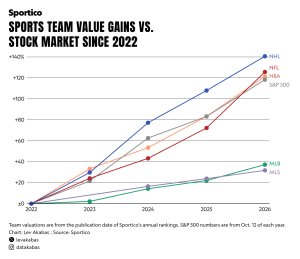
The cost of buying a sports team has soared in recent years, including record price tags in 2026 for the Los Angeles Lakers ($12.5 billion), Seattle Seahawks ($9.34 billion) and Los Angeles Angels ($4 billion). It has spurred talk of a sports valuation bubble. Yes, sports team values are up huge, but they trail stock
Anthropic (ANTH.PVT) is set to publicly file its S-1 investor prospectus as soon as Friday, according to three people familiar with the artificial intelligence firm’s plans. The move would mark a crucial next step for what could be the biggest IPO in history. The much-anticipated public debut, expected to surpass SpaceX’s (SPCX) June IPO, is
Over the last year, memory chip manufacturers have benefited from extraordinary demand for artificial intelligence (AI). In particular, Micron Technology (NASDAQ: MU) has witnessed its market capitalization propel from just $53 billion at the start of the AI revolution to more than $1 trillion today. MU Market Cap data by YCharts Missed Nvidia in 2009?
Micron (NASDAQ: MU) stock has more than tripled so far in 2026, making it the fourth-best-performing stock in the S&P 500 (SNPINDEX: ^GSPC) this year. That’s an impressive run, but for investors, the past really doesn’t matter; only the future. So, could Micron repeat this feat in 2027? One metric suggests that the answer to
Quick Read Ford (F) yields nearly 5% versus GM’s (GM) sub-1%, making Ford the clear winner for investors who need cash income today. GM’s dividend is covered 18 times by free cash flow versus Ford’s 2.6 times, making GM’s payout far safer for long-term holders. GM’s stock gained 187% over ten years versus Ford’s 62%,
You can say a lot of things about the Trump administration, but boring is not one of them. Over the last year and a half, investors have ridden a roller coaster of erratic trade policy, military conflicts, and executive actions. And throughout it all, the S&P 500 index (SNPINDEX: ^GSPC) has risen by a solid
For the better part of the last four years, the stock market has been unstoppable. The artificial intelligence (AI) infrastructure build-out has helped propel the Dow Jones Industrial Average (DJINDICES:^DJI), S&P 500 (SNPINDEX:^GSPC), and Nasdaq Composite (NASDAQINDEX:^IXIC) to several record highs this year. But these gains may prove fleeting, courtesy of Trumpflation — inflation specifically
After a year of record-breaking gains, major market indexes are wobbling. The S&P 500 (^GSPC +0.28%) has fallen by nearly 2% over the last week, as of this writing, while the tech-heavy Nasdaq Composite (^IXIC -0.02%) is down by more than 4% in that time. Much of the sell-off is stemming from the tech sector,
Old Republic International Earnings: What To Look For From ORI Insurance conglomerate Old Republic International (NYSE:ORI) will be reporting earnings this Thursday before market open. Here’s what investors should know. Old Republic International missed analysts’ revenue expectations last quarter, reporting revenues of $2.33 billion, up 5.2% year on year. It was a softer quarter for
Cathie Wood is one of America’s most-watched tech investors, known for her extreme bullishness on Bitcoin and disruptive future technologies like robotics and artificial intelligence (AI). According to her company’s most recent 13F SEC filing, as of the second quarter, Cathie Wood’s Ark Invest portfolio had a total of $15.4 billion of assets under management.
DSV A/S Company Announcement No. 1174 This announcement contains publication of inside information pursuant to Article 17 of the EU Market Abuse Regulation. With the integration of Schenker expected to be completed by the end of 2026 and with DSV on track for further deleveraging of its capital structure, the Board of Directors of DSV
Asian shares were mixed on Wednesday, with Japan and South Korean technology stocks advancing following a broad rally on Wall Street. The Kospi in Seoul gained more than 4% early on and by midday was trading up 3.4% at 5,733.82. South Korean AI company Elice, whose 32% drop Tuesday in its first day of trading
The S&P 500 has gained 12.3% this year. That’s with oil above $100 a barrel, consumer prices climbing 3.7% a year and a 10-year Treasury yielding 5.1%. Stocks are behaving as though none of that counts. So could inflation knock the index down 40%? Can anyone call the market’s next move, whether that’s tomorrow, next
Musk said $1 trillion in SpaceX revenue in 2028 was “no longer impossible,” versus the 2030 scenario he outlined in June. Gene Munster sees 95% odds of a Tesla merger within two years, while Dan Ives puts the probability at 80%-90% by end-2027. Independent committees are exploring a merger, but Musk cautioned that shareholder approval
Homeowners waiting for a better moment to sell should stop trying to time the market, National Association of Home Builders CEO Jim Tobin said. “If you’re trying to time the market, you can’t do it,” Tobin told Yahoo Finance on Monday. “If you talk to anybody who’s bragged about when they sold their home or