China builds ‘big science’ model to foster self-reliance

In December 2025 Reuters reported that Chinese scientists had built a prototype of a machine capable of producing advanced semiconductor chips central to western technological dominance.

Completed in early 2025 and now undergoing testing, the prototype occupies nearly an entire factory floor. It was developed by a team of former engineers from ASML by reverse engineering that company’s extreme ultraviolet lithography (EUV) machines.

For years China has sought to replicate this technology and produce advanced chips using entirely domestically made equipment to reduce reliance on foreign supply chains and strengthen technological independence. The breakthrough marks the culmination of a six-year government initiative to achieve semiconductor self-sufficiency, one of Chinese President Xi Jinping’s top priorities.

While China’s semiconductor ambitions have been widely known, the Shenzhen-based EUV project has been conducted in secrecy. Reuters compared the effort to a modern-day Manhattan Project, the U.S. program to develop the atomic bomb, underscoring the scale of scientific mobilization behind the initiative.

EUV represents one part of a broader shift and reflects the resurgence of “big science,” a model increasingly taking shape in China.
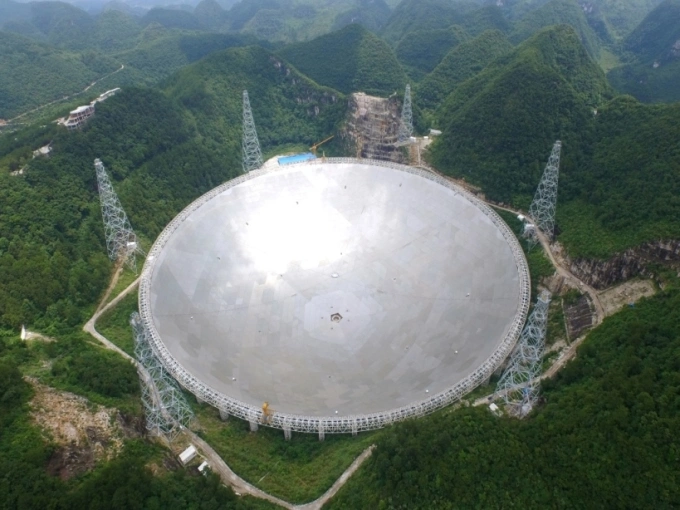
The Five-hundred-meter Aperture Spherical Telescope, the worlds largest single-dish radio telescope. Photo from National Astronomical Observatories, Chinese Academy of Sciences

The Five-hundred-meter Aperture Spherical Telescope, the world’s largest single-dish radio telescope. Photo from National Astronomical Observatories, Chinese Academy of Sciences

More than a decade ago Beijing identified weaknesses in its science and innovation system, including fragmented investment, inefficient resource allocation, limited interdisciplinary collaboration, dependence on foreign core technologies, and gaps in research evaluation. In response, it increased funding and boosted output in journals indexed by the Science Citation Index (SCI), quickly becoming a global leader in research publications.

In 2020 the government moved to reduce what it called “excessive reliance” on SCI publications for academic promotions, hiring, and funding decisions, promoting instead a domestic citation system “with Chinese characteristics and international influence,” according to education news outlet University World News.

The shift followed remarks by Xi in 2018, when he said academic standards in Chinese universities should not be shaped primarily by western systems and called for independent evaluation frameworks. His remarks reflect China’s push for greater self-reliance in science and technology, now evident in how the country organizes research and carries out large-scale scientific projects.

Growing scale of research infrastructure

A defining feature of China’s state-led science model is the increase in the scale of research infrastructure, with projects often being worth billions of U.S. dollars and involving thousands of scientists. These facilities serve not only as experimental platforms but also as engines for generating data and supporting multiple industries.

China has rapidly built a network of such facilities, including the Five-hundred-meter Aperture Spherical Telescope, widely regarded as the world’s most sensitive radio telescope, and the Large High Altitude Air Shower Observatory, which studies high-energy cosmic radiation.

The Shanghai Synchrotron Radiation Facility enables analysis of materials at the atomic scale, supporting advances in semiconductors and biotechnology, while the China Spallation Neutron Source focuses on next-generation materials for batteries and industrial use. According to Nature journal, Beijing is investing heavily in national research infrastructure to strengthen scientific capacity and improve its technological position.

The strategy has produced measurable results.

Chinese research institutions accounted for more than half of top publications in applied sciences in the Nature Index released in late 2025. These projects are integrated into innovation hubs such as Beijing and the Shenzhen–Hong Kong–Guangzhou corridor, where laboratories, companies and manufacturing chains operate within shared ecosystems.

Beyond merely building large projects, China’s approach extends to integrating them into a unified system.

According to the World Intellectual Property Organization, China leads the world in innovation clusters, with 24 ranked among the global top 100, surpassing both the U.S. and Europe. The country also became the world’s largest spender on research and development in 2024, with total investment reaching $785.9 billion and overtaking that of the U.S.

Chinas southern tech hub of Shenzhen. Photo from X

China’s southern tech hub of Shenzhen. Photo from X

This reflects a broader shift in which science operates as a national system.

Research institutes define priorities, companies develop applications, the state coordinates resources, and the domestic market absorbs outputs. This close integration has given rise to what analysts describe as a “big system.” In this model, each component is designed to support and reinforce the others, forming an interconnected ecosystem.

By comparison, the U.S. maintains a more decentralized structure built around leading institutions and independent research centers. Large-scale science projects in the U.S. remain among the world’s most advanced, including particle accelerators at Fermilab, laser systems at Lawrence Livermore and space programs led by NASA.

However, these projects typically operate independently within specific agencies or national laboratories rather than as part of a unified industrial system.

Europe emphasizes cross-border collaboration. Facilities such as those operated by the European Organization for Nuclear Research are jointly funded and managed by multiple governments, allowing sharing of costs and knowledge. However, differing national priorities can slow coordination, and links between research and industrial production remain limited.

China is meanwhile emerging with its own model, defined by centralization and integration, with research projects embedded in industrial clusters to speed up the translation of scientific advances into commercial products.

This divergence is reshaping global technological competition. While the U.S. and Europe continue to lead in fundamental research, China is increasingly aligning scientific discovery with large-scale industrial production, accelerating its progress toward technological leadership.




Source link

Visited 1 times, 1 visit(s) today

Related Article

Yik/Getty Images

Goldman Sachs resets China robotaxi fleet stock forecast

Goldman Sachs just raised its outlook on China’s robotaxi market by a meaningful margin. The revision signals the bank now believes commercialization is moving faster than it previously assumed. In a note published April 18, Goldman analysts led by Allen Chang forecast that China’s robotaxi fleet will nearly triple from 5,000 vehicles in 2025 to

Second Beijing E-Town Half Marathon and Humanoid Robot Half Marathon in Beijing

Humanoid robot wins Beijing half-marathon, defeating the human world record

BEIJING (AP) — A humanoid robot that won a half-marathon race for robots in Beijing on Sunday ran faster than the human world record in a show of China’s technological leaps. The winner from Honor, a Chinese smartphone maker, completed the 21-kilometer (13-mile) race in 50 minutes and 26 seconds, according to a WeChat post

Latest and Breaking News on NDTV

Chinese Humanoid Robots Impress With Record Times In Beijing Half Marathon

The Beijing E-Town Humanoid Robot Half-Marathon, held on Sunday, witnessed a historic milestone in robotics as several humanoid robots outpaced elite human athletes for the first time in a competitive environment. The event featured a “human-robot joint run” where over 100 humanoid robots raced alongside roughly 12,000 human runners on the same 21.1 km course,

‘Chinese Humanoid Robots’ beat ​human winners in half-marathon race, again ‘proving’ Elon Musk right about China being Tesla’s only competitor

‘Chinese Humanoid Robots’ beat ​human winners in half-marathon race, again ‘proving’ Elon Musk right about China being Tesla’s only competitor

In what can be called a display of athleticism by machines, dozens of Chinese-made humanoid robots ran past professional runners in a half-marathon in Beijing on Sunday (April 19). The performance was dominant as they not only broke last year’s record but also surpassed human runners to reach the finish line, seemingly confirming Elon Musk’s

In a race between humans and robots, machines take the victory in a sign of advancements

BEIJING — It was not even close as a bright-red Chinese humanoid named “Lightning” lived up to its name in a half-marathon pitting humans against robots, smoking its competition on Sunday. Subscribe to read this story ad-free Get unlimited access to ad-free articles and exclusive content. The bipedal humanoid, developed by smartphone maker Honor, blazed

US ‘more coordinated’ with China than people assume, fmr. Navy comm. says

The US is more coordinated with China than many assume, former Israeli Navy commander Maj.-Gen. (res.) Eliezer Marom told 103FM on Wednesday. “I think the fuel problem has been completely solved, because the Chinese will get supplies from the Russians,” he said, claiming that alternative energy arrangements are already reducing the impact of regional disruption

A robot crossing the finish line at a marathon event in Beijing

Chinese humanoid robot beats half-marathon world record in Beijing

NEWYou can now listen to Fox News articles! A Chinese-built humanoid robot beat the human half-marathon world record in Beijing on Sunday, marking a breakthrough moment in a high-stakes global race for technological dominance. A robot developed by Chinese smartphone maker Honor completed the 21-kilometer (13-mile) race in 50 minutes and 26 seconds, beating the

China Sending a Clear Signal and Dumps U.S. Treasuries

China Sending a Clear Signal and Dumps U.S. Treasuries

In a move that continues to underscore Beijing’s strategic shift away from U.S. dollar assets amid geopolitical tensions and diversification efforts, China has steadily reduced its holdings of U.S. Treasuries. The latest official data from the U.S. Treasury’s TIC report confirms China’s holdings stood at $693.3 billion at the end of February 2026, down slightly

Text to Speech Icon

China Airlines plane diverted to Whitehorse due to concerns around smoke onboard

Listen to this article Estimated 2 minutes The audio version of this article is generated by AI-based technology. Mispronunciations can occur. We are working with our partners to continually review and improve the results. A China Airlines cargo plane headed to Anchorage, Alaska, from Chicago was forced to stop in Whitehorse early Saturday morning. In

China clean tech exports jump amid global energy disruption

China clean tech exports jump amid global energy disruption

China’s exports of clean technology climbed in March, reinforcing signs that manufacturers are benefiting from rising global demand for alternative energy sources as traditional supplies are roiled by the Iran war.The most notable growth came in shipments of lithiumion batteries and electric vehicles, with an annual increase of 34% and 53%, according to data released

Goldies Express content banner

China Grove Head-On Collision Leaves Five Injured

VICKSBURG, Miss. (VDN) — Five people were transported to area hospitals after a head-on collision on China Grove. At about 2:45 p.m. today, a white service truck and a dark gray sedan collided in the 1300 block of China Grove. Two of the four people in the sedan had to be cut out of the vehicle

Royal New Zealand Air Force P-8A Poseidon  around the Manawatu coastline and RNZAF Base Ohakea.

China’s complaint over NZDF ‘harassment’ could be sign of other concerns: Expert

Royal New Zealand Air Force P-8A Poseidon around the Manawatu coastline and RNZAF Base Ohakea. Photo: Corporal Naomi James A global security expert said China’s complaint, over what it calls the New Zealand Airforce’s repeated “harassment” near its airspace, could be sign of Beijing’s other concerns with New Zealand foreign policy settings – including its

A picture taken on April 6, 2026, shows a torpedo-like 3.7-metre-long and 65-centimetre-wide object, discovered by a fisherman near the Lombok Strait after being towed ashore onto a beach on Gili Trawangan, West Nusa Tenggara. The Indonesian navy said on April 9, it was investigating a torpedo-like object discovered by a fisherman near the Lombok Strait, a key maritime route connecting the Indian and Pacific Oceans. (Photo by AFP)

Device found near Bali and Lombok identified as Chinese undersea monitoring system

By Will Jackson and Hellena Souisa, ABC A picture taken on April 6, 2026, shows a torpedo-like 3.7-metre-long and 65-centimetre-wide object, discovered by a fisherman near the Lombok Strait after being towed ashore onto a beach on Gili Trawangan, West Nusa Tenggara. Photo: AFP A large torpedo-shaped device discovered near an island in a strategically

2025 China & Global Development Reports Published in Hainan

HAIKOU, China, April 18, 2026 /PRNewswire/ — A report from the Hainan International Media Center: The newly published 2025 China & Global Development Reports were unveiled at the event. In Haikou on April 16th, during the 6th China International Consumer Products Expo, a book launch event was held to celebrate the publication of the China Development

China offers loans, technology for Vietnam railways

China offers loans, technology for Vietnam railways

China-Vietnam railway ties were in focus on Friday as President To Lam concluded his visit. Beijing offered loans, technology and training for Vietnam’s rail infrastructure development. The visit also included high-speed train journeys across China’s north and southwest. This is reported by the railway transport news portal Railway Supply. China offers loans, technology for Vietnam

0
Would love your thoughts, please comment.x
()
x