The United States warned of a sustained blockade on Iranian ports, and threatened renewing strikes on the country if Tehran refused to make a deal.
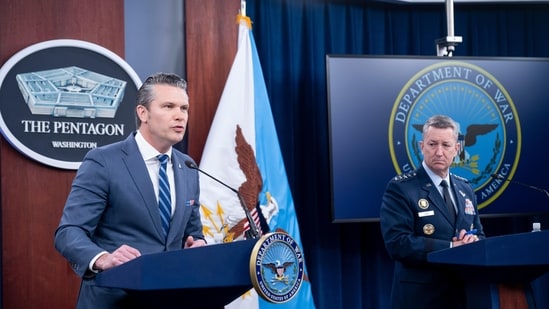
US defense secretary Pete Hegseth said that the military could blockade Iran’s ports for “as long as it takes”.
“If Iran chooses poorly, then they will have a blockade and bombs dropping on infrastructure, power and energy,” AFP cited Hegseth as saying at a news conference at the Pentagon on Thursday.
Also Read | Pete Hegseth’s Pentagon is a lethality-maxxing wasps’ nest
Speaking about the blockade, General Dan Caine, chairman of the joint chiefs of staff, said it “applies to all ships, regardless of nationality, heading into or from Iranian ports.” Caine further warned that the US military will “use force” if any vessels do not comply with the blockade.
“So far, 13 ships have made the wise choice of turning around,” Caine added, according to AFP. The US blockade of Iranian ports began at 1400 GMT on Monday, after the peace talks with Iran in Islamabad failed to produce any decisive outcome.
‘We know what military assets you are moving’: Hegseth warns Iran leaders
Meanwhile, Pentagon chief Hegseth also warned Tehran that the US was aware of Iran’s alleged movements of its military assets.
“We know what military assets you are moving and where you are moving them to. While you are digging out — which is exactly what you’re doing, digging out of bombed out and devastated facilities — we are only getting stronger,” Hegseth said in a warning to Iranian leaders.
Hegseth claimed that Iran was “digging out” its “remaining” launchers and missiles “with no ability to replace them.” “…You have no defense industry, no ability to replenish your offensive or defensive capabilities,” the Pentagon chief added.
Admiral Brad Cooper, head of US Central Command, which is responsible for American forces in the Middle East, said the military was utlising the two-week truce to “rearm” and “adjust” their techniques and tactics.
“We’re rearming, we’re retooling, and we’re adjusting our tactics, techniques and procedures. There’s no military in the world that adjusts like we do…” Cooper said.
Second round of US-Iran talks
While Washington renews threats against Iran, Pakistan army chief Asim Munir is set to meet Iranian officials in Tehran, with arranging a second round of negotiations likely on the cards. The meeting comes even as US President Donald Trump hinted that the war in West Asia was “close to over”.
Trump also announced that leaders from Israel and Lebanon would speak later on Thursday about halting the fighting. The fragile ceasefire between US and Iran was also threatened by the ongoing fighting in Lebanon, with Israel claiming that its war with Hezbollah was not part of the two-week truce.
The White House has said that any further talks with Iran would likely take place in Pakistan’s capital city Islamabad. However, there is uncertainty around the timing of these negotiations and when they will begin.